



Use Wozber and land your dream job
Create Resume
No registration required
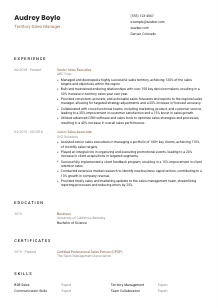
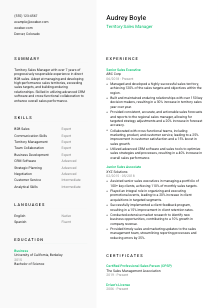
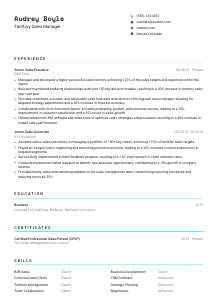
Conquering regions, but your resume feels like uncharted territory? Navigate this Territory Sales Manager resume example, created with Wozber free resume builder. Learn how to align your field expertise with job compasses, guiding your career trajectory to peak sales success!
Territory sales lives in the numbers, but hiring teams do not make decisions on quota attainment alone. They look for people who can grow an assigned region, open new accounts, keep existing customers expanding, and maintain enough control over the pipeline to forecast credibly. Your resume needs to show commercial ownership, not just a list of sales jobs.
A tailored resume changes how quickly a hiring team can see whether you match the territory they need covered. When your document mirrors the language of account growth, CRM discipline, forecasting, and cross-functional selling, ATS screening becomes much smoother. Wozber's free resume builder helps structure that language into an ATS-compliant resume, so the focus stays on your ability to build revenue and relationships in a defined market.
The top of the page should answer the fastest practical questions first: who you are, what sales role you are targeting, and whether you match any location or contact requirements. For a Territory Sales Manager, that means clean details and immediate relevance, not decorative extras.
Use your full name in a larger, readable font so it anchors the page immediately. Keep the presentation polished and straightforward, the same way you would introduce yourself to a new client or regional leader.
Place "Territory Sales Manager" directly beneath your name when that is the role you are applying for. This removes ambiguity and helps both recruiters and ATS tools connect your background to territory ownership, account growth, and field sales leadership from the first line.
Include a reliable phone number and a professional email address you check often. Sales hiring can move quickly, especially once a candidate shows quota history or territory success, so simple errors in contact information can cost interviews.
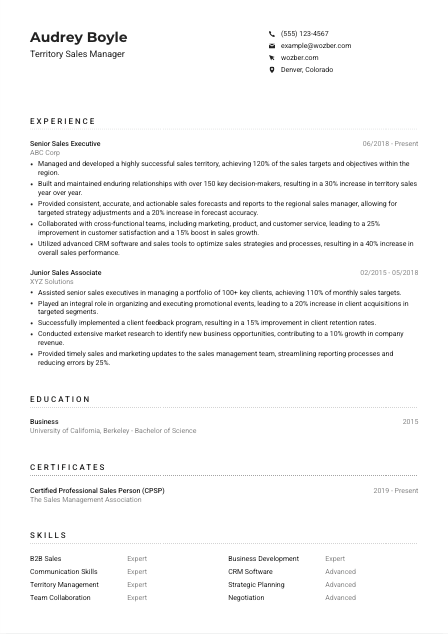
If the posting specifies a territory base, include your city and state. In this example, listing Denver, Colorado directly answers a stated requirement and avoids questions about relocation or local coverage. When location is not part of the role, a city and state line is usually enough.
A LinkedIn profile or professional website can help if it supports your sales story with consistent titles, industry focus, recommendations, or business development results. Make sure it aligns with the resume's dates, employers, and market positioning before you link it.
Your personal details should make you easy to contact and immediately recognizable as a Territory Sales Manager candidate who meets the basics of the opening. Keep it clean, accurate, and aligned with the market you want to cover.




This is the section sales leaders read hardest. They want to see the size of your commercial responsibility, how you performed against target, how you managed customer relationships, and whether your forecasting held up under real pipeline pressure.
Read the job description closely and extract the commercial themes that need to appear in your history. For this role, those themes include direct B2B sales, territory development, quota achievement, relationship management, forecasting, CRM usage, and collaboration with marketing, product, and customer service. Use those priorities to decide which accomplishments deserve space and which can be trimmed.
List roles in reverse chronological order with job title, company name, and dates. Sales hiring teams want to understand progression quickly, such as moving from supporting accounts to owning a territory, or from inside sales into field-based revenue responsibility.
Each bullet should show what you owned, what you did, and what happened. Instead of saying you were responsible for a territory, show what that territory produced. The example resume does this well with lines such as achieving 120% of target, growing territory sales year over year, and improving customer satisfaction through cross-functional work.
Revenue growth, quota attainment, account volume, forecast accuracy, retention, acquisition, and sales cycle improvements all belong here when they reflect your work. Numbers make your commercial impact concrete. A bullet about managing relationships with 150 decision-makers or improving forecast accuracy by 20% gives much more hiring value than a generic claim about strong communication.
Keep the emphasis on work that proves you can run a territory, win B2B business, and coordinate internally to keep customers moving forward. If an older bullet does not connect to pipeline generation, account expansion, reporting, or client retention, shorten it or remove it so the section stays focused on relevant sales performance.
Your experience section should make it easy to picture you owning a territory, hitting target, and keeping leadership informed with reliable pipeline reporting. If those three things are clear, the rest of the resume has a strong commercial foundation.
Education matters most here as a qualification checkpoint. For many Territory Sales Manager openings, it will not outweigh quota history or account growth, but it still needs to be easy to find and aligned with the stated requirement.
Start with the education line in the posting and make sure your resume reflects it plainly. Here, the employer asks for a bachelor's degree in Business, Sales, or a related field, so a Bachelor of Science in Business is a direct match worth stating exactly.
List your degree, field of study, school, and graduation year in a clean sequence. This is not a section that benefits from creativity. Hiring teams and ATS systems should be able to identify your qualification in seconds.
If your degree aligns closely with the role, name that alignment clearly rather than leaving it implied. A business degree supports core Territory Sales Manager work such as pipeline planning, market analysis, pricing conversations, and customer account strategy.
For experienced sales candidates, coursework and campus activities are optional. Include them only if they reinforce commercial relevance, such as sales competitions, business development projects, or leadership in student organizations tied to communication and persuasion.
Once you have several years of B2B sales experience, the education section should stay concise. Let it confirm the credential, then return attention to performance metrics, territory scope, and customer-facing achievements in the rest of the resume.
Education should quickly confirm that you meet the degree requirement and then get out of the way. In sales hiring, its value is clarity and alignment, not length.
Certifications are secondary to revenue performance, but they can still sharpen your profile. For Territory Sales Manager roles, the most useful credentials are the ones that support consultative selling, account management, or industry-specific credibility.
Prioritize credentials that strengthen your case as a disciplined sales professional. A certification such as CPSP signals formal development in sales practice and can add weight when paired with solid B2B results, even if the posting does not require it.
Do not fill this section with every course completion or unrelated credential. Hiring teams will care more about one respected sales certification than a long list that does not connect to territory planning, negotiation, customer management, or business development.
Show the year earned, and if the certification remains active, note that clearly. Dates help employers see whether your training is current and whether you continue to invest in professional development alongside field performance.
Review this section regularly, especially if you work in a market where product knowledge, channel selling, or regulated industry experience matters. Updated certifications can support credibility when several candidates have similar quota histories.
Certifications will not replace a record of target attainment, but they can strengthen the picture of a sales professional who keeps refining their approach. Include the ones that genuinely support the role you want.
The skills section should read like the toolkit behind your sales results. For a Territory Sales Manager, that usually means a mix of selling ability, territory execution, customer management, reporting discipline, and collaboration across internal teams.
Look beyond the keyword list and identify the actual work behind it. In this posting, that includes B2B selling, territory management, CRM proficiency, forecasting, relationship building, and collaboration with marketing, product, and customer service. Those are the skill areas worth surfacing first.
Combine hard skills and people-facing skills in a way that reflects how territory sales actually works. CRM software, pipeline management, and strategic planning matter, but so do negotiation, communication, and stakeholder management because deals move through relationships as much as systems.
Do not crowd the section with generic strengths that could belong to any office role. Lead with skills that directly support revenue generation and territory coverage. The example resume gets this mostly right by emphasizing B2B Sales, Territory Management, Business Development, CRM Software, and Communication Skills before less central items.
This section should tell a sales leader that you have the tools to manage pipeline, grow accounts, and work a territory with discipline. Relevance matters more than length.
Language ability can matter in territory sales, especially when client bases are regional, diverse, or relationship-driven. Even when only one language is required, this section can still support your customer-facing profile if it is presented accurately.
If the posting names a language explicitly, list it first and state your proficiency clearly. In this case, strong English proficiency is a stated requirement, so English should appear prominently and at an honest level that reflects how you handle client calls, presentations, and reporting.
Use labels such as Native, Fluent, Advanced, or Conversational in a way that reflects real working ability. Territory sales often involves live objections, pricing conversations, and follow-up emails, so your stated level should match what you can handle with customers and internal partners.
Extra languages can strengthen your profile if they support the customer mix in your territory. Spanish, for example, may be useful in some markets, but it should be presented as an added advantage rather than a universal requirement for every Territory Sales Manager role.
Do not overstate your fluency. If you can greet clients but cannot negotiate, present that honestly. Sales roles depend on trust, and language claims are easy to test in an interview or customer-facing scenario.
If multilingual ability has helped you win business, support retention, or build rapport across customer groups, make that connection elsewhere in the resume. Here, the languages section should remain concise while still showing practical communication range.
Handled well, this section reinforces your ability to communicate clearly with customers and internal teams. That matters most when the language listed supports the territory you want to manage.
Your summary should give a hiring manager a quick, credible picture of your level, market experience, and commercial strengths. For Territory Sales Manager roles, that means a short paragraph grounded in B2B selling, territory performance, and customer relationship management.
Before writing, identify the few points that define your candidacy best. For this kind of role, that usually means years in direct B2B sales, success managing a territory, quota performance, relationship-building strength, and comfort with CRM-based reporting and forecasting.
Open with your professional identity and years of relevant experience. A line such as "Territory Sales Manager with 7+ years in direct B2B sales" gives immediate context and helps distinguish you from candidates whose background is broader but less aligned.
Add specific selling strengths backed by the kind of proof leaders care about. The example summary works because it references territory development, exceeding sales targets, relationship building, and CRM use instead of relying on vague claims about being results-driven.
Aim for a concise paragraph that a regional manager can scan in seconds. Skip generic traits and focus on what translates directly to revenue production, account growth, and disciplined territory management.
A strong summary should frame you as someone who can step into a territory, manage the pipeline, and produce results. When that message is clear up front, the rest of the resume reads with more momentum.
A Territory Sales Manager resume works when it makes your commercial ownership easy to follow: the territory you managed, the targets you hit, the customers you grew, and the pipeline discipline behind those results. That is what hiring teams want to understand quickly.
Use Wozber's free resume builder and ATS resume scanner to align your wording with the posting, surface missing requirements, and organize your experience in an ATS-friendly resume format. The final document should make one thing unmistakable: you know how to grow revenue in a defined territory and report on it with confidence.




