



Use Wozber and land your dream job
Create Resume
No registration required
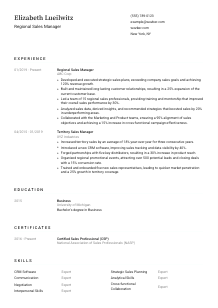
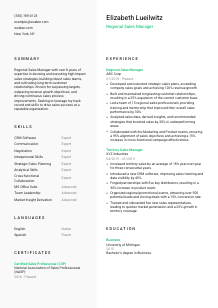
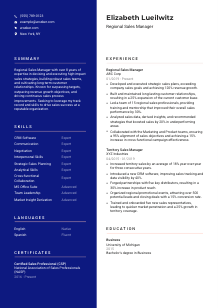
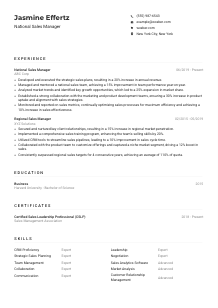
Scaling sales frontiers, but your resume feels geographically misplaced? Check out this Regional Sales Manager resume example, created with Wozber free resume builder. Learn how to put your leadership and networking strengths front and center to match the job's regional and revenue goals, and watch your career territory expand with each winning sales venture!
Regional Sales Managers are hired to turn a territory plan into repeatable revenue. That means your resume needs to show more than general sales ability. It should make your market coverage, quota performance, account growth, and team leadership easy to understand within a few lines. If you have managed a region, expanded distribution, coached reps, or corrected underperforming areas, those are the details that should lead.
Hiring teams also sort quickly between candidates who have owned a region and those who have only supported one. A tailored resume, built with Wozber's free resume builder and shaped for ATS optimization, helps surface the right language around territory management, CRM usage, sales planning, and target attainment so your application reads like a match for regional ownership from the start.
For a Regional Sales Manager, the top of the resume should read like a clean business card, not a crowded profile. Hiring teams want immediate access to your name, role, contact details, and any location information that affects territory coverage or interview logistics.
Use your full name in the most prominent text on the page so it is easy to spot in a resume stack or ATS preview. Keep the styling simple and professional. In a client-facing leadership role, polished presentation matters, and the header should reflect that.
Place the job title directly under your name and match it to the role you are pursuing when accurate. If you are applying for a Regional Sales Manager position, say "Regional Sales Manager" rather than a broader label like "Sales Professional" or "Business Development Leader." This immediately frames your background around regional ownership, forecasting, and team leadership.
Include a reliable phone number and a professional email address. Sales hiring often moves quickly, and responsiveness is part of the impression you create. If you include a LinkedIn profile or website, make sure it reflects the same employers, dates, and results shown on the resume.
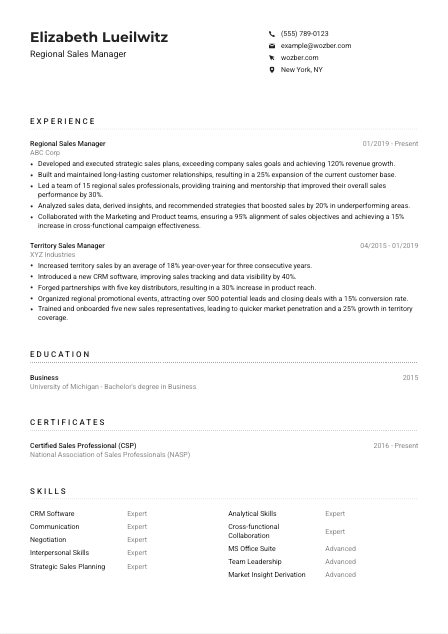
If the employer asks for a specific location or openness to relocate, address it clearly in this section. Here, listing "New York, NY" supports a stated requirement and removes a practical question early. Only do this when it is relevant to the posting, not as a blanket rule for every sales application.
A current LinkedIn profile can reinforce your credibility, especially in sales leadership where relationship-building and market presence matter. Keep the headline, recent roles, and key wins aligned with the resume. If your profile says you lead regional growth and CRM-driven pipeline management, the resume should show the same story with numbers.
Your header should answer the practical basics fast: who you are, how to reach you, what role you are targeting, and whether any location requirement is already covered. That keeps attention on your sales record instead of avoidable admin questions.




This section carries the most weight for Regional Sales Manager hiring. Companies want to see whether you have actually owned revenue across a territory, led salespeople, grown accounts, and used performance data to adjust strategy when results slipped.
Start by identifying the core asks in the posting. For this role, that includes executing strategic sales plans, driving revenue growth, leading a regional team, building customer relationships, and analyzing sales data. Those priorities should shape which achievements you choose and how you phrase them.
List your jobs in reverse chronological order with title, company, and dates. For sales leadership roles, progression matters. A move from Territory Sales Manager to Regional Sales Manager, for example, tells a clear story of increased market scope, people leadership, and accountability for bigger numbers.
Write bullet points around business results, not task lists. The example resume does this well by leading with outcomes such as 120% revenue growth, 25% customer base expansion, and 20% gains in underperforming areas. Those statements work because they connect strategy to measurable territory performance.
Regional sales work is measured in quotas, growth rates, account expansion, team output, conversion, and market coverage. Use those metrics wherever you can. If you improved close rates, grew distributor reach, lifted year-over-year sales, or shortened ramp time for new reps, say so plainly and quantify the change.
Prioritize accomplishments that show ownership of a region or territory. Strong examples include coaching a field team, using CRM data to refine strategy, coordinating with Marketing or Product, or expanding customer reach through channel partners. Leave out wins that do not support the case that you can lead a region and deliver against target.
Your experience section should leave little doubt that you can plan territory growth, coach a team, manage pipeline discipline, and close business at scale. If the numbers and scope are clear, the role becomes much easier to picture you in.
Education usually will not outrank your sales results, but it still matters when the posting calls for a bachelor's degree. For Regional Sales Manager roles, this section should confirm that requirement quickly and stay easy to scan.
If the job asks for a bachelor's degree in Business, Marketing, or a related field, make sure your degree is stated clearly. In the example, "Bachelor's degree in Business" directly aligns with the requirement and removes ambiguity for both recruiters and ATS systems.
List your degree, field of study, school, and graduation year. That is usually enough for an experienced sales leader. Avoid overloading this section with extra detail unless it adds real value to your candidacy.
When your degree closely matches the posting, use the common wording naturally. If you studied Business, Marketing, or Sales Management, naming that field clearly helps your resume align with the employer's stated criteria without forcing keywords awkwardly.
Early-career candidates may benefit from listing coursework in marketing, analytics, consumer behavior, or management. For someone with 5+ years in sales leadership, territory growth and target attainment matter far more, so keep this section brief unless academic detail meaningfully supports the role.
Academic honors, leadership roles, or notable projects can stay if they are concise and relevant. For example, leading a student sales competition team or graduating with honors may help if your professional record is still developing. Otherwise, your resume space is usually better spent on revenue, team, and customer results.
This section should confirm that you meet the degree requirement and then get out of the way. For an experienced Regional Sales Manager, the heavy proof comes from territory performance, team leadership, and revenue growth.
Certifications are rarely the deciding factor in regional sales hiring, but the right one can reinforce your command of sales process, account management, or leadership development. Include them when they add weight to your commercial track record.
Choose certifications that strengthen your case for sales leadership, negotiation, account growth, or management capability. If the posting does not require a credential, treat certifications as supporting proof rather than filler.
A credential such as Certified Sales Professional can work well because it connects directly to structured selling and professional development. One relevant certification is stronger than a long list of general courses that say little about your ability to lead a region.
Include the issue date and, if relevant, the current validity period. This is especially useful for credentials that require renewal or continuing education. It shows that your training is active rather than outdated.
Sales methods, CRM workflows, and leadership expectations change over time. Updating your certifications can signal that you stay current on consultative selling, pipeline management, or coaching practices. That matters more when the credential ties back to how you actually run a team or sales process.
A concise certification section can strengthen your profile when it reflects real sales discipline and current professional development. Keep it relevant, current, and connected to the kind of regional leadership the role requires.
The skills section should quickly confirm that you have the commercial tools and leadership abilities the role depends on. For Regional Sales Manager resumes, the best skills lists combine sales execution, data fluency, team leadership, and communication.
Review the job description closely and note the abilities that appear in the requirements and responsibilities. Here, that includes CRM software, communication, negotiation, interpersonal skills, strategic sales planning, and sales data analysis. Those are the skills your resume should make visible first.
Only list skills that are supported elsewhere on the resume. If you claim strategic sales planning, your experience should show territory plans, growth outcomes, or corrective action based on market performance. If you claim CRM expertise, include a result tied to pipeline visibility, forecasting, or adoption.
A Regional Sales Manager needs more than persuasion. Include a mix of hard and soft skills such as CRM platforms, forecasting, reporting, market analysis, negotiation, team coaching, and cross-functional collaboration. The example skills list works because it combines operational tools like CRM and MS Office with leadership strengths like communication and team leadership.
A focused skills section should reinforce the rest of the resume, not repeat it vaguely. When the listed abilities line up with your results in revenue growth, team performance, and account expansion, the profile becomes much more convincing.
Language ability matters in sales when it affects how well you communicate with customers, distributors, internal teams, or a broader territory. This section should stay straightforward and relevant to the role's communication demands.
If the posting specifies English communication, show your English proficiency clearly. In this case, the employer asks candidates to articulate well in English, so listing English prominently helps confirm a basic operating requirement for client conversations, team leadership, and cross-functional meetings.
List your native or highest-proficiency language at the top with a clear level such as Native or Fluent. This makes the section easy to scan and helps employers understand your primary communication strength immediately.
Additional languages can be valuable when a region includes diverse customer groups, distributor networks, or multilingual internal teams. For example, Spanish may strengthen outreach or relationship-building in certain markets, even when it is not formally required.
Use honest labels such as Native, Fluent, Intermediate, or Basic. Overstating language ability can create problems quickly in client calls, negotiations, or field leadership. Clear levels are more useful than optimistic claims.
Only include languages that add genuine value to your candidacy. If an additional language helps with account expansion, territory communication, or cultural fluency, it belongs here. If not, keep the section lean and focused.
For Regional Sales Manager roles, language skills matter when they improve how you lead, sell, and build relationships across a market. Make that practical value clear and keep the section honest.
The summary sets the commercial tone of the resume. For this role, it should quickly establish your years in sales, level of regional responsibility, leadership scope, and the kind of revenue or market growth you consistently deliver.
Open with your title and experience level, then anchor it in the type of work you actually own. "Regional Sales Manager with 8+ years in territory growth and team leadership" says much more than a broad claim about being results-driven. It immediately places you in the right lane.
Use the next line to show the areas where you are strongest, such as strategic sales planning, customer expansion, regional team leadership, distributor management, or CRM-led pipeline discipline. The summary should give a concise preview of how you operate, not just how long you have worked.
Include measurable outcomes that fit regional sales leadership. The example summary works because it references surpassing targets, revenue growth, and sales process improvement. You can make yours even sharper by naming a growth figure, team size, or customer expansion result if space allows.
Aim for three to five lines that match the target role. Avoid generic objectives or broad claims about passion. A hiring manager should finish the summary knowing your sales level, your management scope, and the business results you tend to produce.
A well-written summary should make the rest of the resume feel consistent before the reader reaches your first job entry. For a Regional Sales Manager, that means leading with territory ownership, revenue performance, and team leadership in concise language.
A Regional Sales Manager resume should make your territory results, customer growth, forecasting discipline, and leadership scope easy to read from top to bottom. When each section supports that story, the application feels grounded in real commercial ownership rather than broad sales language.
Use Wozber's free resume builder to tighten structure, align your wording with the posting, and create an ATS-friendly resume template that highlights the right metrics and responsibilities. The final read should make it clear that you can lead a region, grow revenue, and guide a sales team with confidence.




