



Use Wozber and land your dream job
Create Resume
No registration required
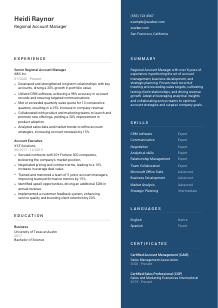
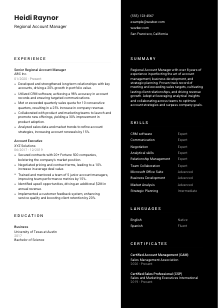
Covering territories, but your resume seems lost in translation? Check out this Regional Account Manager resume example, created with Wozber free resume builder. Learn how to map your strategic sales successes to match job requirements, steering your career trajectory toward the most promising regions of opportunity!
Regional Account Managers carry a dual mandate: protect existing revenue while growing it. Hiring teams look for people who can expand strategic accounts, uncover new business, and keep delivery issues from turning into churn. Your resume should make that commercial range visible through account growth, renewal performance, quota attainment, and cross-functional work with product, operations, or marketing.
A tailored resume changes how quickly that track record comes into focus. When your wording reflects the employer's language around account management, CRM usage, negotiation, and revenue targets, an ATS-compliant resume is more likely to surface the right experience early. Wozber's free resume builder helps organize those details cleanly, so the hiring team can quickly see whether you can manage a region, grow accounts, and hit number-driven goals.
This section is simple, but it still affects how smoothly your application moves. For a Regional Account Manager, the basics should immediately confirm who you are, what role you target, and whether you meet practical filters such as location and contact availability.
Place your full name prominently at the top of the page in a clean, professional style. Sales and account management resumes often move fast through internal recruiters, hiring managers, and sales leaders, so readability matters from the first line.
Use "Regional Account Manager" directly under your name when that is the role you are pursuing. Matching the job title helps frame your background correctly, especially if your previous titles include close variants such as Account Executive, Senior Account Manager, or Territory Manager.
List a current phone number and a professional email address with zero errors. If a hiring team wants to discuss pipeline ownership, account scope, or quota performance, you do not want a typo in your contact details to slow down the process.
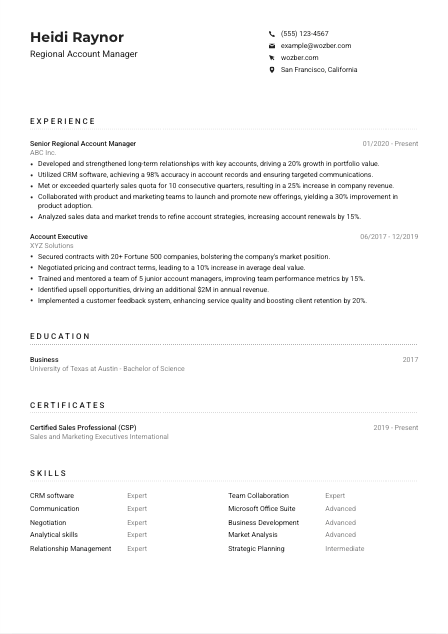
Some account management roles are tied to a territory, office, or travel footprint. Here, the employer specifically asks for someone based in San Francisco, CA, so showing "San Francisco, California" in your header removes an immediate question about territory coverage and availability.
A LinkedIn profile or personal website can reinforce your resume when it reflects the same roles, dates, and commercial achievements. If it includes recommendations, account growth examples, or industry focus, it can strengthen your positioning. Keep it aligned with the resume you send.
Your personal details should confirm the practical facts fast: identity, target role, contactability, and any location requirement tied to the territory. Clean execution here keeps attention on your sales results and account portfolio.




This is the section hiring managers study most closely for a Regional Account Manager. They want to see how you handled account ownership, business development, revenue targets, customer retention, and internal coordination once deals were in motion.
Before you edit a single bullet, mark the responsibilities that define success in the role. In this posting, that means long-term account relationships, new business development, solution selling, quota performance, CRM proficiency, and using sales data to refine account strategy. Those themes should shape what you emphasize in each role.
Start with your most recent position and work backward. Include job title, company name, and employment dates for each role. For account management hiring, this format makes it easy to spot progression from hunting or inside sales work into larger account ownership, regional responsibility, or senior client management.
Do not stop at listing duties like "managed accounts" or "worked with internal teams." Rewrite bullets around outcomes tied to revenue, renewals, expansion, and customer adoption. The sample resume does this well with lines such as growing portfolio value by 20%, improving product adoption by 30%, and increasing renewals by 15% through sharper account strategy.
Regional Account Manager work is tracked by numbers, so your resume should be too. Use metrics such as quota attainment, revenue growth, average deal size, renewal rate, upsell value, portfolio growth, retention, or CRM data accuracy. "Exceeded quota for 10 consecutive quarters" tells a much clearer story than "consistently met goals."
Prioritize experience that shows how you managed relationships and produced commercial results. If you include earlier or adjacent roles, choose bullets that still connect to client ownership, negotiation, pipeline expansion, contract value, or cross-functional delivery. That keeps the section focused on what matters for this profession.
A Regional Account Manager resume should read like a record of revenue ownership. When your experience section shows account growth, quota consistency, renewals, and coordinated delivery, hiring teams can picture you managing a book of business from day one.
Education usually will not carry the application on its own for this role, but it can still remove doubt quickly. Most employers hiring Regional Account Managers want to confirm that you meet the degree requirement and have a relevant business foundation.
If the posting asks for a bachelor's degree in Business, Sales, or a related field, present that information clearly. In the example, a Bachelor of Science in Business aligns neatly with the requirement and supports the candidate's commercial background.
List your degree, school, field of study, and graduation date in a simple structure. This section is usually a qualification check, so clarity matters more than detail unless the role places unusual weight on academic background.
If your degree is in Business, Marketing, Sales, Finance, or another related discipline, do not bury the field of study. It helps connect your training to core account management work such as forecasting, customer analysis, and commercial planning.
Most mid-career account managers do not need a long academic breakdown. Include coursework only when it supports the target role in a meaningful way, such as sales management, market analysis, customer relationship management, or business communication.
Honors, leadership roles, or strong extracurriculars can help if they show early commercial or client-facing experience, but keep them brief. At this stage, your sales results and account achievements should remain the center of gravity.
Education should confirm that you meet the stated baseline and have relevant business grounding. Once that is clear, let your account portfolio, revenue performance, and customer results carry the rest of the case.
Certifications are rarely the main reason a Regional Account Manager gets hired, but they can sharpen your profile when they reinforce selling discipline, account planning, or customer management. They matter more when the employer explicitly names them, as this one does.
If the job description mentions credentials such as Certified Sales Professional (CSP) or Certified Account Management (CAM), move those to the top of the section when you have them. That makes it easy for the recruiter to connect your background to the preferred profile.
Choose certifications that support how the role is performed, not just general professional development. Sales methodology, account management, negotiation, customer success, and strategic selling credentials tend to be more useful here than broad, unrelated certificates.
Add issue dates or active periods where relevant. Current credentials suggest that your training is recent enough to support modern account work, from CRM-driven pipeline management to structured client planning and renewals.
Regional account work changes with market conditions, buyer expectations, and sales tooling. Ongoing certifications or recent training show that you stay current in areas that affect performance, whether that is consultative selling, data-driven account planning, or contract negotiation.
Relevant certifications add weight when they reinforce the way you sell, manage accounts, and grow revenue. They will not replace results, but they can strengthen the picture of a commercially disciplined candidate.
The skills section should function like a quick commercial profile. For a Regional Account Manager, that means showing the tools and abilities used to grow accounts, manage pipelines, interpret account data, and handle customer conversations that affect revenue.
Start with the skills the employer already names. In this case, CRM software, Microsoft Office Suite, communication, negotiation, and analytical skills belong near the top because they connect directly to account planning, reporting, and customer-facing work.
Do not present only soft skills or only tools. Regional Account Managers are expected to work inside CRM platforms, track account activity, and analyze sales data, while also leading renewals, negotiations, and executive conversations. Your list should reflect both sides of the role.
Use concise skill labels rather than long phrases. Prioritize account management, business development, relationship management, forecasting, negotiation, market analysis, CRM proficiency, and collaboration with internal teams. The example resume handles this well by mixing technical tools with commercial capabilities.
Every skill listed should connect to a real part of the job, whether that is pipeline discipline, customer communication, account expansion, or data-backed planning. That makes the section useful to both recruiters and sales leaders scanning your resume quickly.
Language ability matters in account management when it affects client communication, regional coverage, or internal coordination. Even when only English is required, the way you present languages can still strengthen your profile.
If the posting asks for strong oral and written English, state your level clearly. For a client-facing commercial role, this supports your ability to handle presentations, proposals, negotiations, and day-to-day account communication without ambiguity.
Additional languages can be valuable when a territory includes multilingual clients, cross-border stakeholders, or diverse customer bases. They are not mandatory for every Regional Account Manager role, but they can expand your usefulness in relationship-building and business development.
Terms such as "Native," "Fluent," "Intermediate," and "Basic" are enough. They give hiring teams a practical sense of how comfortably you can speak, write, and conduct business in each language.
If your accounts span multiple regions or industries with international touchpoints, extra languages deserve space. If the role is strictly domestic and English-only, keep this section brief and do not overstate its importance.
Language skills are most useful when they support business outcomes such as stronger client relationships, smoother stakeholder communication, or broader prospecting reach. For example, Spanish fluency may be worth noting when it helps you serve part of a regional portfolio more effectively.
For Regional Account Managers, language skills matter when they improve communication with customers, partners, or internal teams. Present them clearly, and let their relevance depend on the market you are targeting.
Your summary should quickly establish the level of accounts you manage, the kind of growth you drive, and the business results you are known for. For this role, a vague opener wastes space. A focused summary gives the reader your commercial profile before they reach the bullet points.
Start with the big themes from the posting: account management, business development, customer relationship growth, revenue targets, and data-informed strategy. That gives you the right frame for a summary that feels specific to Regional Account Manager hiring.
Lead with your title or specialty and your experience level. Phrases such as "Regional Account Manager with 8+ years of experience" work well because they establish seniority immediately and prepare the reader for portfolio and revenue examples.
Follow with two or three strengths tied to the role, such as quota attainment, portfolio growth, strategic account development, contract negotiation, or cross-functional collaboration. The example summary works because it connects experience in account management and business development to measurable revenue and relationship outcomes.
Aim for a short paragraph that can be scanned in seconds. Three to five lines is usually enough to cover your experience level, commercial focus, and a few standout results without repeating the entire experience section.
A good summary tells the reader what kind of Regional Account Manager you are before they read the rest of the page. When it highlights revenue growth, account ownership, and customer strategy clearly, the rest of the resume lands faster.
A Regional Account Manager resume works best when every section supports the same business story: you build relationships that last, expand accounts that matter, and manage the commercial details that keep revenue moving. Keep the language close to the posting, use metrics that sales leaders actually track, and make your CRM, negotiation, and account strategy experience easy to find.
Wozber's free resume builder can help you shape that story into an ATS-friendly resume format, while ATS optimization keeps the wording aligned with the role's real requirements. The finished resume should make one thing easy to judge: whether you can step into a territory, grow the book of business, and deliver against target.