




Use Wozber and land your dream job
Create Resume
No registration required
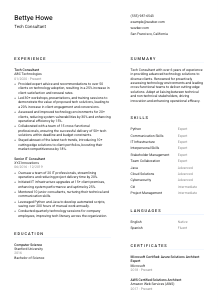
Cracking codes, but your resume needs decryption? Check out this Tech Consultant resume example, created with Wozber free resume builder. Learn how to present your technical brilliance and consulting acumen in line with job expectations, launching your career as the go-to solution architect in the digital landscape!

Tech consulting work gets judged in real situations where a client needs clarity fast. Hiring teams look for consultants who can assess an environment, explain tradeoffs to non-technical stakeholders, and guide implementation across cloud platforms, infrastructure, or security priorities without losing business context. Your resume should make that consulting range visible, not bury it under generic IT bullets.
When the wording on your resume reflects the language of the target role, it becomes much easier to surface the consulting strengths that matter first, especially in an ATS-compliant resume. Wozber's free resume builder helps you align titles, achievements, and role-specific terminology so hiring teams can quickly recognize client advisory work, technical depth, and delivery credibility.
For a Tech Consultant, the top of the resume should remove basic friction immediately. This section needs to confirm who you are, how to reach you, and, when the job asks for it, whether your location lines up with the role. Keep it clean, current, and easy to scan.
Your name should sit at the top in a clean, readable format. For consulting roles, that header becomes the anchor for everything that follows, so avoid decorative formatting that competes with the rest of the resume.
Place the role title under your name when it matches your background. If the posting says "Tech Consultant," use that wording rather than a broader label like "IT Professional" or "Technology Specialist." It tells both ATS filters and human reviewers that your experience is aligned with consulting work.
Your phone number and email need to look reliable and current because client-facing technology roles depend on responsiveness and professionalism from the first interaction.
Some consulting jobs have a firm location requirement because of client meetings, workshops, or hybrid delivery expectations. Here, listing "San Francisco, California" supports a stated requirement and removes doubt about availability. Only do this when location is relevant to the opening.
A polished LinkedIn profile or professional website can strengthen your application, especially if it reinforces your consulting focus, certifications, project scope, or technical specialties. Make sure titles, dates, and major achievements match your resume exactly.
This section should answer the practical questions fast: who you are, how to contact you, and whether you meet basic role logistics. Once that is clear, the resume can focus on consulting impact.




This is the section hiring teams read to understand whether you can guide technology decisions and help get them implemented. For Tech Consultants, strong experience bullets combine advisory work, technical scope, stakeholder interaction, and measurable outcomes such as adoption, uptime, vulnerability reduction, or project delivery speed.
Read the job description for the repeated themes, then reflect those priorities in your bullets. In this role, that includes cloud solutions, IT infrastructure, cybersecurity, cross-functional collaboration, and client-facing communication. Use those ideas naturally in your experience instead of relying on generic phrases like "responsible for technology projects."
List positions in reverse chronological order and include job title, employer, and dates in a consistent format. For consulting resumes, that structure matters because reviewers often track progression from technical execution into advisory leadership, solution ownership, or broader client scope.
A Tech Consultant resume should show what changed because of your recommendations. Replace task-based bullets with outcome-driven ones that connect assessment, advice, and implementation. The sample does this well with points like advising 50+ clients on technology adoption and leading 30+ workshops that increased engagement and conversions. Those bullets show both client contact and business results.
Metrics make consulting work credible because they show scale and effect. Good examples include number of clients served, workshops delivered, vulnerabilities reduced, hours automated, system uptime improved, projects delivered on time, or renewal rates influenced. Pick numbers that match the kind of consulting work you actually did, not just the biggest number you can find.
Every bullet should help answer whether you can advise on technology choices, collaborate across technical teams, and support successful delivery. If a point does not speak to consulting scope, technical depth, stakeholder communication, or business impact, trim it or rewrite it. Focus keeps the section sharper and improves ATS optimization without keyword stuffing.
Your experience section should leave little doubt that you can assess environments, recommend practical solutions, and help teams execute them. The best bullets show both technical judgment and the client outcomes that followed.
Education usually will not carry a Tech Consultant resume on its own, but it still matters when the role asks for a specific academic background. Keep this section straightforward and make sure the degree information supports the technical foundation expected for consulting work.
If the role asks for a bachelor's degree in Computer Science, Information Technology, or a related field, list that information plainly. A direct match helps early screening move faster and shows the technical base behind your consulting recommendations.
Include your degree, field of study, school, and graduation year or date in a consistent order. Straightforward formatting helps ATS systems parse the section cleanly and keeps the emphasis on the qualification itself.
When your degree closely matches the posting, use the full wording. For example, "Bachelor of Science in Computer Science" speaks directly to this role's requirement and supports technical credibility in areas like programming, systems, and architecture.
If you are earlier in your career, selective extras such as cloud computing projects, cybersecurity coursework, or systems design work can strengthen the section. For more experienced consultants, those details usually matter less than recent client results and certifications.
Honors, scholarships, or standout technical projects can be worth including when they add something meaningful to your profile. Keep them brief and relevant to the kind of consulting work you want, especially if they support architecture, development, or infrastructure knowledge.
This section should confirm that you meet the academic baseline without taking attention away from your consulting experience. Clear degree information is enough unless an extra academic detail genuinely strengthens your case.
Certifications carry real weight in consulting because they show current platform knowledge and give clients confidence in your recommendations. For cloud, infrastructure, and security-focused roles, this section often helps separate general IT experience from role-ready consulting expertise.
When a job description calls out certifications such as "Microsoft Certified: Azure Solutions Architect Expert" or "AWS Certified Solutions Architect," place matching credentials prominently. Those are not filler keywords. They signal platform depth that matters for solution design and client advice.
Order certifications by importance to the target role, not by the date you earned them. A cloud architecture credential should appear before a less relevant certificate if the consulting work centers on cloud migration, infrastructure planning, or solution adoption.
Technology certifications age differently than degrees. Listing the year earned, renewal period, or active status helps show that your knowledge is current, especially for platform ecosystems that update services and best practices frequently.
If you are working toward another relevant certification, you can include it when progress is genuine and the credential supports the role. That works well for consultants expanding into cloud architecture, security frameworks, or vendor-specific implementation work.
Well-chosen certifications reinforce the technical side of your consulting profile. They tell employers and clients that your recommendations are grounded in current platform knowledge, not just past exposure.
A Tech Consultant needs a skills section that does more than list tools. It should show the blend of technical knowledge and consulting capability the role requires, from programming and cloud platforms to stakeholder communication and workshop delivery.
Review the posting for both technical and interpersonal requirements. Here, that means programming languages like Python, Java, or C#, along with cloud solutions, IT infrastructure, cybersecurity, and strong communication with non-technical stakeholders. Include both sides of the role because consulting work depends on that combination.
Every skill should connect to experience, certifications, or projects elsewhere on the resume. If you list Python, cloud solutions, or stakeholder management, make sure your experience section shows where those skills were used, such as automation work, architecture recommendations, or client workshops.
Lead with the skills most central to the target job. For this kind of position, a focused list featuring cloud solutions, IT infrastructure, cybersecurity, programming, communication, and collaboration will be stronger than a long inventory of loosely related tools. The section should help a reviewer understand your consulting profile in seconds.
The best skills sections reinforce what your experience already proves. Keep the list tight, role-specific, and grounded in the technical and client-facing work that defines tech consulting.
Consulting roles often involve workshops, recommendations, status discussions, and translation between technical specialists and business stakeholders. Language ability matters most when it directly affects how clearly you can communicate in those settings.
If the job requires strong English proficiency, list English prominently and use an accurate level. That quickly confirms you can handle presentations, client discussions, written recommendations, and cross-functional communication.
Extra languages are useful when they support client relationships, regional delivery, or collaboration across distributed teams. They are a plus, especially in consulting environments with international stakeholders, but they should not distract from the core requirement.
Use clear labels such as Native, Fluent, Professional, or Conversational. Consulting work depends on trust and clarity, so overrating your proficiency can create problems quickly in meetings, workshops, or training sessions.
Not every Tech Consultant role needs multiple languages. Include them when they genuinely support the kind of work you pursue, such as multilingual client support, global implementation projects, or training across regions.
Language skills matter because they affect how well you explain technical options, gather requirements, and build client confidence. In consulting, communication is part of delivery, so only include languages you would be comfortable using in a professional setting.
List the languages that strengthen your ability to advise, present, and collaborate. For a Tech Consultant, communication quality matters most when it supports client trust and smooth delivery.
Your summary should quickly establish your consulting focus, your level of experience, and the areas where you create value. For Tech Consultant roles, that usually means a concise statement that combines technical specialization, client advisory work, and a few outcomes or strengths that match the target job.
Start with the requirements that matter most for the opening. If the role emphasizes cloud solutions, infrastructure assessment, cybersecurity exposure, and stakeholder communication, those points should shape the summary more than unrelated experience from earlier jobs.
A direct line such as "Tech Consultant with 6+ years of experience" works because it gives immediate context. Then narrow the focus by naming the kind of consulting work you handle, whether that is cloud adoption, infrastructure improvement, client workshops, or technology assessments.
Use two or three specifics that connect to the role's real work. The sample summary points to assessing technology environments, leading cross-functional delivery, and working with technical and non-technical stakeholders. That combination reads credibly for consulting because it connects analysis, communication, and execution.
Aim for a compact paragraph of three to five lines. You want enough detail to establish direction, but not so much that the summary becomes a duplicate of the experience section. Focus on consulting scope, technical emphasis, and the kind of results you tend to drive.
A well-written summary tells the reader what kind of Tech Consultant you are before they read a single bullet. Keep it specific enough to guide the rest of the resume toward the consulting work you want next.
A Tech Consultant resume should make three things easy to see fast: your technical range, your ability to advise clients clearly, and your track record of helping teams deliver workable solutions. When those points show up consistently across your title, summary, experience, skills, and certifications, the resume reads like someone who can step into workshops, assessments, and implementation planning with confidence.
Use Wozber's free resume builder to sharpen that alignment with ATS-friendly resume templates and an ATS resume scanner that helps map job requirements to your content. The finished resume should give hiring teams a clear read on your consulting value, your platform knowledge, and your readiness to handle client-facing technology work.




