



Use Wozber and land your dream job
Create Resume
No registration required
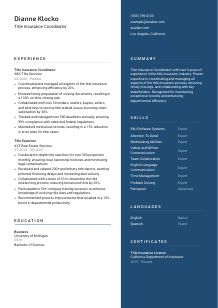
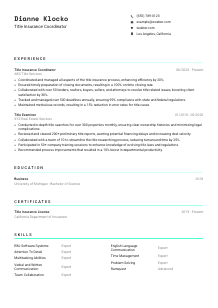
Firming up property titles, but feeling uncertain about your resume? Settle in with this Title Insurance Coordinator resume example, created with Wozber free resume builder. Learn how to clearly highlight your due diligence and title expertise to match job prerequisites, drafting a career journey that's as secure as a title search!
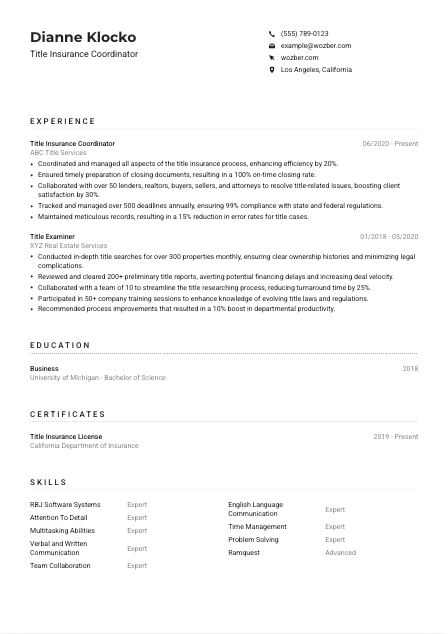
Title Insurance Coordinators work in the narrow space where paperwork errors turn into delayed closings, funding problems, or unresolved title defects. That is why hiring teams look closely at whether your resume shows control of the transaction process itself, from ordering title commitments and reviewing reports to clearing issues, preparing closing documents, and keeping files compliant and moving on schedule.
A tailored resume helps distinguish title operations experience from broader real estate or administrative support work. Using Wozber's free resume builder to align your wording with the posting and keep an ATS-compliant resume structure makes it easier for employers to see whether you have handled the coordination, deadline management, software, and stakeholder communication this kind of title desk depends on.
In title insurance, small oversights create unnecessary friction fast. Your contact section should reflect the same accuracy you would bring to a file, a closing package, or a title issue log.
Place your full name at the top in a clean, readable format. Keep it slightly more prominent than the rest of the header so it is easy to identify when your resume is printed, forwarded, or reviewed alongside other candidates for title operations roles.
If you are targeting a Title Insurance Coordinator position, use that title directly under your name when it reflects your background. This immediately frames your experience around title commitments, closing coordination, and defect resolution instead of leaving the reader to guess whether your work was in escrow, mortgage support, or general real estate administration.
List a reliable phone number and a professional email address you check often. In a job built around deadline tracking, document follow-up, and responses to lenders, agents, buyers, and attorneys, even a typo here suggests the kind of avoidable error employers want to prevent.
Some openings have a specific location requirement, and this one calls for Los Angeles, California. If you already live in the required market, state it clearly in your header so the employer does not need to search for it or question whether relocation is part of the process.
A LinkedIn profile can support your application if it matches your resume and shows relevant title, escrow, or real estate transaction experience. Only include it if the dates, titles, and responsibilities are consistent, especially when your resume emphasizes coordination across multiple parties and high transaction volume.
This section should confirm that you are easy to contact, correctly located for the opening, and already presenting yourself as someone who handles transaction details carefully.




This is the section where employers look for proof that you have managed real title work under real deadlines. Focus less on broad administrative language and more on the transaction steps, document control, issue resolution, and compliance habits that keep closings on track.
Read the responsibilities closely and make sure your bullets reflect the actual title process. For this role, that means showing experience with ordering and reviewing title commitments, clearing title defects, preparing closing documents, coordinating with lenders and agents, and maintaining compliant files. The sample resume does this well by matching the posting's workflow instead of describing the job in vague office terms.
List your positions in reverse chronological order and make sure the roles closest to title coordination appear first. If your background includes adjacent work such as title examination, escrow support, or real estate transaction processing, emphasize the parts that connect directly to curative work, document preparation, and closing timelines.
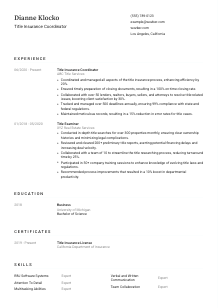
Do not stop at saying you were responsible for a process. Show what happened because you handled it well. A bullet like "Ensured timely preparation of closing documents, resulting in a 100% on-time closing rate" works because it ties routine coordination work to a measurable business result that matters in title operations.
Metrics make your scope easier to understand when they are native to the job. Strong examples include number of files handled, closings completed on time, title reports reviewed, defects cleared, parties coordinated, compliance rate, or error reduction. In the sample, "tracked and managed over 500 deadlines annually" gives a clear picture of pace, complexity, and control.
Every bullet should support your case for handling title insurance coordination. Remove unrelated tasks unless they directly strengthen your candidacy, such as process improvement, regulatory training, or cross-functional work with underwriting, escrow, or legal teams. Keep the section anchored in closings, curative work, documentation accuracy, and stakeholder coordination.
By the end of this section, an employer should be able to picture you managing title commitments, resolving issues, preparing documents, and keeping transactions compliant through closing.
Education is usually a supporting section for this job, but it still matters when the posting asks for a degree in Business, Finance, or a related field. Present it clearly so the hiring team can confirm the baseline requirement quickly and move back to your title experience.
Start with the exact educational requirement listed in the posting. Here, a bachelor's degree in Business, Finance, or a related field is requested, so place your degree in a way that makes that match easy to see if you have it.
List your degree, field of study, school name, and graduation year in a straightforward order. This section does not need decoration. It needs to be fast to read and consistent with the rest of a resume that already carries a lot of operational detail elsewhere.
If your degree lines up directly with the requirement, say so clearly. "Bachelor of Science in Business" is stronger than forcing the employer to infer that your education is relevant. The sample resume handles this well by showing a business degree without extra filler.
For most experienced candidates, coursework is optional. Include it only when it strengthens your case, such as classes in business law, finance, real estate transactions, or compliance. Early-career applicants can use this space to connect education to the document-heavy and regulation-sensitive nature of title work.
Honors, scholarships, or leadership roles are worth mentioning only when they add meaningful context. If they show analytical strength, process discipline, or industry interest, include them. If not, keep the section lean and let your transaction experience do the heavier lifting.
Your education section should quickly show that you meet the posted degree expectation without distracting from the experience that proves you can handle the day-to-day demands of title coordination.
Certifications are especially useful in title insurance because they point to regulatory awareness, licensing status, and ongoing industry involvement. Use this section to reinforce qualifications that matter in a document-driven, compliance-sensitive environment.
Even when a posting does not explicitly require a certification, relevant credentials can strengthen your resume. A title insurance license, notary credential, escrow-related certification, or state-approved industry training can all support your case, depending on the market and employer.
Do not fill this section with generic learning badges. Prioritize certifications that connect to title insurance, closings, compliance, real estate documentation, or state licensing rules. In the sample resume, the California Title Insurance License adds useful local and industry-specific credibility.
If a credential is active, include the date range or valid-through date so the employer can see it is current. This matters for regulated work, especially when the role includes compliance tracking and transaction documentation where outdated credentials can raise questions.
Title laws, underwriting guidelines, and closing requirements change over time. If you complete relevant training or renew credentials consistently, that signals you stay current with the rules and workflows that affect title review and closing accuracy.
Well-chosen certifications show that your knowledge is current and relevant to the legal and procedural demands that come with coordinating title transactions.
The strongest skills sections in this field look practical, not generic. Employers want to see the software, coordination strengths, and process habits that support accurate title work, responsive communication, and on-time closings.
Start with the language the employer already uses. In this opening, that includes industry software such as RBJ Software Systems or Ramquest, along with attention to detail, multitasking, organization, and strong written and verbal communication. If those reflect your experience, include them in your skills section and reinforce them in your work history.
A Title Insurance Coordinator needs more than software familiarity. Pair technical tools with the abilities that make the workflow run well, such as deadline management, document review, issue follow-up, stakeholder communication, and file organization. The sample resume does this effectively by listing both platforms and operational strengths.
Choose skills that support the actual work of title coordination rather than broad workplace traits. A shorter list built around title systems, compliance awareness, communication, and transaction management is more persuasive than a long inventory of generic soft skills.
A hiring manager should be able to scan this section and immediately recognize that you know the tools, pace, and coordination demands of a title insurance desk.
Language ability matters here because title work relies on accurate communication with clients and transaction partners. Present language skills in a way that supports the role's communication demands without overstating their importance beyond what the job actually requires.
This posting specifically calls for strong English communication, so list English clearly with an honest proficiency level. For a role involving title questions, closing documents, and coordination across multiple parties, written and verbal precision matters.
Start with the language required for the job, then add any others that may support client communication or regional business needs. In some markets, an additional language can help when working with buyers, sellers, or agents who are more comfortable discussing transaction details in that language.
Use clear levels such as Native, Fluent, Intermediate, or Basic. Title insurance work leaves little room for misunderstanding, so it is better to be precise than to overstate your ability, especially if you may need to explain document requests or title issues to clients.
Additional languages are not always required, but they can support smoother service in diverse markets and reduce communication delays during active transactions. The sample resume's English and Spanish combination is a useful example of this kind of added value, especially in a large metropolitan market.
Do not let languages overshadow your title experience unless the employer strongly emphasizes bilingual service. For most Title Insurance Coordinator roles, language skills are an asset that supports client communication, not the main qualification.
This section works best when it reinforces your ability to communicate clearly with the people involved in a closing, while keeping the focus on your title coordination expertise.
Your summary should quickly establish that you already understand the workflow, pace, and accuracy standards of title insurance. Keep it short, specific, and grounded in the type of coordination work the employer needs handled well from day one.
State your current professional identity clearly and include your years of relevant experience. For example, "Title Insurance Coordinator with 3+ years in title insurance" immediately places you in the right lane and helps separate you from broader administrative or real estate support candidates.
Mention the core functions most relevant to the role, such as coordinating title processes, reviewing commitments, clearing defects, preparing closing documents, and managing communication with lenders, realtors, buyers, sellers, or attorneys. Choose two or three of the most relevant responsibilities instead of trying to list everything.
Include a brief proof point that reflects how you work. That might be a record of on-time closings, efficient file management, high compliance accuracy, or improved turnaround time. The sample summary succeeds because it ties process expertise to timely closings and strong recordkeeping rather than relying on generic claims.
Aim for a compact paragraph of about 3 to 5 lines. Skip broad statements that could belong on any operations resume. Your summary should sound clearly rooted in title insurance, with language that matches the employer's priorities and the rest of your resume.
A well-shaped summary should make the rest of your resume read as proof that you can manage title files accurately, communicate well across the transaction, and keep closings moving.
A Title Insurance Coordinator resume works best when it shows command of the actual file lifecycle: title review, issue clearing, document preparation, deadline control, and accurate communication with everyone involved in the closing.
Use Wozber to build an ATS-friendly resume template that mirrors the posting, strengthens ATS optimization with the right title insurance terminology, and keeps your experience easy to scan. The finished resume should make one thing clear right away: you can keep title work accurate, compliant, and moving toward closing.