



Use Wozber and land your dream job
Create Resume
No registration required
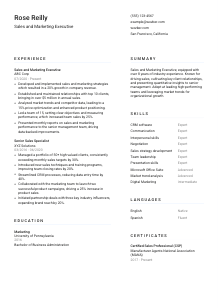
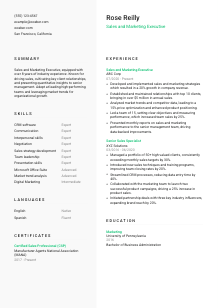
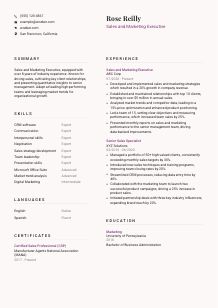
Closing deals, but your resume isn't sealing the offer? Check out this Sales and Marketing Executive resume example, created with Wozber free resume builder. Learn how to clearly map out your business brilliance to match job criteria, ensuring your career trajectory is as stellar as your sales figures!
Sales and marketing leadership gets judged quickly on business traction. Hiring teams want to see whether you have actually grown revenue, strengthened client accounts, sharpened positioning, and led teams that hit targets instead of simply supporting activity. Your resume needs to show commercial judgment, not just energy and communication skills.
When the resume mirrors the language of the role, it becomes much easier to connect your wins to the company's priorities, especially in ATS screening. Wozber's free resume builder helps you structure that alignment cleanly, so strategy work, client growth, reporting cadence, and CRM-backed execution stand out in an ATS-compliant resume.
For a Sales and Marketing Executive, the header should do one practical job well. It should confirm who you are, what role you do, and whether you meet any immediate screening requirements, such as location or contact availability, without adding clutter.
Use your full name in the largest text on the page so the resume opens with a clear professional identity. Keep the styling polished and simple. For a commercial leadership role, the goal is credibility, not branding slogans or decorative taglines.
Place "Sales and Marketing Executive" right under your name if that is the role you are applying for. This creates an immediate connection between your background and the opening, and it helps both recruiters and ATS tools categorize your profile correctly.
List a phone number you answer, a professional email address, and, if relevant, a current LinkedIn profile or business-facing website. Check every character. In senior commercial hiring, missed calls and bounced emails are avoidable mistakes that can stall an interview process before anyone reads your revenue numbers.
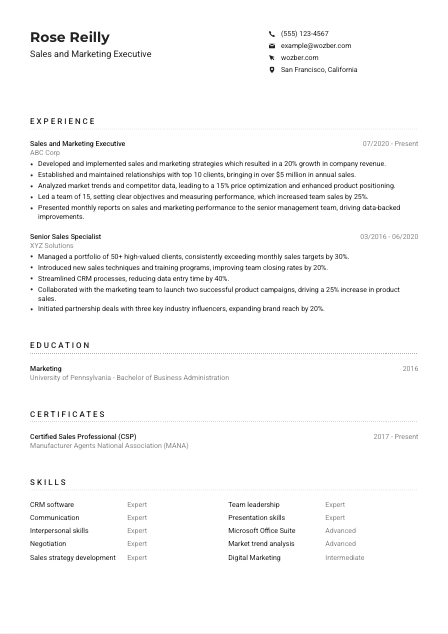
If the employer asks for candidates in a specific market, include your city and state. Here, San Francisco, California matters because it answers a stated requirement right away. For other openings, use location only when it helps clarify territory coverage, local client access, or relocation readiness.
A LinkedIn profile can help if it supports your resume with consistent titles, client-facing experience, campaign history, or leadership scope. Include a website only when it adds real value, such as a portfolio of product launches, speaking appearances, or thought leadership tied to market growth.
This section should remove friction. A hiring manager should be able to confirm your role alignment, contact details, and any location requirement in seconds, then move straight to your commercial track record.




This is the section that carries the most weight for a Sales and Marketing Executive. Employers look for proof that you can grow accounts, shape strategy, manage teams, and report performance in a way senior leadership can use. Generic duty lists will not carry that message.
Before writing or revising this section, isolate the themes in the job description. For this role, those include revenue growth, client relationship management, market and competitor analysis, team leadership, and regular reporting to senior management. Your bullets should reflect those same business levers using your own results and scope.
List jobs in reverse chronological order and make the strongest results easy to spot. A bullet such as "Developed and implemented sales and marketing strategies which resulted in a 20% growth in company revenue" works because it ties strategy directly to growth. That is far stronger than saying you were responsible for strategy execution.
Revenue generated, target attainment, client portfolio value, price optimization, closing rate improvement, campaign lift, retention, and team performance all belong here when they are accurate. The sample resume does this well with figures like $5 million in annual sales, 25% team sales growth, and a 15% pricing improvement. Those metrics make your commercial contribution concrete.
Focus on work that shows ownership, judgment, and measurable outcomes. For this kind of role, that usually means strategy development, account growth, partner relationships, market positioning, and team management. Routine administrative tasks or generic collaboration points should stay out unless they led to a result such as faster CRM workflows, better forecast visibility, or higher conversion.
Use the terms employers actually use, including phrases like "sales and marketing strategies," "key clients," "market trends," "competitor data," "pricing strategies," and "CRM software," where they truthfully describe your work. Natural wording matters. The best bullets read well to a VP of Sales and still perform well in ATS optimization.
Your experience section should show a pattern of commercial results, not isolated claims. By the end of it, a reader should understand how you grew business, led people, and turned market insight into sales performance.
Education matters here because the role asks for a bachelor's degree in Business, Marketing, or a related field. Once that requirement is covered, this section becomes a quick confirmation of your foundation rather than the main source of your value.
List your degree, school, field of study, and graduation year clearly. If your background is in Business, Marketing, or a closely related discipline, make that easy to see. A degree such as Bachelor of Business Administration in Marketing aligns neatly with the requirement in this example.
Hiring teams do not need a paragraph here. They need clean facts that confirm qualification level and timeline. Institution name, degree title, field, and year are usually enough unless you are early in your career or applying to a role that places unusual emphasis on academic pedigree.
Honors, relevant coursework, case competitions, or leadership in marketing and business organizations can help if they connect to sales planning, market analysis, brand strategy, or presentation work. For an experienced executive, include them selectively so they support the story instead of distracting from your revenue history.
If you have completed relevant executive training, sales methodology programs, or marketing certifications, those can complement your degree and show continued development. In this guide's example, the sales certification supports the commercial focus even though it appears in a separate section.
Do not crowd this section with unrelated coursework or outdated school details. Choose items that strengthen your case for strategic sales leadership, market knowledge, or business communication. That keeps the education section aligned with the level of the role.
Once your degree is clear and relevant, let the resume return to the sections that prove execution. For a Sales and Marketing Executive, education supports credibility, but results drive the decision.
Certifications are useful when they sharpen your commercial profile or show that you stay current with selling methods, market practices, or leadership development. They are supporting material, not the core of the resume, so choose them carefully.
Give space to credentials tied to sales performance, marketing strategy, account management, digital channels, analytics, or leadership. A certification such as Certified Sales Professional fits because it reinforces expertise in selling, client engagement, and commercial discipline.
Certification dates help employers understand whether the knowledge is current. If the credential is active or renewed, show that clearly. In the example, "2017 - Present" signals that the certification remains relevant rather than sitting as an old one-time course.
Sales and marketing changes fast. New CRM practices, channel strategies, buyer behavior data, and go-to-market approaches all affect performance. Relevant certifications show that you invest in staying effective, especially if your career spans both sales execution and broader market strategy.
A few relevant certifications are stronger than a long list of loosely related courses. Choose credentials that support your ability to drive growth, lead teams, improve positioning, or communicate with senior stakeholders. That makes the section feel executive, not crowded.
When chosen well, certifications add another layer of credibility to your resume. They should support the picture already built by your experience, especially around sales execution, market insight, and professional growth.
The skills section should read like a snapshot of how you operate, not a catch-all list. For a Sales and Marketing Executive, that means combining commercial tools, analytical ability, leadership strengths, and communication skills that directly affect growth and client outcomes.
Start with the capabilities the employer names directly. Here, that includes CRM software, communication, interpersonal skills, negotiation, and Microsoft Office Suite. Add closely related strengths from your background, such as sales strategy development, market analysis, forecasting, pipeline management, or team leadership, if you can support them elsewhere in the resume.
This role sits at the intersection of strategy and execution. A useful skills list shows both. Pair hard skills like CRM platforms, pricing analysis, reporting, and campaign coordination with soft skills such as negotiation, client relationship building, presentation, and coaching teams toward targets.
Order matters. The first few skills should match the opening most closely and reflect the work you want to do next. In the sample, leading with CRM software, communication, negotiation, sales strategy development, and team leadership makes sense because those capabilities map directly to the responsibilities in the role.
A recruiter should be able to scan this section and understand how you win business, manage relationships, and lead performance. If a skill does not support that picture, it probably does not belong near the top.
Language ability matters most when it affects communication with clients, partners, internal teams, or target markets. For a Sales and Marketing Executive, this section should confirm required fluency first and then highlight any additional language strengths that expand your reach.
If the role calls for strong English communication, list English first with an honest proficiency level such as Native or Fluent. That quickly answers a stated requirement and supports the presentation, negotiation, and reporting aspects of the role.
Additional languages can strengthen your profile when they relate to client communication, regional sales coverage, channel partnerships, or multicultural campaigns. Spanish, for example, can be valuable in many customer-facing environments, but include any language only when you can use it confidently.
Use clear labels such as Native, Fluent, Advanced, or Conversational, and avoid overstating your level. In a role that involves meetings, negotiation, and presentations, language claims are easy to test during interviews.
Multiple languages can suggest stronger relationship building, better cultural awareness, and smoother communication across markets or customer groups. That matters most when your target roles involve regional expansion, partner management, or diverse client portfolios.
Do not overbuild the language section if languages are not central to the role. Cover the required communication standard first, then include extra languages as an advantage rather than the centerpiece of your candidacy.
This section works best when it quietly strengthens the rest of the resume. It should confirm that you can communicate clearly where the job demands it and add reach where extra language ability helps business development.
The summary is your opening commercial case. In a few lines, it should tell the reader how much experience you bring, what kind of growth or leadership work you handle, and which results make you worth a closer look.
Start with your title or closest equivalent, followed by years of experience and the area you operate in. "Sales and Marketing Executive with 8+ years of experience" works because it sets level, discipline, and seniority immediately without wasting space.
Choose strengths that match the job's core demands. For this opening, useful themes include revenue growth, key client management, market analysis, pricing strategy, team leadership, and reporting to senior management. The sample summary handles this well by focusing on growth, client relationships, leadership, and quantitative reporting.
A summary should usually stay within three to five lines. That is enough room to establish your commercial profile without repeating the whole experience section. Every phrase should earn its place through relevance, scope, or measurable impact.
This is where you separate yourself from a general salesperson or a pure marketer. Blend both sides of the function by showing that you can drive strategy, lead revenue teams, and turn market insight into action. That positioning is important in executive hiring because adjacent profiles can look similar at first glance.
A strong summary makes the rest of the resume easier to read. It should quickly frame you as someone who can lead growth, manage client relationships, and report performance with the level of judgment expected from a Sales and Marketing Executive.
A Sales and Marketing Executive resume should make your commercial value easy to read. Show how you grew revenue, managed important accounts, guided teams, used market data, and communicated results to leadership in language that matches the role.
Use Wozber's AI resume builder to tighten that alignment, improve ATS optimization, and present your background in an ATS-friendly resume format that keeps the focus on measurable growth and leadership scope. That is what hiring teams need to see first.




