



Use Wozber and land your dream job
Create Resume
No registration required
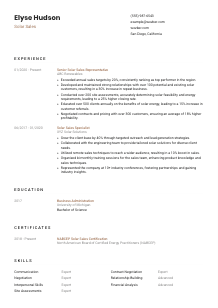
Basking in the sun, but your resume seems cloudy? Check out this Solar Sales resume example, created with Wozber free resume builder. Learn how to shine a light on your sales prowess, align it with job specifics, and power your career to new horizons!
Solar sales hiring moves quickly when a candidate can show two things at once: they can win trust with homeowners or commercial buyers, and they can turn technical and financial details into a confident purchase decision. A resume for this field needs to make that visible fast through customer development, site assessment work, payback analysis, contract negotiation, and quota performance.
When those details are tailored to the job ad, your background reads less like general sales experience and more like proven solar revenue work. Wozber's free resume builder helps shape that into an ATS-compliant resume by aligning your wording with terms the employer already uses, so hiring teams can quickly recognize experience with customer relationships, feasibility discussions, and profitable deal closing.
This section is brief, but in field-based sales roles it still carries practical weight. Hiring teams want to know who you are, how to reach you, and whether you match basic logistics such as location before they spend time reviewing pipeline results or customer-facing experience.
Place your full name at the top in a clean, readable format. Keep it slightly larger than the rest of the text so it anchors the page without looking styled for its own sake. In sales hiring, clarity matters. Your resume should feel as straightforward as a well-run customer consultation.
Add the title "Solar Sales" beneath your name, or use your more specific current title if it clearly aligns, such as "Senior Solar Sales Representative." This immediately frames your background around solar customer acquisition, solution selling, and contract closing instead of leaving you looking like a general sales candidate.
List a reliable phone number and a professional email address. Check them carefully. Sales roles depend on responsiveness, and a missed recruiter call or sloppy email handle can undercut the polished client-facing image the role requires.
If the employer wants someone based in a specific market, include your city and state. In the example opening, San Diego, California is a stated requirement, so that detail belongs here. If you are relocating, say so clearly rather than leaving the employer to guess about territory coverage or local availability for site visits.
Include LinkedIn or a professional website if it supports your candidacy. For solar sales, that might reinforce your background in renewable energy, community outreach, partnerships, or sales performance. Make sure the profile matches your resume titles, dates, and achievements so your credibility stays intact across every touchpoint.
Your personal details should answer the practical basics immediately: who you are, how to contact you, and whether you are positioned for the market the employer serves. Keep it clean and complete.




This is the section employers read most closely for a Solar Sales role. They are looking for revenue performance, customer relationship depth, site assessment exposure, financial selling ability, and proof that you can move buyers from interest to signed agreement.
Start by marking the responsibilities that define the role. Here, the employer is asking for customer relationship management, in-person and remote selling, site assessments, solar feasibility conversations, payback analysis, contract negotiation, and awareness of incentives and regulations. Your experience bullets should echo the parts you have actually done, using the same professional language where it fits naturally.
Present your most recent role first, then work backward. For each position, include job title, company, and dates. This layout helps hiring teams quickly track your progression from earlier sales work into stronger quota ownership, more complex solar consultations, or broader customer portfolios.
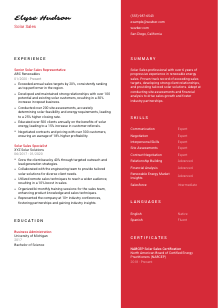
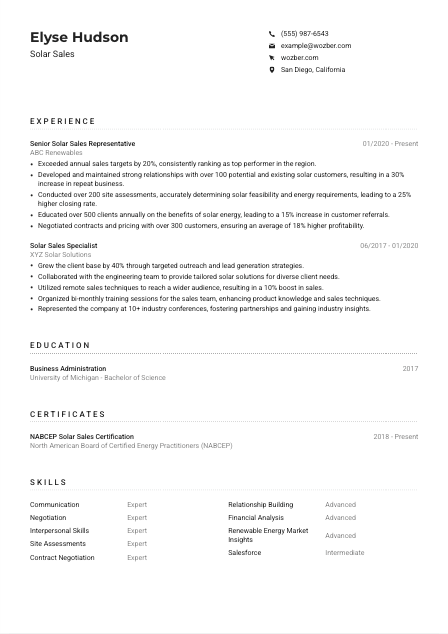
Each role should show what you sold, who you sold to, and what outcomes you produced. In solar sales, useful bullets often cover lead conversion, referral growth, repeat business, site visits completed, contracts negotiated, average deal profitability, or territory growth. The example resume does this well by tying relationship management to repeat business and site assessments to a higher close rate.
Numbers matter here because sales performance is measured. Include metrics such as quota attainment, percentage growth, number of customers managed, assessments completed, conversion rate, referral volume, or profitability improvement. "Exceeded annual sales targets by 20%" and "negotiated contracts with over 300 customers" are strong examples because they show both scale and business outcome.
Keep the focus on experience that helps an employer picture you handling consultations, explaining system value, addressing objections, and closing profitable solar deals. If you have broader sales history, prioritize the parts tied to energy, technical products, field sales, financial analysis, or account growth. Remove duties that do not strengthen that picture.
Your experience section should leave little doubt that you can build trust, assess customer needs, present the financial case for solar, and close business at target margins. That is the core story this role needs.
Education is rarely the deciding factor in sales hiring on its own, but it still matters when the employer asks for a degree. In solar sales, it can also reinforce that you understand business fundamentals, customer decision-making, and the analytical side of solution-based selling.
If the job requests a Bachelor's degree in Business, Marketing, or a related field, list that information plainly. The example resume uses a Bachelor of Science in Business Administration, which aligns well because it supports sales strategy, customer communication, and commercial analysis. If your degree is in another field, include it honestly and let your experience carry more weight elsewhere on the page.
Include degree, field of study, school name, and graduation year or date. Keep this section easy to scan. Hiring teams should be able to confirm the credential in seconds and move back to the sales metrics and industry experience that usually matter more for this kind of role.
If you are earlier in your career or your degree closely supports the role, include coursework, academic projects, or concentrations tied to marketing, finance, energy markets, or business development. This is especially useful when you need to show comfort with payback analysis, ROI conversations, or customer-facing presentations.
Honors, scholarships, leadership roles, or case competition work can add value if they reinforce communication, business judgment, or commercial drive. Keep them only if they strengthen your story as a candidate who can handle consultative selling and relationship-based growth.
If you have completed recent coursework in solar design basics, energy policy, financing, or advanced sales methods, include it when it adds current industry relevance. Ongoing learning is especially useful in a market shaped by changing incentives, regulations, and customer economics.
Education should support your commercial credibility and industry understanding, not distract from your sales record. Keep it concise, relevant, and easy to verify.
Certifications carry more weight in solar than in many other sales fields because they show industry commitment and a working grasp of how systems, savings, and customer recommendations come together. Used well, this section can separate you from candidates whose background is only general sales.
Put the most relevant credential first. For this opening, NABCEP Solar Sales Certification is explicitly mentioned as a plus, so it deserves clear placement. A certification like that tells employers you have invested in the technical and ethical side of advising customers on solar solutions.
Only include certificates that strengthen your candidacy for the role. Good choices might relate to solar sales, renewable energy, energy efficiency, finance, or CRM platforms used in a sales environment. A short list of directly relevant credentials is stronger than a long list of unrelated courses.
Show the issue date and, if applicable, the active period or expiration date. This is helpful for credentials that require maintenance or ongoing standing. In a regulated and incentive-driven market like solar, recent and active certifications can carry more weight than outdated ones.
Solar sales changes with financing models, utility rules, installation economics, and policy updates. Certifications and continuing education help show that your recommendations are based on current market conditions, not old talking points. That matters when customers are asking about savings timelines and program changes.
Relevant certifications tell employers that you bring more than sales instinct. You also understand the industry context behind the recommendation, the proposal, and the contract.
The skills section works best when it reflects the actual sales cycle you handle. For solar sales, that usually means prospect conversations, site evaluation, financial explanation, objection handling, CRM discipline, and negotiation that protects both close rates and margin.
Review the job ad closely and note both direct requirements and implied ones. In this case, communication, negotiation, interpersonal skills, site assessments, financial payback analysis, and relationship management stand out immediately. Those are the abilities your resume should surface because they map directly to day-to-day work.
List the strongest matches first, especially those supported by your achievement bullets. If you mention contract negotiation, your experience section should show negotiated pricing or terms. If you list site assessments, your background should show feasibility reviews, energy requirement analysis, or proposal development. The sample resume connects those pieces well.
Choose skills that help an employer picture you running a solar sales process from first contact through signed agreement. A mix like communication, negotiation, relationship building, site assessments, financial analysis, renewable energy market knowledge, and CRM use is more persuasive than a long generic list. If you know tools such as Salesforce, include them when they support pipeline management and follow-up discipline.
Your skills list should read like the toolkit of someone who can educate buyers, manage a pipeline, and close solar business with sound commercial judgment.
Language ability matters in sales because it shapes trust, clarity, and follow-through. In solar sales, that can affect consultations, financing discussions, and community outreach, especially in markets where buyers may be more comfortable discussing energy costs and contract terms in more than one language.
If the job requires English proficiency, list English clearly with an honest proficiency level. That requirement is stated directly in this opening, so it should not be buried. Clear communication matters when you are explaining savings assumptions, installation expectations, and contract terms.
Include additional languages that can help you build rapport with a broader customer base. In some solar markets, bilingual communication can support outreach, referrals, and smoother consultations. The example resume includes Spanish, which can be a practical advantage in many communities, though it is not a universal requirement.
Choose clear terms such as Native, Fluent, Intermediate, or Basic. Avoid overstating your ability. In customer-facing roles, hiring teams need to know whether you can actually conduct consultations, answer objections, and explain proposals in that language.
If you are applying to roles that involve diverse neighborhoods, regional outreach, or broader inside sales coverage, language skills can become a real differentiator. Mention them when they expand your ability to connect with prospects and support the sales process.
Additional language fluency can support future territory growth and stronger relationship building. If you are actively improving a language that is useful in your market, that can be worth developing into a stronger sales asset over time.
List languages when they improve your ability to communicate with customers and move deals forward. In a relationship-driven sales role, that is practical value, not filler.
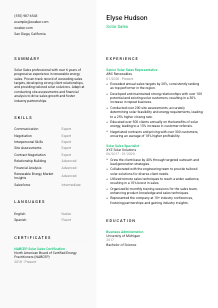
The summary sits at the top of the page, so it needs to establish your commercial profile quickly. For solar sales, that usually means years of experience, industry relevance, quota performance, customer-facing strengths, and any technical or financial fluency that helps you sell consultatively.
Start with a direct description of who you are professionally. For example, "Solar Sales professional with 6+ years in renewable energy sales" immediately places you in the right market and seniority range. Keep the opening grounded in the work you actually do.
Use the next sentence or two to highlight the parts of your background that match the role best. For this kind of job, that often includes exceeding sales targets, building a book of customers, conducting site assessments, presenting payback analysis, or negotiating profitable agreements. The example summary does this by combining sales performance, client relationships, and tailored solar solutions.
Aim for 3 to 5 lines. This section should not repeat your entire work history. It should give a hiring manager a fast read on whether you belong in the interview stack for a role that blends consultative selling, customer education, and revenue delivery.
Adjust the summary for each application so the priorities match the employer's version of solar sales. If the opening emphasizes remote selling, incentives knowledge, or financial analysis, bring those elements forward when they reflect your real background. This is also where Wozber's AI resume builder can help refine phrasing around the job's terminology while keeping the summary natural and relevant.
By the time someone finishes your summary, they should already understand your sales track record, your solar relevance, and the kind of customer conversations and commercial outcomes you can handle.
A Solar Sales resume works when it connects your sales record to the realities of the role: prospecting, customer education, site-based selling, financial payback discussions, contract negotiation, and consistent target attainment.
Use Wozber to turn that experience into an ATS-friendly resume format with sharper role alignment, stronger ATS optimization, and language that matches the employer's priorities without sounding forced.
When the resume is tailored well, hiring teams can quickly see whether you can build trust, explain value clearly, and close profitable solar business.




