



Use Wozber and land your dream job
Create Resume
No registration required
Working through sales strategies, but your resume seems off-pitch? Harmonize it with this Sales Operations Analyst resume example, created with Wozber free resume builder. Learn how to stay in sync with job criteria, ensuring your career hits all the high notes!
Sales operations teams sit where revenue targets, process discipline, and reporting accuracy meet. A Sales Operations Analyst resume needs to show more than comfort with spreadsheets. It should make clear that you can turn pipeline data, forecast trends, and CRM hygiene into decisions the sales team can actually use.
When that story is tailored well, hiring teams can quickly separate candidates who simply report numbers from those who improve forecast quality, dashboard adoption, and sales process performance. Wozber's free resume builder helps shape an ATS-compliant resume around the language of the role, so your experience with tools, reporting, and cross-functional support comes through clearly from the first scan.
For a Sales Operations Analyst, small details matter because the work itself depends on clean data, consistent systems, and accurate reporting. Your header should reflect that same discipline with straightforward, complete information and no distractions.
Use your full name in the largest text on the page so it anchors the resume immediately. Keep it simple and professional. This section does not need flair. It needs the same clarity you would expect in a sales dashboard title or executive report header.
Place "Sales Operations Analyst" under your name when that is the role you are targeting. Matching the title helps frame the rest of the resume around sales reporting, CRM administration, forecasting, and process improvement rather than broader analyst work that may be less relevant.
Include a phone number and a professional email address that uses your real name. Accuracy matters here. If a hiring team sees careless formatting in the contact section, it can raise questions about the care you bring to data entry, reporting, and system maintenance.
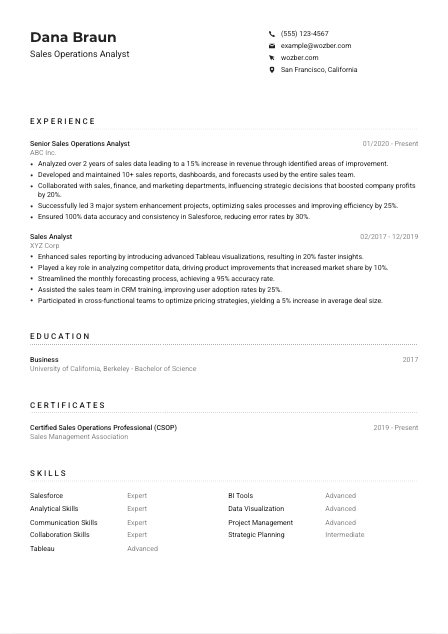
If a job specifies a location requirement, include your city and state in this section. In the example posting, San Francisco, CA is listed as a requirement, so showing "San Francisco, California" removes an avoidable question early in the review process.
Add your LinkedIn profile or professional website if it supports your application. For this profession, that usually means a polished LinkedIn page with clear role progression, reporting tools, CRM platforms, and measurable business results. Skip links that do not strengthen your sales operations profile.
Your contact section should read like a clean system record: accurate, relevant, and easy to trust. That first impression supports the kind of detail-heavy work sales operations depends on.




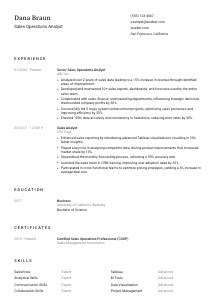
This is the section most likely to decide whether you move forward. Sales Operations Analyst experience should show how you improved reporting, supported forecasting, cleaned up CRM data, or helped sales leadership make better decisions from the numbers in front of them.
Start by identifying the work the employer cares about most. For this role, that includes analyzing sales data, building reports and dashboards, maintaining forecasts, supporting cross-functional decisions, leading system enhancements, and protecting data accuracy. Those themes should shape which bullets you keep and which you cut.
Use reverse chronological order and make each entry easy to scan with title, company, and dates. Sales operations hiring teams often want to see progression from reporting support into ownership of dashboards, forecasting, process design, or CRM improvement. A clean timeline helps them spot that growth quickly.
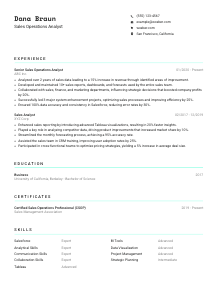
Each bullet should show what changed because of your work. Instead of saying you "responsible for sales reporting," show what you built, improved, or influenced. The example resume does this well with lines about developing more than 10 reports and dashboards, leading system enhancement projects, and collaborating with finance and marketing to support strategic decisions.
Use numbers that fit the work: forecast accuracy, reporting speed, revenue lift, process efficiency, adoption rates, error reduction, dashboard usage, or deal-size improvement. In the sample, metrics such as 15% revenue growth, 95% forecast accuracy, 25% efficiency gains, and 30% fewer Salesforce errors make the impact easy to understand.
Prioritize accomplishments connected to pipeline analysis, BI reporting, CRM administration, process optimization, compensation support, forecasting, or cross-functional planning. If a bullet does not help prove your value in a revenue operations environment, replace it with one that does.
Your experience section should show that you can work inside the sales engine, improve its reporting and systems, and turn data into practical recommendations. That is the difference between analyst experience and sales operations experience.
Education matters here because sales operations sits close to finance, analytics, and business planning. The degree itself is usually straightforward, but the way you present it should make the business and analytical foundation easy to recognize.
Check the posting for the degree baseline and mirror it clearly. Here, the employer asks for a bachelor's degree in Business, Finance, Analytics, or a related field. If your background aligns directly, make that easy to see without forcing the reader to interpret it.
List your degree, field of study, school, and graduation year. That is usually enough for an experienced Sales Operations Analyst. Clean formatting works best because this section is meant to confirm your academic background quickly, not compete with your reporting and process achievements.
If your degree is closely related to the role, let that relevance do its job. A Bachelor of Science in Business, like the one in the example resume, aligns naturally with sales planning, performance analysis, and cross-functional commercial work.
Include relevant coursework, capstones, or academic projects if they strengthen your case, especially if you are earlier in your career. Good examples include sales forecasting models, business analytics projects, data visualization work, or CRM-related research.
Honors, leadership roles, or extracurriculars are most useful when they reinforce analytical or commercial strengths. For newer candidates, a business case competition, analytics club leadership, or a thesis on market performance can add useful context. For experienced candidates, keep this section lean.
Your education section should confirm that you have the business or analytical base to work with revenue data, reporting tools, and operational processes. Keep it crisp and relevant.
Certifications are not always required for sales operations roles, but the right ones can strengthen your profile, especially when they reinforce systems knowledge, analytics, or process improvement. They work best when they support the experience already on the page.
List certifications that connect to sales operations, analytics, CRM platforms, BI tools, or project delivery. A credential such as Certified Sales Operations Professional immediately supports your positioning because it points to specialized understanding of sales process and operations work.
When deciding what to include, favor certifications tied to Salesforce, Tableau, reporting, business analysis, process improvement, or project management over generic professional development courses. Hiring teams care more about applied operational value than broad attendance-based learning.
Show when the certification was earned, and if it remains active, make that visible. Dates help employers understand whether your training reflects current tool versions, reporting practices, or platform knowledge.
Sales operations changes with the systems that support it. As CRM workflows, dashboard expectations, and forecasting tools evolve, recent certifications can reinforce that your methods are current and that you stay engaged with the operational side of revenue work.
Certifications should sharpen your profile, not pad it. Include the ones that strengthen your credibility in CRM management, reporting, analytics, and sales process improvement.
A Sales Operations Analyst skills section should reflect the actual mechanics of the job. That usually means a mix of systems, analysis, reporting, and cross-functional communication rather than a long list of generic strengths.
Start with the language used in the job description. Here, the employer names CRM and BI tools such as Salesforce and Tableau, along with analytical ability, data visualization, communication, and collaboration. Those terms belong in your skills section if they reflect your real experience.
Lead with the tools and capabilities most central to the work. In this profession, that often means Salesforce, Tableau or other BI platforms, forecasting, reporting, data analysis, dashboard development, process improvement, and stakeholder communication. This ordering helps both ATS parsing and human review.
Do not overload this section with every platform you have ever touched. A tighter list makes your strengths easier to understand. The example resume balances technical tools like Salesforce and Tableau with role-critical capabilities such as data visualization, collaboration, and project management, which is a practical model to follow.
Your skills section should show that you can manage the systems, analysis, and communication rhythm of sales operations. Relevance matters more than volume.
Language skills are usually a supporting detail for this profession, but they can still matter. Sales operations often works across sales reps, finance partners, marketing stakeholders, and leadership teams, so clear communication is part of the job even when the role is heavily data-driven.
Read the posting carefully for explicit language expectations. In this case, effective English communication is required, so English should be listed clearly with an honest proficiency level.
List required or most useful languages first, followed by additional languages that may support internal collaboration or regional sales coverage. This makes the section easy to read and keeps the most relevant information visible.
If you speak another language, include it when it could support cross-functional work, communication with regional teams, or broader market exposure. Spanish, as shown in the example, can be a useful addition in many commercial environments, even when it is not a formal requirement.
Use realistic levels such as Native, Fluent, Advanced, or Conversational. Sales operations often involves presenting findings, explaining dashboards, and discussing forecast assumptions, so overstating language ability can become obvious quickly.
Languages should support your application, not take over space needed for reporting, systems, and analytical achievements. Include them, but let the main weight of the resume stay on operational and analytical work.
This section should reinforce your ability to communicate clearly in the environments where sales operations work happens. Keep it accurate and in scale with the rest of the resume.
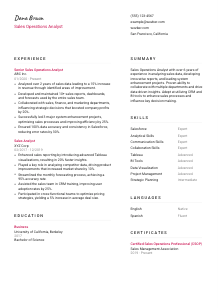
The summary is where you establish your version of sales operations in a few lines. It should tell the reader how long you have worked in the field, what kinds of operational problems you solve, and which tools or outcomes define your value.
Use the posting to identify the themes that belong in your opening lines. Here, that means sales data analysis, reporting and dashboards, forecasting, collaboration with sales and finance, system enhancements, and data quality. Your summary should reflect the mix that best matches your own background.
Open with your professional identity and years of relevant experience. A line like "Sales Operations Analyst with 6+ years of experience" immediately gives the reader the level and function they need before moving into specifics.
Follow with two or three strengths tied to outcomes or operational scope. The sample summary works because it combines data analysis, reporting, system enhancement projects, and cross-functional collaboration rather than relying on vague language. If you can mention a business result such as forecast accuracy, revenue improvement, or process efficiency, even better.
Aim for a concise paragraph, usually three to five lines. Every phrase should support the case that you can improve sales reporting, maintain reliable systems, and help commercial teams make better decisions. Cut broad claims that could belong to any analyst role.
A focused summary helps the reader understand your sales operations profile before they reach the detail below. By the time they enter your experience section, they should already know your level, your strengths, and the kind of operational value you bring.
A Sales Operations Analyst resume should make three things easy to see: your command of sales data, your comfort with CRM and BI systems, and your ability to improve how revenue teams operate. When those points are supported by clear metrics, relevant tools, and cross-functional examples, the resume reads like someone who can contribute quickly.
Use Wozber's free resume builder to organize that story in an ATS-friendly resume format, refine wording with role-specific language, and check alignment with an ATS resume scanner before you apply. The finished resume should make it easy to judge your impact on reporting, forecasting, data quality, and sales process performance.




