



Use Wozber and land your dream job
Create Resume
No registration required
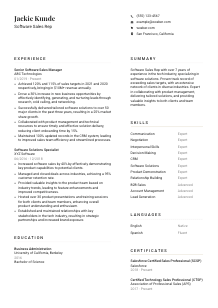
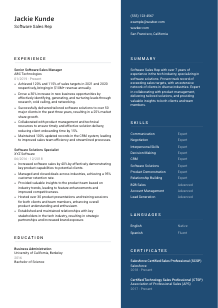
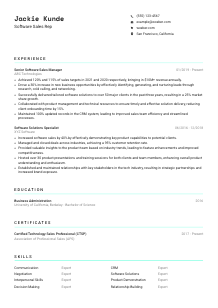
Pitching software, but your resume isn't making sales? Check out this Software Sales Rep resume example, created with Wozber free resume builder. It shows how to position your sales prowess in sync with software specs, helping your career hit the high revenue marks!
Software sales resumes are read through a revenue lens. Hiring teams want to see whether you can open doors, run a disciplined sales cycle, understand the product well enough to demo it credibly, and turn conversations into closed business. If that story gets buried under generic sales language, even solid candidates start to look interchangeable.
The first screen often comes down to whether your resume clearly connects quota performance, lead generation, CRM discipline, and product-facing work. Wozber's free resume builder helps you shape that story in an ATS-friendly resume format, so the language matches what software sales roles actually ask for and the hiring team can quickly see your ability to sell complex solutions.
This section is brief, but it still carries practical weight in software sales hiring. A clear title, reliable contact details, and the right location signal can remove friction before anyone reaches your pipeline numbers or win history. Keep it clean and aligned with the role you are targeting.
Use your full name in the largest text on the page and keep the styling simple. Software sales is a client-facing job, so your resume should already read like polished business communication. You do not need design flourishes here, just a presentation that looks credible and easy to scan.
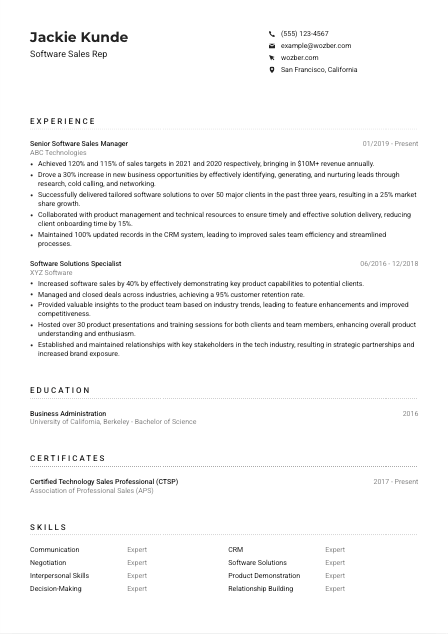
Place "Software Sales Rep" directly under your name if that is the role you are pursuing. This immediately frames your background around software sales rather than broader account management, customer success, or general business development work. If your recent title was different, such as "Senior Software Sales Manager" or "Software Solutions Specialist," your headline can still reflect the target role while your experience section shows the progression.
List one phone number you answer, a professional email address, and, if relevant, a website or LinkedIn profile that supports your commercial background. Double-check every character. In a role built on follow-up, prospecting, and responsiveness, sloppy contact details send the wrong message fast.
If the employer wants someone in a specific market, include your city and state. For this example, "San Francisco, California" directly addresses the stated requirement and removes uncertainty about relocation or territory coverage. When location is not a factor in another posting, keep it simple and avoid adding extra personal detail.
A polished LinkedIn profile can reinforce your sales narrative with recommendations, deal scope, industry focus, and career progression. Make sure it matches the resume on job titles, dates, and achievements. Consistency matters, especially when recruiters compare your profile with CRM-heavy, quota-carrying experience on the page.
This section should answer the basic contact and availability questions without distracting from your commercial track record. Once it is accurate and aligned, the reader can move straight to the part that matters most for software sales hiring: your ability to generate revenue and manage the sales process.




For a Software Sales Rep, the experience section carries most of the decision-making weight. It needs to show more than activity. Hiring teams look for quota attainment, pipeline creation, product credibility, deal ownership, and coordination with product or technical teams when a solution needs tailoring.
Before rewriting bullets, mark the recurring demands in the posting. Here, the employer emphasizes lead generation, prospect qualification, product demonstration, full-cycle sales management, CRM accuracy, and collaboration across product and technical teams. Those are the themes your experience bullets should reflect, using the same commercial language when it truthfully matches your background.
Start with your most recent position and work backward. For each role, include title, company, and dates in a format that is easy to scan. In software sales, progression matters. Moving from a specialist role into a senior or broader revenue role helps show increased ownership of accounts, larger deal sizes, or deeper involvement in solution selling.
Replace generic responsibilities with accomplishment-focused bullets tied to actual sales work. Instead of saying you handled prospecting, show how many qualified opportunities you created, what channels you used, or how your outreach changed pipeline volume. The sample resume does this well with a bullet about driving a 30% increase in new business opportunities through research, cold calling, and networking.
Software sales performance is measured. Use numbers that reflect how the work is evaluated: quota attainment, annual revenue, conversion improvements, retention, onboarding speed, market share growth, or number of enterprise clients supported. Bullets like "Achieved 120% of sales target" or "brought in $10M+ annually" give a hiring manager a much sharper read than broad claims about exceeding expectations.
Prioritize experience that supports solution selling, B2B relationship management, product presentations, negotiations, and cross-functional execution. If a past role does not connect clearly to software sales, either trim it down or focus only on transferable commercial work such as prospecting, account growth, or closing. Every bullet should help explain why you can sell a software product, not just why you have worked before.
After this section, the hiring team should understand your sales scope, the kind of software environment you have worked in, and the results you delivered. If they can quickly spot quota success, deal ownership, and product-facing credibility, your experience section is doing its job.
Education will rarely outweigh sales results for an experienced Software Sales Rep, but it still matters because many employers use it as an initial qualification check. Present it clearly, especially when the posting names preferred fields such as business or computer science.
When a posting asks for a bachelor's degree in Business, Computer Science, or a related field, make sure your education entry is impossible to miss. If your degree matches closely, that is worth stating plainly. In the example, a Bachelor of Science in Business Administration lines up cleanly with the employer's preferred background.
List the degree, field of study, school, and graduation year. That is enough for most software sales resumes. Hiring teams are usually checking that the requirement is met, not looking for long academic descriptions, so clarity beats detail here.
Your degree can subtly reinforce how you sell. Business-related studies suggest commercial grounding in markets, negotiation, or management. Technical coursework can support your ability to understand product architecture, features, and implementation conversations. If your background bridges both sides, that can be particularly useful in software sales environments with consultative demos.
Early-career candidates can include coursework if it strengthens their case. Classes in sales management, business communications, information systems, or software fundamentals can help explain your readiness for solution-based selling. If you already have several years of quota-carrying experience, coursework usually adds less value than sales metrics.
Honors, student leadership, or projects are worth adding only when they support the story you are telling. For newer candidates, a business competition, startup club, or capstone project with a product or market focus can show initiative. For seasoned reps, keep the section lean unless the achievement is especially relevant.
This section should confirm that you meet the academic bar without taking attention away from sales performance. If the degree is relevant and easy to find, it supports the rest of your resume without competing with it.
Certifications are often a secondary factor in software sales hiring, but they can still sharpen your profile. They work best when they reinforce product knowledge, sales process discipline, or fluency with widely used platforms such as CRM systems.
If the employer mentions certifications such as CTSP or SCSP, move those to the top of this section. Even when listed as a plus rather than a requirement, they show extra commitment to the field and reduce doubt about your familiarity with technology sales standards.
Be selective. A short list of relevant credentials is stronger than a long catalog of unrelated courses. For a Software Sales Rep, focus on certifications tied to technology sales, CRM platforms, solution consulting, or product-led selling rather than broad learning badges that do not strengthen your commercial profile.
Add the issuing organization and the date earned or active period. This helps the reader understand whether the certification is current and credible. In fast-moving software markets, recency matters because product categories, sales tools, and buyer expectations change quickly.
Review this section before every application. Expired or outdated certifications can weaken the impression if they dominate the list. Fresh credentials in sales methodology, SaaS platforms, or CRM usage can support your case, especially if the role involves demos, pipeline reporting, or enterprise sales processes.
Relevant certifications can strengthen a software sales resume, especially when they align with the employer's language and your real day-to-day work. They should add confidence in your sales approach and product fluency, not distract from your revenue results.
The skills section should read like a quick map of how you operate in software sales. Employers are looking for a mix of customer-facing ability, commercial discipline, and enough technical understanding to explain product value convincingly.
Start with the capabilities emphasized in the posting. In this case, communication, negotiation, interpersonal strength, product knowledge, CRM use, and software solution selling all deserve space if you genuinely have them. Mirroring the language helps with ATS optimization and makes your relevance easier to spot in a fast scan.
A Software Sales Rep needs both relationship skills and product fluency. Pair sales abilities such as lead generation, account management, objection handling, and closing with role-specific strengths like product demonstration, CRM management, solution positioning, or working alongside technical resources. The example resume handles this well by combining negotiation and communication with software solutions and product demonstration.
List the skills most central to the role and most visible in your experience section. If you claim expertise in B2B sales, CRM, or relationship building, your bullet points should show deals closed, records maintained, or accounts expanded. Keep the list focused so the skills section sharpens your profile instead of reading like a generic sales inventory.
A strong skills list should quickly confirm that you can prospect, demo, negotiate, and manage the sales process in a software environment. If each item connects back to real results elsewhere on the resume, this section becomes a useful summary instead of a list of claims.
Language ability matters in sales because it affects meetings, demos, negotiations, and written follow-up. For most Software Sales Rep roles, English proficiency is the baseline. Additional languages can help when the territory, client base, or internal team is international or multilingual.
If the job asks for strong English, list English clearly with an honest proficiency level. This is especially important in software sales, where communication includes discovery calls, product demonstrations, proposal discussions, and contract-stage conversations. Do not make the reader guess on a requirement that is directly stated.
Extra languages can be valuable when selling across regions, working with diverse buyer groups, or supporting international accounts. They are not a substitute for sales performance, but they can broaden your usefulness. In the example, Spanish adds a practical layer for relationship building in a varied market.
Use clear levels such as Native, Fluent, Advanced, or Conversational, and be realistic. In client-facing roles, overstating language ability creates risk quickly, especially if interviews move into live discussion or presentation scenarios.
If a language has helped you manage regional accounts, support multilingual demos, or work with distributed teams, that value can also appear in your experience section. On its own, a language entry is useful. Connected to market coverage or customer communication, it becomes more persuasive.
Only include languages you would be comfortable using in a professional setting. The purpose here is not to appear worldly. It is to show communication range that could matter in prospecting, account development, or client retention.
For software sales hiring, language skills matter when they support communication with buyers, partners, or internal teams. Keep the section accurate and practical, and it can add one more layer of client-facing value to your profile.
The summary is the top-of-page sales pitch for your own candidacy. For a Software Sales Rep, it should quickly establish your tenure, your market or product background, and the results you are known for without repeating the entire resume.
Before drafting, identify the few things the employer most needs to know first. In this posting, that includes software sales experience, target achievement, product understanding, and the ability to manage a full sales cycle. Build the summary around those points instead of writing a broad personal statement.
Lead with a direct description of who you are professionally. A line such as "Software Sales Rep with 7+ years of experience selling software solutions" works because it immediately sets your lane. It tells the reader your function, your level, and your relevance within a few words.
Use the next lines to mention the business outcomes and capabilities that matter most. Quota overachievement, revenue impact, lead generation success, product demos, or collaboration with product and technical teams all belong here when they reflect your history. The sample summary succeeds because it combines experience length, target performance, solution specialization, and cross-functional work in a compact form.
Aim for 3 to 5 lines with dense, specific information. Avoid adjectives that do not add proof. A software sales summary should sound commercial and grounded, the same way you would introduce your value to a prospective client in the first minute of a call.
A sharp summary tells the reader, early and clearly, what kind of software sales professional you are and what level of performance you bring. Once that frame is in place, the rest of the resume can back it up with metrics, deals, and progression.
A Software Sales Rep resume works when it makes your commercial value easy to understand: how you build pipeline, how you qualify and guide buyers, how well you know the product, and what results you have delivered. When each section supports that story, the document starts reading like a credible revenue profile instead of a list of past jobs.
Use Wozber to shape that story into an ATS-compliant resume with job-aligned language, clean structure, and stronger targeting for each application. The final read should make one thing clear fast: you can sell software, manage the sales cycle, and contribute revenue from day one.




