



Use Wozber and land your dream job
Create Resume
No registration required
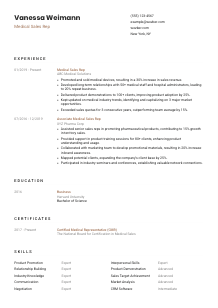
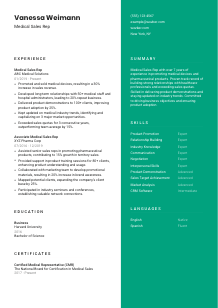
Pitching medical marvels, but your resume lacks the right prescription? Check out this Medical Sales Rep resume example, created with Wozber free resume builder. It shows how to highlight your sales acumen and product knowledge to meet job criteria, leading your career to healthier prospects and robust growth!
Medical sales resumes are read through a commercial lens and a clinical one. Hiring teams want to see that you can win business with physicians, hospital staff, and purchasing stakeholders while speaking comfortably about products, indications, and use cases. If your resume only lists sales activity without showing product knowledge, account growth, or training support, it can miss what makes this field different from general B2B selling.
A tailored resume helps separate broad sales experience from medical sales experience. When your wording reflects the employer's terminology around product promotion, healthcare relationships, demonstrations, and quota attainment, Wozber's free resume builder helps you shape that into an ATS-compliant resume that is easier to rank and easier for a hiring team to read as relevant territory-ready experience.
In medical sales, the header should make it easy to contact you and immediately place you in the right lane. Keep it clean, professional, and aligned with the role so the hiring team can focus on your territory fit and sales background without distractions.
Use your full name in a clear, readable format at the top of the page. In a field built on trust and professional presence, your resume should open with the same level of polish you would bring to a physician meeting or hospital account review.
Use the job title "Medical Sales Rep" directly under your name when that matches the role you are pursuing. This instantly positions your background in the right category and helps ATS systems connect your resume to openings focused on medical devices, pharma, or healthcare product sales.
Include a reliable phone number and a professional email address. If the posting names a location requirement, address that here. In the example, listing New York, NY supports the employer's request for candidates based there or willing to relocate, which is useful when territory coverage matters.
A current LinkedIn profile can reinforce your experience with account management, product lines, certifications, and industry network. If you include it, make sure the roles, dates, and achievements match your resume so there is no confusion around quota history or territory progression.
Do not include age, marital status, photo, or other unrelated personal details. Medical sales hiring should stay focused on customer-facing credibility, industry knowledge, certifications, and track record, not information that has no bearing on performance.
Keep this section straightforward and businesslike. When your header is accurate, role-aligned, and location-aware where needed, the rest of your resume can do the real selling.




This is the section that carries the most weight for a Medical Sales Rep. Employers want to see sales performance, account development, product education, and comfort working with healthcare professionals. Your bullets should show what you sold, who you sold to, how you supported adoption, and what commercial result followed.
Read the posting closely and build your experience section around its main priorities. For medical sales, that usually means product promotion, relationship management with healthcare stakeholders, product demonstrations, competitive awareness, and quota performance. Use that language naturally when it reflects your actual work so your background reads as directly relevant.
List your most recent role first and work backward. This format helps hiring teams quickly understand your current market exposure, product complexity, and sales maturity. If you moved from an associate role into full territory responsibility, make that progression obvious.
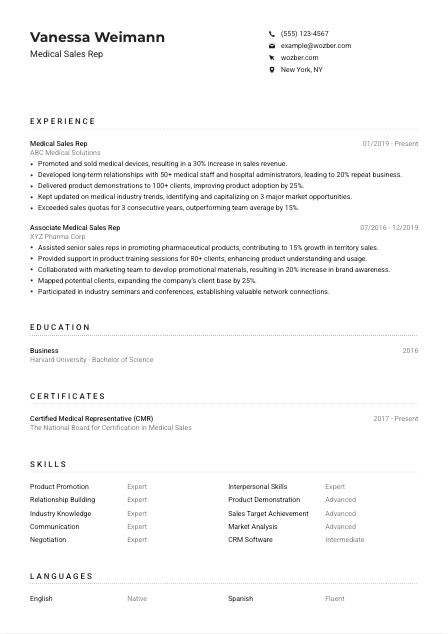
Write bullets that connect your actions to business results. The example does this well with lines such as increasing sales revenue by 30 percent, improving product adoption through demonstrations, and building relationships with more than 50 medical staff and administrators. That gives the reader a clear picture of account growth, training support, and stakeholder reach.
Quantify revenue growth, quota attainment, repeat business, client volume, territory expansion, training sessions, or adoption rates wherever you can. "Exceeded sales quotas for 3 consecutive years" tells a hiring manager far more than "responsible for sales targets" because it speaks the language of performance reviews in this field.
Prioritize experience that shows healthcare-facing sales work over generic sales duties. Market analysis, product launches, provider education, formulary discussions, hospital relationships, and CRM-based account management all carry more weight here than broad statements about customer service. Trim anything that does not support your case for selling medical products in a regulated, relationship-driven environment.
Your experience section should read like a record of territory growth, customer trust, and product adoption. When each bullet shows both commercial impact and healthcare relevance, the fit becomes much easier to see.
Education matters in medical sales because employers often want proof that you can absorb clinical information, understand regulated products, and communicate with healthcare professionals without losing accuracy. Keep this section concise, but make the degree match easy to find.
If the role asks for a bachelor's degree in Business, Life Sciences, or a related field, list that information plainly. A degree in Business, as shown in the example, supports the commercial side of the role. A Life Sciences background can support technical fluency with products, disease states, or treatment context.
List degree, field of study, school, and graduation year or date range. Clean formatting matters because recruiters often scan education quickly to confirm eligibility before moving back to quota history and industry experience.
Write the full degree name instead of shortening it too much. "Bachelor of Science in Business" is clearer than a vague label and makes it easier for both ATS parsing and human readers to confirm you meet the stated requirement.
If you are early in your career, coursework in biology, pharmacology, healthcare marketing, anatomy, or sales strategy can help connect your education to medical sales work. If you already have several years of direct industry experience, keep coursework brief and let your results lead.
Honors, research, case competitions, or leadership roles are worth mentioning when they strengthen your story. For example, a healthcare-focused project or business competition can reinforce presentation skills, market analysis, or industry interest. Skip extras that do not support your move into medical sales.
Education does not need to be lengthy, but it should quickly confirm that you meet the baseline requirement and can handle the mix of sales and product learning the role demands.
Certifications carry real weight in medical sales because they show ongoing commitment to the industry and familiarity with product, compliance, and healthcare-facing selling standards. If a posting mentions a preferred or required credential, this section deserves careful attention.
Put medical sales credentials first, especially when the employer mentions them directly. A certification such as Certified Medical Representative is worth highlighting because it reinforces industry-specific training rather than broad professional development.
Choose certificates tied to medical devices, pharmaceuticals, healthcare compliance, clinical product knowledge, or consultative sales. A shorter list of relevant credentials is more persuasive than a long list of unrelated courses.
Add the issue date and, if applicable, the active period or expiration date. In the example, showing "2017 - Present" helps communicate that the certification is current, which matters in an industry shaped by ongoing regulation, product updates, and training requirements.
Medical sales changes with new products, treatment approaches, and compliance expectations. Updating your certifications over time shows that your knowledge has not gone stale and that you are serious about staying credible with clinicians and procurement stakeholders.
Use certifications to reinforce that you are already operating in the language and standards of medical sales. The right credential can strengthen both ATS matching and recruiter confidence.
A Medical Sales Rep needs a mix of sales execution, clinical fluency, and relationship management. Your skills section should reflect how the job is actually done, from product presentations and negotiation to medical terminology and account development.
Review the posting for explicit and implied skill requirements. In this field, that often includes communication, negotiation, product demonstrations, relationship building, medical industry knowledge, and sales target achievement. Mirror those terms when they truthfully match your experience so your resume aligns with both ATS filters and hiring expectations.
Lead with capabilities that matter in daily medical sales work, such as product promotion, provider education, territory growth, CRM usage, market analysis, and stakeholder management. The example's mix of relationship building, product demonstration, and industry knowledge works because it reflects actual selling activity, not generic workplace traits.
Do not overload this section with every skill you have used. Choose the ones most relevant to the target role and support them elsewhere in the resume through achievements. A concise list helps the reader quickly identify whether you can handle the sales cycle, customer conversations, and product training the role requires.
Choose skills that sound like the day-to-day work of medical sales. The best list reinforces your ability to sell credibly, educate customers, and manage accounts in a healthcare setting.
Language skills can matter in medical sales when you are working across diverse provider groups, patient populations, or regional markets. Even when English is the only stated requirement, this section can still support your customer-facing value if you keep it accurate and relevant.
If the job states that English is mandatory, list it first and show your actual proficiency clearly. This is especially important for roles involving provider conversations, product demonstrations, training sessions, and written communication with healthcare accounts.
Use clear labels such as Native, Fluent, Professional, or Conversational. Avoid vague wording. In sales roles, language skill affects presentation quality, relationship building, and how comfortably you can explain product benefits or respond to objections.
Additional languages can be valuable when they support communication with a broader mix of clinicians, office staff, or regional accounts. The example's Spanish fluency is a useful add when serving diverse territories, though it is a plus rather than a universal requirement.
Only claim a level you can use in real customer interactions. If you list a language as fluent, expect to handle introductions, product explanations, and follow-up discussions in that language without struggling.
For many medical sales roles, languages are secondary to quota history and product knowledge, so keep this section brief. Include it when it strengthens your territory coverage or communication value, not just to fill space.
Handled well, this section adds practical market value. It should show where your communication range may help with account access and relationship development.
Your summary should quickly tell the reader what kind of medical sales professional you are. In a few lines, connect your years of experience, product area, customer base, and commercial results so the hiring team understands your value before they reach the detailed work history.
Frame your summary around the realities of the role: selling medical devices or pharmaceutical products, building trust with healthcare professionals, supporting demonstrations or training, and delivering against quota. That gives the opening immediate relevance instead of sounding like a generic sales profile.
Open with a direct line such as "Medical Sales Rep with 7+ years of experience in medical devices and pharmaceutical products." This immediately establishes tenure and domain, which matters more here than broad claims about being results-driven.
Choose achievements that reflect how medical sales performance is judged. Quota attainment, revenue growth, account retention, provider relationships, product adoption, and training delivery are all strong options. The example summary works because it combines years of experience, relationship building, and quota success without drifting into vague language.
Aim for 3 to 5 lines that are easy to read and specific to the opening. If the employer emphasizes device sales, hospital relationships, or certifications, adjust your wording to reflect that. Wozber's AI resume builder can help refine phrasing and align your summary with the job description while keeping the language natural.
A strong summary should make your direction clear within seconds: what you sell, who you work with, and the level of commercial performance you bring. That sets up the rest of the resume well.
Medical sales hiring moves quickly toward candidates who look credible in front of healthcare professionals and dependable against quota. Before you send your resume, check that the core story is easy to follow: relevant sales tenure, medical industry knowledge, customer-facing product support, and measurable results.
Use Wozber's free resume builder, ATS-friendly resume templates, and ATS resume scanner to tighten wording, match job-specific terminology, and improve ATS optimization across each section. The finished resume should make it easy to judge whether you can grow accounts, explain products clearly, and perform in a medical sales territory.