



Use Wozber and land your dream job
Create Resume
No registration required
Whispering wisdom at work, but your resume isn't being heard? Amplify your credentials with this Sales Trainer resume example, created with Wozber free resume builder. Learn how to showcase your training skills to match job expectations, ensuring your career journey speaks as persuasively as your presentations!
Sales training is judged in the field, not in theory. Hiring teams want to see whether you can turn product knowledge, call structure, and coaching into stronger pipeline activity, better close rates, and reps who actually hit quota. Your resume should make that connection clear by showing how you assessed skill gaps, built training programs, and reinforced the behavior changes that improved team performance.
When that story is tailored to the posting, recruiters can quickly tell whether your background is rooted in frontline selling, enablement, or people leadership, and an ATS can match the right terms around coaching, sales methodologies, and training delivery. Wozber's free resume builder helps you shape an ATS-compliant resume around the role's language so your experience reads clearly as sales training work, not just general sales experience.
This section does not need flair. It needs accuracy, professionalism, and the few details that remove friction early in the review. For a Sales Trainer, that means a clear title, reliable contact information, and location details that match any stated requirement.
Use your full name in a slightly larger font than the rest of the header so it stands out immediately. Sales training roles often involve cross-functional visibility with sales leaders, HR, and enablement teams, so your header should look polished and businesslike from the first glance.
Place "Sales Trainer" directly under your name if that is the role you are pursuing. If your recent title was different, such as Sales Lead or Sales Coach, you can still target the role by using a headline that reflects where your experience is heading, as long as the rest of the resume backs it up with training, coaching, and performance improvement work.
List a phone number you answer, a professional email address, and, if relevant, a LinkedIn profile or personal site. If you include LinkedIn, make sure it reinforces the same themes as the resume, such as sales enablement, rep coaching, quota attainment, onboarding, or workshop facilitation.
If the employer asks for someone based in a certain city or open to relocation, reflect that clearly in this section. In the example, listing "New York, NY" immediately answers a stated requirement. Use this tactic when location is part of the screening process, not as a default for every application.
A website or LinkedIn profile should add substance, not clutter. Include it if it shows training materials, speaking engagements, recommendations from sales leaders, or a career history that supports your credibility as someone who can coach reps and influence performance.
Hiring teams should never have to search for your title, phone number, or location status. In a role built on communication and clarity, even the header should feel organized and easy to act on.




This is the section that carries the most weight for a Sales Trainer. Employers are looking for proof that you have done more than sell well yourself. They want to see that you identified training needs, built useful coaching programs, worked with managers, and improved measurable sales outcomes.
Before writing bullets, isolate the responsibilities that define the role. Here, the employer is asking for training design, needs assessment, coaching, collaboration with leadership, and current knowledge of sales best practices. Those priorities should shape which achievements you include and how you phrase them.
List roles in reverse chronological order and make the link between selling experience and training experience easy to follow. A background that moves from quota-carrying sales into leadership, onboarding, coaching, or enablement often reads well for this profession because it shows you understand both the pressure of the sales floor and the mechanics of improving rep performance.
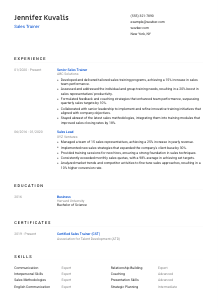
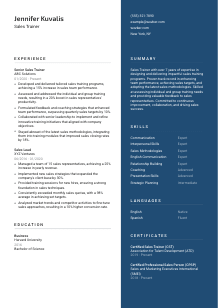
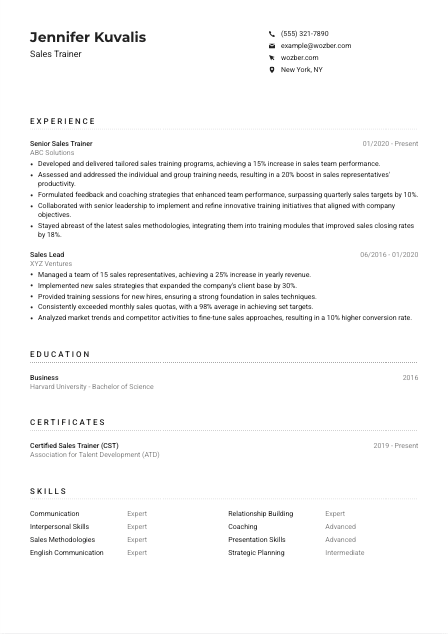
Each bullet should show what you did, who it affected, and what changed. Good Sales Trainer bullets often include verbs like developed, delivered, coached, assessed, implemented, and improved. The example does this well by pairing training work with outcomes such as a 15% increase in team performance and an 18% improvement in closing rates.
Revenue matters, but training roles are also measured through productivity, quota attainment, conversion rate, ramp time, adoption of methodology, and manager feedback. If your work improved call quality, onboarding speed, product knowledge retention, or target attainment, quantify it. The sample resume uses percentage gains in productivity, quarterly target performance, and closing rates, which are all natural measures in sales training.
Not every achievement belongs here. Prioritize experience that shows you can diagnose gaps, reinforce behaviors, and partner with sales leaders to move results. Even if part of your background is in direct sales, frame those years around leadership, peer coaching, onboarding, or process improvement so the hiring team sees a trainer, not only a top seller.
The strongest experience sections show a straight line from coaching activity to sales outcomes. If a reader can quickly see how your programs improved rep performance, you are presenting the right story for this role.
Education is rarely the deciding factor for an experienced Sales Trainer, but it still matters when the posting calls for a business-related degree. Keep this section straightforward and aligned with the level of formality common in sales, enablement, and training hiring.
If the role asks for a bachelor's degree in Business, Sales, or a related field, list that clearly and use the official degree name. In the example, a Bachelor of Science in Business lines up directly with the employer's stated requirement, which helps remove doubt during early screening.
Include degree, school, field of study, and graduation year or date. Recruiters scanning quickly should be able to confirm your academic background in seconds, especially when the degree is listed as a requirement rather than a preference.
If your degree is in business, marketing, communications, psychology, or another relevant discipline, spell out the field rather than leaving it vague. For Sales Trainer roles, subjects tied to buyer behavior, communication, management, or commercial operations can all support your positioning.
Most mid-career candidates do not need to list classes. Add coursework, honors, or projects only if they directly support training, sales strategy, presentation, or adult learning. Otherwise, let experience and certifications carry more of the narrative.
If you have 5+ years in sales and training, education should be concise. Save the space for coaching wins, leadership collaboration, and measurable sales improvements unless your academic background is unusually relevant to the employer's industry or training model.
For this kind of role, education should quickly answer the degree requirement and support your business credibility. The heavier proof usually comes from training delivery and sales performance results.
Certifications can add weight in sales training, especially when they show formal grounding in coaching, facilitation, or sales methodology. They are usually a supporting signal rather than the main reason you get hired, so list the ones that sharpen your case for the role.
If the posting says certification is a plus, use this section to show continued professional development in areas that matter. Credentials such as sales training certifications, facilitation programs, coaching credentials, or respected sales methodology coursework can strengthen your profile. The example's CST and CPSP credentials are a solid illustration of this approach.
A shorter, relevant list is stronger than a long inventory of unrelated learning. Choose credentials that connect to how Sales Trainers work, such as designing programs, coaching reps, reinforcing methodology, or improving performance in a revenue environment.
Add the year earned and, when relevant, the active date range. Sales methodologies, enablement practices, and product training approaches evolve, so recent or current certification can signal that you are keeping your content and delivery style up to date.
If training is becoming a larger part of your career, certifications can help make that transition visible. They are especially useful for candidates moving from front-line sales into dedicated training roles because they show deliberate investment in coaching and facilitation skills.
Relevant credentials can reinforce your authority with sales leaders and hiring teams. Keep the list focused on certifications that support your ability to teach, coach, and improve commercial performance.
A Sales Trainer skills section should read like a practical toolkit for developing reps and improving results. Hiring teams are usually scanning for a mix of communication strength, coaching ability, methodology knowledge, and the interpersonal range to work across senior leaders and front-line sellers.
Start with the language in the job description, then add the closely related abilities the role depends on. Here that includes communication, presentation, interpersonal skill, coaching, sales methodology knowledge, training delivery, and collaboration with leadership. This gives you better ATS alignment while keeping the list grounded in real work.
If the posting asks for "exceptional communication, presentation, and interpersonal skills," use those phrases if they are accurate for you. Matching the employer's language helps your resume read more naturally in an ATS resume scanner and makes it easier for human reviewers to connect your background to their needs.
Do not overload this section with every general workplace ability you have. Prioritize skills that speak to training performance, such as coaching, workshop facilitation, relationship building, sales methodologies, needs assessment, and performance feedback. The example works because it keeps the list centered on communication, coaching, presentation, and sales expertise rather than drifting into generic filler.
Your skills list should make sense to a sales leader reading it in ten seconds. If the section clearly supports training delivery, coaching quality, and sales effectiveness, it is doing its job.
Language ability matters differently depending on the market, customer base, and internal team structure. For a Sales Trainer, clear English communication is often essential because training sessions, coaching notes, and presentations need to land cleanly with a broad audience.
When the job description specifically calls for clear English communication, list English prominently and indicate your level accurately. In the example, "English - Native" handles that requirement immediately and leaves no ambiguity about presentation or coaching ability in the working language.
If you can train, coach, or build rapport in another language, include it. A second language can be valuable when supporting multilingual sales teams, regional markets, or customer-facing organizations that serve diverse audiences. Spanish in the sample is a good example of a useful added capability, though it is not a universal requirement for every role.
Use clear levels such as Native, Fluent, Advanced, or Conversational. Sales training depends on precision in explanation, objection handling, and feedback, so vague language claims can create doubt if you are later expected to facilitate sessions or coach reps live.
Only include languages you can genuinely use in a professional setting. If a language helps you deliver onboarding, support regional teams, or coach bilingual reps, it strengthens your case. If not, it may belong lower on the priority list.
For most Sales Trainer positions, languages are secondary to coaching results, methodology knowledge, and training delivery. Include them when they add real range, but do not let this section overshadow the core commercial and instructional strengths the role depends on.
This section works best when it answers one practical question: in what languages can you coach, present, and communicate clearly enough to improve sales performance?
Your summary should quickly establish two things: you understand sales, and you know how to improve other people's sales performance. For this role, the strongest summaries combine years of experience, training scope, and a few concrete outcomes or specialties without turning into a long paragraph.
Read the posting closely and identify the themes that deserve top billing in your opening lines. For this one, that means sales training program development, coaching, needs assessment, collaboration with leaders, and familiarity with current sales methods. Those should shape the summary more than generic claims about being driven or passionate.
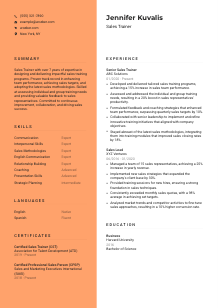
Open with your professional identity and years of relevant experience so the reader can place you quickly. A line such as "Sales Trainer with 7+ years in sales and coaching" works because it combines role focus with seniority in a compact, credible way.
Choose strengths that are central to how Sales Trainers are hired, such as building training programs, coaching reps against targets, improving adoption of sales methodologies, or partnering with managers to reinforce training in the field. The sample summary does this well by combining training design, target achievement, and needs assessment into one coherent profile.
Aim for three to five lines with concrete language. Mention outcomes or scope when you can, but do not cram in every credential or tool. A concise summary with the right sales and coaching signals will read better in both an ATS-friendly resume format and a quick recruiter scan.
A good summary makes it obvious that you can train sales teams, improve performance, and work credibly with leadership. If those points come through in the first few lines, the rest of the resume has a strong foundation.
A Sales Trainer resume should leave no doubt about your ability to turn selling knowledge into repeatable team performance. When your sections are aligned around coaching, training design, collaboration with sales leadership, and measurable improvement, hiring teams can quickly picture you leading onboarding, reinforcement, and field development.
Use Wozber's free resume builder to tighten that alignment, apply ATS optimization without losing natural language, and present your background in an ATS-friendly resume template that keeps the focus on results. The final read should make one thing easy to judge: you can help a sales team perform better, not just sell well yourself.




