



Use Wozber and land your dream job
Create Resume
No registration required
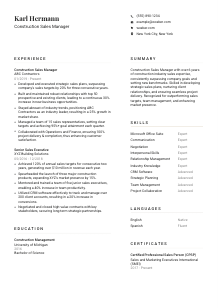
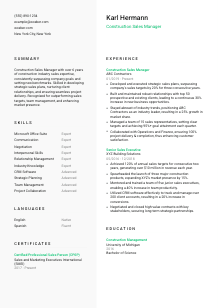
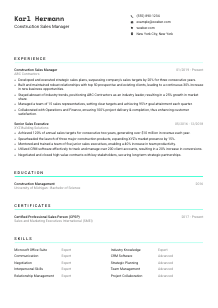
Closing construction deals, but your resume isn't breaking ground? Check out this Construction Sales Manager resume example, created with Wozber free resume builder. Learn how to stack your selling strategies to fit job-specific frameworks, ensuring your career stands as strong as the structures you pitch!
Construction sales leadership sits at the point where revenue promises meet project reality. Hiring teams want to see more than general sales success. They look for proof that you can grow pipeline in a construction environment, win high-value deals, and keep client confidence strong through handoff, execution, and closeout.
The first scan usually looks for direct construction-sector experience, target ownership, and team leadership before anything else. Wozber's free resume builder helps you shape that experience into an ATS-compliant resume that uses the right language from the posting, so your track record in client development, forecasting, and cross-functional project support is easy to spot early.
For a Construction Sales Manager, the top of the resume needs to confirm practical basics fast. Contact information, title alignment, and location can affect whether a hiring team keeps reading, especially when the role involves travel, client meetings, and a stated local requirement.
Your name should be the most visible text on the page, clean and easy to read. Construction sales is a relationship-driven role, so start with a professional presentation that feels credible in front of clients, estimators, operations leaders, and executives.
Place "Construction Sales Manager" directly under your name when that is the role you are pursuing. Matching the job title helps connect your background to the opening immediately and keeps your positioning clear in both ATS screening and human review.
Make every contact line useful and current. This role often involves fast follow-up around bids, meetings, and account development, so there should be no friction in reaching you.
If a job requires local presence, list your city and state clearly. In the example, stating New York City, New York directly supports a location-specific requirement and removes an avoidable hiring question early.
Include LinkedIn or a professional website if it reinforces your sales background. For this profession, a strong profile can support your resume with endorsements, account growth examples, industry history, or major project and client wins.
These details should answer the basic logistical questions right away: who you are, what role you do, how to reach you, and whether you meet any location requirement. For a Construction Sales Manager, that clean start supports a faster read on your market relevance and client-facing professionalism.




This is where Construction Sales Manager resumes usually separate. Hiring teams want to see revenue performance, client growth, market knowledge, and how well you work across sales, operations, and finance once business is won.
Start by identifying the responsibilities that carry the most weight in the role. In this case, that includes strategic sales planning, pipeline development, client relationship management, team oversight, and coordination with operations and finance. Those themes should shape which achievements you highlight and how you phrase them.
Use reverse chronological order so your latest construction sales leadership is seen first. For experienced candidates, recent roles usually show the clearest picture of account scope, sales targets, team management, and the size of business you are trusted to grow.
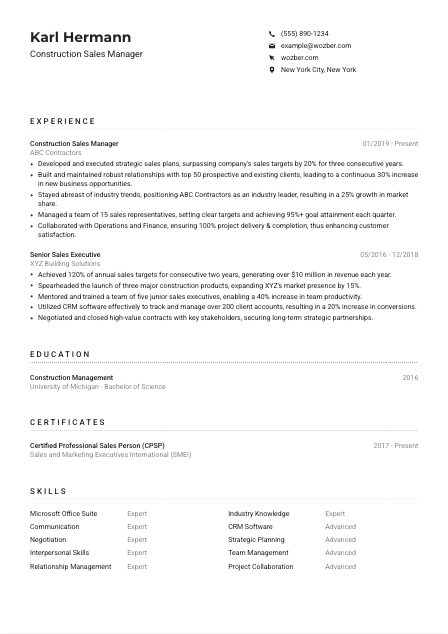
Replace generic statements like "responsible for sales" with results tied to targets, accounts, and delivery. The sample does this well by showing outcomes such as surpassing sales targets by 20%, growing new business opportunities by 30%, and improving market share by 25%. Those details tell a hiring manager how you perform, not just what you were assigned to do.
Construction sales is measured through revenue, quota attainment, conversion, account growth, contract value, market expansion, and retention. Include numbers wherever you can support them. Examples such as managing 200+ client accounts, generating more than $10 million annually, or driving 95%+ team goal attainment make your scope and consistency much easier to judge.
Prioritize experience that shows construction industry selling, leadership, negotiation, and project-linked client management. If older or unrelated roles do not strengthen that story, trim them back. Space on the page should go to bids won, markets developed, teams led, and partnerships maintained.
Your experience section should make it easy to see that you can bring in work, manage a pipeline, lead a sales team, and stay aligned with project delivery after the contract is signed. That combination matters in construction, where sales success is judged by both booked revenue and execution credibility.
Education is rarely the longest section for an experienced Construction Sales Manager, but it still matters. A degree in business, construction management, or a related field helps confirm that you understand both commercial decision-making and the industry context behind the sale.
Read the posting closely and mirror the education requirement in straightforward language. When an employer asks for a bachelor's degree in Business, Construction Management, or a related field, make that qualification easy to find without extra interpretation.
List your degree, field of study, school, and graduation year in a simple order. This role does not require a long academic narrative. Clear formatting is enough to show you meet the baseline educational requirement.
If your degree directly matches the posting, let that work for you. The example's Bachelor of Science in Construction Management is a strong fit because it aligns naturally with construction sales, project environments, and industry-specific client conversations.
Early-career candidates can include coursework in sales, estimating, project management, finance, or construction methods if it helps connect academic work to the role. For more experienced professionals, those details are usually less important than sales performance and account growth.
Academic distinctions are worth listing only if they reinforce your professional story. Relevant examples might include capstone work tied to construction operations, market analysis, or business development rather than unrelated campus activities.
This section should confirm that you meet the degree requirement and, when applicable, show a relevant industry or business foundation. For an established Construction Sales Manager, that is usually enough before the resume moves back to revenue results and client impact.
Certifications are not always mandatory for Construction Sales Manager roles, but the right one can strengthen your profile. They are most useful when they support sales discipline, industry knowledge, or leadership credibility.
Start with the posting. If certifications are required, list the matching ones prominently. If they are not required, include only those that reinforce your ability to lead sales conversations, manage accounts, or operate confidently in the construction sector.
Prioritize credentials tied to professional selling, business development, construction management, or related commercial work. The CPSP listed in the example works because it adds recognizable sales credibility without forcing a weak connection to the role.
Certification dates show whether a credential is current, active, or recently earned. That matters more when the certification reflects ongoing professional development or current sales practice.
Construction markets, buyer expectations, and solution-based selling approaches change over time. Adding recent credentials or training in sales leadership, CRM use, contract strategy, or construction business development can strengthen your positioning, especially when competing for senior roles.
A certificate should add something meaningful to your resume, whether that is sales credibility, industry knowledge, or leadership depth. If it does not strengthen your case for managing pipeline, clients, and team performance, leave it out.
The skills section should reinforce the tools and strengths that show up in your experience, not repeat generic buzzwords. For Construction Sales Manager roles, the mix usually includes sales systems, business development skills, team leadership, and client-facing communication.
Start with the skills the employer named directly. Here, that includes CRM software, Microsoft Office Suite, communication, negotiation, and interpersonal skills. These are not filler terms. They point to how the job is performed day to day through pipeline tracking, presentations, forecasting, and client meetings.
Include both operational tools and sales capabilities. CRM proficiency, reporting tools, and Microsoft Office matter because construction sales managers track accounts, monitor targets, and present forecasts. Pair those with negotiation, relationship management, strategic planning, and team management to show full role coverage.
Order the section so the most job-relevant skills appear first, and avoid padding it with traits that are already obvious from your experience bullets. The example works because it stays close to the role, highlighting CRM software, strategic planning, relationship management, and project collaboration rather than vague personality terms.
A hiring team should be able to glance at this section and recognize the core mechanics of your job: managing pipeline, leading conversations, negotiating deals, supporting delivery, and keeping teams aligned around revenue goals.
Language ability matters most when it affects how you present, negotiate, and maintain client trust. In construction sales, that usually means making your working language clear and adding other languages only when they genuinely expand your reach.
If the posting states an English speaking requirement, list English clearly and use an accurate proficiency level. That removes doubt about your ability to handle client communication, internal coordination, and sales presentations.
Lead with the language the role requires, then list others that could support your market coverage. For the example, placing English prominently aligns directly with the posting and confirms readiness for a client-facing role.
Additional languages can be valuable if you work with diverse clients, subcontractors, or regional markets. Spanish, for example, may strengthen communication in some construction environments, but it should be presented as an added asset rather than a universal requirement.
Use clear labels such as Native, Fluent, Advanced, or Conversational. A sales role depends on trust and accuracy, so language claims should reflect what you can actually handle in meetings, calls, and negotiations.
Do not overexpand this section unless language capability is central to the territory or client base. For most Construction Sales Manager resumes, language skills support the application, but sales results and industry experience still carry more weight.
This section should quickly confirm that you can communicate at the level the job requires. Any additional language should strengthen your reach with clients or teams, not distract from your construction sales record.
The summary sits at the top of the resume, so it needs to establish your sales background quickly and in the language of the role. For Construction Sales Manager positions, that means leading with industry experience, performance, and the kind of accounts or teams you have handled.
Open with your professional identity and years of relevant experience. Phrases such as "Construction Sales Manager with 6+ years in construction industry sales" work because they establish sector experience right away and align with a posting asking for 5+ years.
Choose two or three strengths that match the target role closely, such as strategic sales planning, client relationship development, team leadership, or cross-functional coordination. The example summary uses this approach by combining sales expertise, pipeline growth, and project delivery support in a compact way.
Aim for a short paragraph of three to five lines. Every sentence should carry weight. Skip broad claims about being dynamic or results-driven unless you immediately support them with something tangible like quota performance, market growth, or leadership scope.
Close with a point that shows what your work changes for the employer. That could be exceeding targets, expanding market share, growing strategic accounts, or improving customer satisfaction through strong operational partnership. The summary should leave no doubt that you can sell, lead, and support delivery in a construction setting.
A well-written summary tells the reader, in a few lines, that you understand construction sales, can deliver against targets, and know how to maintain trust after the deal is won. That is the standard the rest of the resume should then prove.
A Construction Sales Manager resume should show a clear record of revenue growth, client development, team leadership, and coordination with the people who deliver the work. When those points are easy to find, your application reads like someone who understands both the sale and the project environment behind it.
Use Wozber's free resume builder to organize that experience in an ATS-friendly resume format, then refine the language with the ATS resume scanner so your terminology matches the job description naturally. The finished resume should make it easy to judge whether you can win business, lead a team, and support successful project outcomes.




