



Use Wozber and land your dream job
Create Resume
No registration required
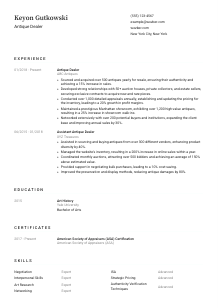
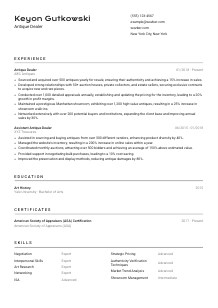
Unearthing treasures, but your resume feels like a vintage find? Browse this Antique Dealer resume example, created with Wozber free resume builder. Learn how to match your historical acumen to job demands, ensuring your career remains as rich and valuable as the artifacts you admire!
Antique dealing is built on judgment that can hold up under scrutiny. Hiring teams want to see how you evaluate provenance, protect margin when buying, and turn research into pieces buyers actually want. Your resume should make that commercial and appraisal judgment visible, not just list a general interest in antiques or art.
A tailored resume quickly separates someone who has worked around antiques from someone who has sourced, priced, and sold them responsibly. Using Wozber's free resume builder helps you align your wording with the posting, keep an ATS-compliant resume structure, and surface the details that matter first, such as appraisal volume, sourcing channels, showroom or online sales results, and relationship depth across the market.
For an Antique Dealer, the top of the resume should read like the header of a credible appraisal report: clear, professional, and easy to act on. Keep this section straightforward so the employer can immediately place you in the market, contact you, and confirm any location requirement without hunting for basics.
Your name should sit at the top in a clean, readable format. Antique dealing depends on reputation, repeat buyers, and trusted referrals, so your header should present you like a professional whose judgment people can rely on.
Place "Antique Dealer" directly under your name when that matches the role you want. It removes ambiguity for both recruiters and ATS screening, especially if your background includes adjacent titles such as Appraiser, Gallery Manager, or Assistant Antique Dealer.
List a phone number and professional email address that you check regularly. In a field where conversations with auction houses, estate sale contacts, collectors, and buyers often move quickly, inaccurate contact details can cost you an interview just as easily as they can cost a deal.
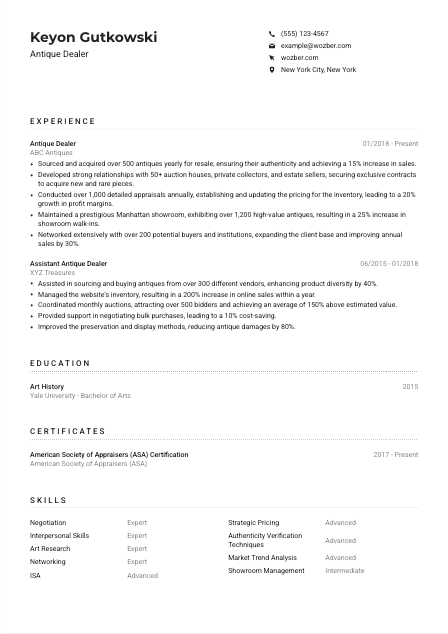
If a role specifies a city or market, show it clearly in your personal details. Here, New York City is part of the requirement, so listing "New York City, New York" signals that you already meet a practical condition tied to showroom operations, client access, and local sourcing networks.
If you have a website, portfolio, or LinkedIn profile that reflects your antique trade background, include it. A useful link might show curated inventory, published appraisals, event participation, or a professional track record that supports your claims about period knowledge, sales, or collector relationships.
This section does not need flair. It needs accuracy, professionalism, and any practical detail the employer is screening for, including location and a credible professional presence.




Experience is where Antique Dealer resumes either become convincing or stay vague. Employers need to see what you bought, how you verified it, where you sourced it, how you priced it, and what commercial outcome followed. General retail or generic sales bullets will not carry the same weight as concrete antiques work.
Start by marking the recurring themes in the posting: sourcing and purchasing antiques, authenticity verification, pricing and appraisal, showroom or online presentation, and relationship building with collectors, institutions, and auction channels. Those priorities should shape the bullets you choose and the order in which you present them.
List each position with employer, title, and dates, starting with your most recent role. In this profession, progression matters. A move from assistant buying support into independent sourcing, appraisal, and client development tells a hiring manager that your market judgment and responsibility have grown over time.
Each bullet should describe work that matters in the antiques trade: acquired inventory, researched provenance, appraised pieces, negotiated purchases, managed sales channels, or built relationships that led to better stock. The sample resume does this well by naming activities such as sourcing 500+ antiques yearly and conducting 1,000+ appraisals annually instead of relying on generic statements about being "responsible for sales."
Metrics are especially persuasive here because they show both volume and judgment. Good numbers include annual pieces sourced, appraisal count, profit margin improvement, sales growth, showroom traffic, online conversion, number of vendor relationships, or auction performance. A bullet about a 20% profit margin increase says much more than "updated pricing regularly."
Prioritize experience tied to antiques, collectibles, appraisal, gallery operations, auctions, estate sales, luxury retail, or high-value client service. If an older role does not support your ability to buy, authenticate, price, sell, or cultivate buyers, reduce it or remove it so the relevant market-facing work stands out faster.
The best bullets show that you can source desirable inventory, price it with confidence, and move it through the right sales channels. When those results are quantified, your experience starts to look commercially credible, not merely interesting.
Education matters in antique dealing because it shapes how you research objects, understand period context, and communicate value to buyers. It usually will not outweigh hands-on buying and appraisal experience, but it does strengthen your credibility when the role asks for formal study in Art History, Business, or a related field.
Check the posting for the exact education baseline and make sure your degree is easy to spot. For this role, a bachelor's degree in Art History, Business, or a related field is requested, so a Bachelor of Arts in Art History should appear clearly without forcing the reader to search for it.
List degree, field of study, school, and graduation year. This section should be easy to scan, especially for recruiters reviewing many candidates. Clear structure matters more than decorative detail.
If your field connects closely to antiques, decorative arts, art history, material culture, or business, keep that visible. An Art History degree supports research depth, period knowledge, and the ability to discuss historical significance with collectors or institutions.
If you are earlier in your career, relevant coursework in art history, valuation, museum studies, preservation, or business can add useful context. With 5+ years of antiques experience, keep extras selective unless they reinforce a specialty such as European furniture, fine art, or auction practice.
Honors, thesis work, or relevant academic societies can stay if they reinforce your seriousness in the field. If they do not add much beyond what your experience already proves, keep the section concise and let your sourcing, appraisal, and sales record carry more weight.
Use this section to confirm that you meet the academic requirement and to support your historical or commercial grounding. Then let your work history show how that knowledge translated into buying, pricing, and selling decisions.
In antiques, credentials matter most when they support trust. A respected appraisal or specialist certification can reassure employers that your valuation methods, ethics, and professional standards are backed by recognized industry bodies, especially when the role includes authenticity checks and pricing responsibility.
Read the posting carefully before deciding how much weight to give this section. Here, certification from the American Society of Appraisers or the International Society of Appraisers is listed as a plus, which means it can strengthen your candidacy even if it is not a hard requirement.
List certifications that directly support your work as a dealer, appraiser, or specialist in historical objects. ASA and ISA credentials are especially relevant because they speak to appraisal discipline and professional standing in the market.
Add the year earned or active date range so employers can see whether the credential is current. In a field shaped by changing market values, fraud risks, and evolving buyer demand, recent or actively maintained certification has more credibility than an undated line item.
If you do not yet hold a major appraisal certification, consider pursuing one when it matches your career direction. Ongoing study in authentication methods, valuation, decorative arts, or regional specialties can sharpen both your resume and your real-world buying decisions.
A certificate section should tell the employer that your judgment is backed by recognized standards, not just personal interest. That matters most when the role includes appraisals, authenticity review, and high-value transactions.
A useful skills section for an Antique Dealer should sound like the trade, not a generic sales resume. The best list combines commercial ability, research discipline, and relationship-based work across sourcing, valuation, negotiation, and presentation.
Start with the skills the employer names directly, then add the practical abilities those tasks require. For this opening, that includes negotiation, networking, interpersonal skills, authenticity verification, market trend analysis, and pricing judgment.
Only include skills you can support with experience bullets, education, or certifications. If you list "Strategic Pricing" or "Showroom Management," your work history should show pricing updates, margin improvement, inventory curation, merchandising, or showroom traffic growth.
Do not overcrowd this section with broad workplace terms. A tighter list built around appraisal research, vendor relations, antique period knowledge, sales negotiation, online inventory presentation, and collector networking gives a much clearer picture of how you operate in the market.
Employers should be able to connect each listed skill to the buying, appraisal, sales, and relationship work they need done. If the section feels generic, refine it until it reflects the trade more clearly.
Language ability can matter in antique dealing because the work often involves international buyers, cross-border sourcing, catalog research, and high-touch client conversations. Even when only one language is required, listing language skills carefully can show added reach in the market.
Review the posting for explicit language expectations and reflect them clearly. In this case, fluent spoken and written English is required, so English should appear prominently and at an accurate proficiency level.
List English first when it is a stated requirement, then add any other languages that support your work with collectors, auction contacts, or international inventory sources. French, for example, can be useful in parts of the art and antiques market, but it should follow the required language rather than compete with it.
Choose clear levels such as Native, Fluent, Intermediate, or Basic. Precision matters here. If a role involves client communication, catalog interpretation, or negotiation, overstating your ability can quickly become obvious.
Only list languages you can use in a work setting at the level stated. If you can correspond with overseas sellers or speak comfortably with clients, say so through the right proficiency label rather than trying to make the section look more impressive.
Additional languages are most valuable when they connect to sourcing regions, collector relationships, or international sales channels. They are a useful advantage, but they should support your antiques expertise rather than distract from it.
Keep this section factual and relevant. When language ability helps you research, negotiate, or build relationships across markets, it becomes a practical asset rather than a side note.
The summary is your fastest chance to frame the kind of Antique Dealer you are. In a few lines, it should tell the employer whether your background centers on sourcing, appraisal, sales growth, collector relationships, showroom management, or a combination that fits their opening.
Before writing, identify the two or three points the employer cares about most. For this position, that includes antiques buying and selling, authenticity verification, pricing and appraisal, and relationship building across the market.
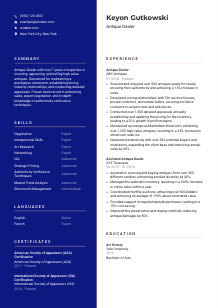
Lead with a direct first line that names your profession and level, such as "Antique Dealer with over 7 years of experience in sourcing, appraising, and selling high-value antiques." That immediately places you in the right lane for a role asking for at least 5 years of relevant experience.
Follow with details that show how you work. Good summary material includes period knowledge, appraisal depth, negotiation strength, showroom or online sales responsibility, and relationship building with auction houses or private collectors. The sample summary works because it pairs broad capability with specifics like maintaining a prestigious showroom and conducting detailed appraisals.
Aim for 3 to 5 lines with no filler. This is not the place for generic passion statements. It should quickly tell the reader that you understand authenticity, market value, buyer relationships, and the commercial side of moving inventory.
When done well, this section tells the employer that you are already operating at the level the role demands. It should make your resume read like that of someone trusted to source, price, and sell with sound judgment.
An effective Antique Dealer resume shows more than enthusiasm for historical objects. It shows that you can source intelligently, verify authenticity, price with discipline, and build the relationships that keep inventory and buyers moving through the business.
Use Wozber to tighten that story into an ATS-friendly resume format, refine wording with its AI resume builder, and check alignment with an ATS resume scanner so the right buying, appraisal, and sales details stand out early.
When each section supports the same message, hiring teams can quickly see that you are prepared to manage antiques with commercial judgment and professional credibility.




