



Use Wozber and land your dream job
Create Resume
No registration required
Sealing deals, but your resume seems on backorder? Check out this Purchasing Agent resume example, created with Wozber free resume builder. Learn how to list your procurement prowess to match job specifications, upgrading your career trajectory to express delivery!
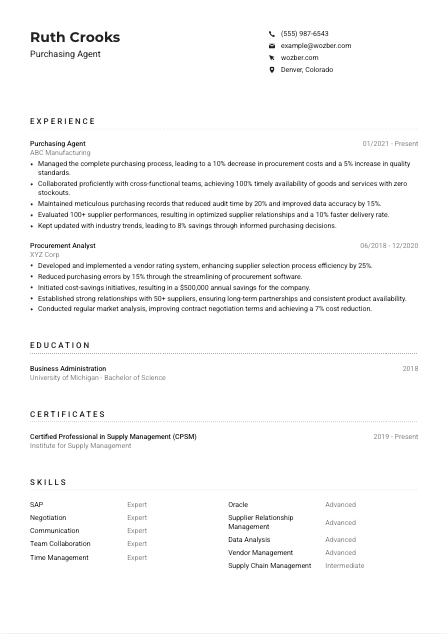
Purchasing work gets judged in hard business terms. Can you control spend without weakening quality, keep materials available without overbuying, and manage supplier relationships with enough discipline to support production or operations? Your resume should make that operating range visible quickly, especially if your background includes sourcing, contract negotiation, purchasing records, or supplier performance tracking.
A tailored resume helps separate purchasing candidates who only processed orders from those who actively improved cost, delivery, and vendor decisions. Wozber's free resume builder makes it easier to build an ATS-compliant resume around the language that matters in procurement, so hiring teams can see your experience with tools, purchasing workflows, and measurable supply outcomes without digging for it.
This section is simple, but in purchasing, small errors already raise questions about accuracy. Your contact details should look controlled and current, the same way your purchase orders, supplier files, and pricing records would need to be on the job.
Use your full name as the clear heading of the resume, set larger than the body text. It should read like a professional identifier, not a design element.
Add "Purchasing Agent" under your name when that matches the role you are pursuing. This immediately frames your background around procurement rather than a broader operations or analyst profile.
Make it easy for an employer to reach you without hunting through the page.
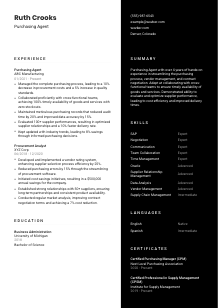
If the employer specifies a city or relocation requirement, reflect that here. In the example, listing Denver, Colorado directly supports a stated requirement and removes an avoidable question about availability.
Include LinkedIn or a professional website if it supports your purchasing background with consistent job titles, certifications, or supply chain experience. Leave it out if it is outdated or weaker than the resume itself.
Your personal details should show the same precision expected in purchasing records and supplier communication. Clean, complete information helps the reader move straight to your procurement experience.




For a Purchasing Agent, experience is where employers look for operating judgment. They want to see how you sourced vendors, negotiated terms, supported internal demand, managed procurement systems, and improved cost or delivery performance in real working conditions.
Before rewriting bullets, mark the duties and requirements that define the role. Here, the clearest priorities are sourcing, supplier selection, contract negotiation, purchasing record accuracy, collaboration with internal teams, and use of procurement systems such as SAP or Oracle. Those themes should appear in your recent experience if they reflect what you have actually done.
List your positions in reverse chronological order so the employer sees your current procurement scope first. For purchasing roles, recent work usually carries the most weight because supplier management practices, ERP workflows, and cost conditions change quickly.
Each role should show decisions, actions, and results tied to purchasing. Replace vague lines like "responsible for procurement" with specifics such as managing supplier bids, negotiating pricing, maintaining purchase orders, or coordinating with production teams to prevent stockouts. The example does this well by naming supplier evaluations, cross-functional collaboration, and record maintenance instead of broad administrative language.
Purchasing performance is measurable, so use numbers where they are natural. Cost reduction, annual savings, improved on-time delivery, fewer purchasing errors, shorter audit time, and supplier counts all help hiring teams understand your scale and effectiveness. Metrics like 10% lower procurement costs or $500,000 in annual savings work because they reflect how procurement success is commonly tracked.
Prioritize experience that connects to purchasing decisions, vendor management, market analysis, inventory support, contract terms, or manufacturing supply needs. If you have broader operations or analyst experience, keep the bullets that show transferable procurement value and cut details that do not support the role you are targeting.
The strongest experience sections make your procurement judgment visible. When your bullets show supplier decisions, system use, cross-functional coordination, and measurable savings or delivery gains, the hiring team can picture you handling the purchasing process with confidence.
Education is usually a checkpoint for purchasing roles, but it still matters. When the posting asks for a bachelor's degree in business, supply chain, or a related field, your resume should make that qualification easy to find and easy to connect to procurement work.
List your highest relevant education clearly, especially if it aligns with business administration, supply chain management, operations, or a closely related field. In the example, a Bachelor of Science in Business Administration directly supports the educational requirement.
Use a consistent format with degree, field of study, school, and graduation year or date. Clear structure helps the reviewer confirm qualifications quickly, particularly when screening many candidates against baseline degree requirements.
If your degree title closely matches the posting, use the formal wording from your diploma or transcript. This is especially helpful for ATS matching and for roles where business or supply chain education is explicitly requested.
Early-career candidates can include relevant coursework such as supply chain management, operations management, contract law, inventory planning, or data analysis. If you already have several years of purchasing experience, coursework usually matters less than results in your Experience section.
Honors, scholarships, or project work are worth mentioning when they support analytical ability, business discipline, or supply chain interest. Keep them brief and only include what strengthens your case for procurement work.
Your education section does not need much space, but it should remove doubt. A clearly listed degree in a relevant field supports the rest of your purchasing story and helps you clear one of the role's basic requirements quickly.
In purchasing, certifications often signal deeper commitment to the field and familiarity with professional standards. They are especially useful when the employer mentions supply management credentials or when you want to show growth beyond your degree and day-to-day job experience.
If the posting mentions credentials such as CPSM or CPM, place them prominently in this section when you hold them. In the example, both certifications are directly relevant because the employer listed them as a plus.
Prioritize certifications tied to procurement, supplier management, inventory control, contract administration, or ERP processes. A short, relevant list works better than a long set of credentials with little connection to buying decisions or vendor management.
Add issue dates, renewal periods, or active status when that information helps show the certification is current. This is useful for credentials that require ongoing maintenance or professional development.
Purchasing changes with market conditions, software adoption, supplier risk, and compliance expectations. Ongoing certification work or newer credentials can reinforce that you stay current with procurement practices instead of relying only on past experience.
Relevant certifications add weight when they support the exact kind of purchasing work the employer needs. They are especially persuasive when paired with experience in sourcing, negotiation, supplier evaluation, and procurement systems.
The best Purchasing Agent skills sections read like a working toolkit. Employers expect to see a mix of procurement systems, negotiation ability, supplier management, and the communication skills needed to work with operations, finance, and vendors.
Start with the skills the employer names directly, then add the ones implied by the responsibilities. This job points clearly to procurement software, negotiation, written and verbal communication, supplier evaluation, record accuracy, and collaboration with internal teams.
Choose skills that match the posting and that you can support elsewhere in the resume. SAP, Oracle, negotiation, supplier relationship management, vendor management, and data analysis all make sense here because they connect directly to purchasing workflows and decision-making. The example skills list works because the tools and interpersonal skills are both relevant to procurement execution.
Lead with the skills most likely to matter in screening and on the job. For a manufacturing-oriented purchasing role, procurement software, supplier management, contract negotiation, purchasing analysis, and cross-functional communication should usually appear before broader strengths like time management.
A focused skills section should reinforce what your experience already shows. When the tools, negotiation strengths, and supplier-facing capabilities line up across the resume, your profile reads as someone ready to manage purchasing work from analysis to execution.
Language ability matters in purchasing because the role depends on clear communication. You may be negotiating terms, confirming order details, documenting contract changes, or coordinating with internal stakeholders on demand and delivery timing.
When the posting requires English proficiency, list it clearly rather than assuming it will be inferred. If you are fully comfortable in spoken and written business English, say so through a clear rating such as Native or Fluent.
Extra languages can be valuable if you work with international suppliers, regional distribution networks, or multilingual internal teams. They are not mandatory for every Purchasing Agent role, but they can broaden your usefulness in supplier communication.
Choose simple labels such as Native, Fluent, Intermediate, or Basic so the reader understands your level immediately. Avoid vague wording that makes it hard to judge whether you can handle business conversations or written documentation.
If the employer operates across countries or sources from global markets, language skills may support negotiation, relationship management, and fewer communication errors. Even when English is the only requirement, an additional language can still be a practical advantage.
Language skills are most useful when they connect to the actual work. For purchasing roles, that means helping employers picture you handling supplier conversations, internal coordination, and written communication with clarity.
Your summary should establish your purchasing profile in a few lines, not repeat the whole resume. This is where you quickly connect your years of experience, procurement strengths, and business results to the kind of buying role you are targeting.
Look at what the role emphasizes most before writing the summary. For this opening, the strongest themes are purchasing process ownership, supplier selection, negotiation, procurement system use, and support for timely material availability. Your opening lines should reflect the parts of that mix you already own.
Begin with a direct introduction such as "Purchasing Agent with 4+ years of experience" or a closely related version that reflects your background. That immediately places you in the right lane and helps both recruiters and ATS tools categorize your profile correctly.
Focus on abilities that matter in the role and can be backed up elsewhere in the resume. Good choices include cost reduction, supplier performance management, contract negotiation, ERP proficiency, or preventing stockouts through strong coordination. The example summary works because it mentions streamlining the purchasing process, vendor management, and delivery improvement rather than relying on generic claims.
Aim for three to five lines with concrete language. A hiring team should come away knowing your purchasing scope, the kind of environment you have worked in, and the business outcomes you tend to influence.
A sharp summary gives context for everything that follows. When it captures your purchasing scope, systems familiarity, and measurable business contribution, the rest of the resume reads with much more clarity.
Once each section points to the same procurement strengths, your resume becomes much easier to trust. Hiring teams should be able to see your purchasing scope, supplier management experience, system proficiency, and cost or delivery results without piecing the story together themselves.
Use Wozber's free resume builder to shape that story in an ATS-friendly resume format, then refine it with the ATS resume scanner so the language, requirements, and structure stay aligned with the job you want. The finished resume should make one thing clear fast: you can manage purchasing work with accuracy, commercial judgment, and reliable follow-through.