



Use Wozber and land your dream job
Create Resume
No registration required
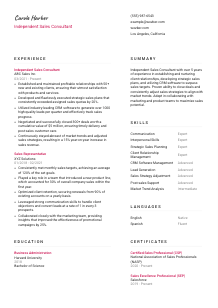
Sealing deals solo, but your resume feels like it needs a team pitch? Check out this Independent Sales Consultant resume example, created with Wozber free resume builder. Learn how to present your entrepreneurial prowess to match the job blueprint, ensuring your career growth stays just as independent as your success stories!
Independent sales consulting is measured in commercial results. Hiring teams want to see whether you can open doors, build trust quickly, manage a territory or book of business, and convert conversations into signed deals and retained accounts. Your resume needs to make that sales cycle visible, from lead generation and pipeline management to negotiation, forecasting, and post-sale follow-through.
When that story is tailored well, the first scan becomes much more decisive. Wozber's free resume builder helps you line up your experience with the wording used in the job ad and present it in an ATS-friendly resume format, so quota performance, CRM fluency, and client relationship strength are easier to spot early. That matters when employers are sorting candidates who all claim sales experience, but only some show how they actually grew revenue.
Sales work starts with credibility, and your header sets that tone before anyone reads a bullet point. For an Independent Sales Consultant, this section should confirm professional identity, clean contact information, and any practical requirement that affects whether you can be considered right away.
Use your full name in a clean, prominent style. A sales resume benefits from immediate clarity because your document is already being read through a client-facing lens, and a cluttered header can make the rest of the resume feel less polished.
Place the job title directly under your name when it accurately reflects your work. Using "Independent Sales Consultant" helps connect your background to the role quickly, especially when the employer is screening for direct sales experience rather than broader business development or account support profiles.
Add a reliable phone number and a professional email address. In sales hiring, responsiveness matters, so even small details such as a clean email format can reinforce that you present yourself well with prospects, clients, and internal partners.
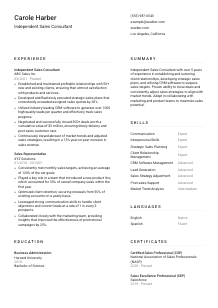
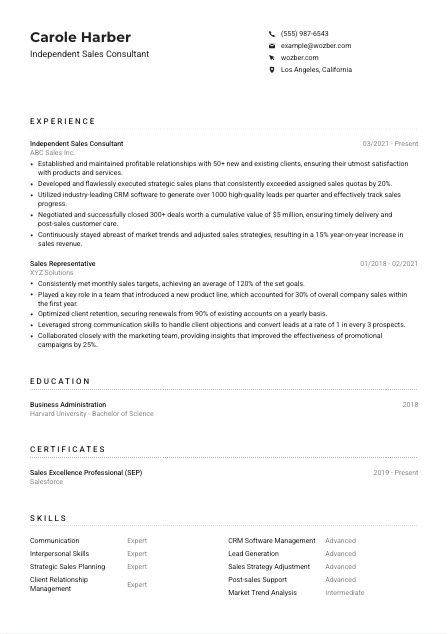
If the role requires a specific market or territory, show that clearly in your header. Here, listing "Los Angeles, California" addresses a stated requirement right away. Treat location this way when the posting makes geography operationally important, not as a default rule for every application.
A LinkedIn profile or professional website can strengthen this section if it reflects the same sales history, results, and positioning as your resume. For consultants, that extra link can reinforce credibility, client-facing polish, and consistency across your professional presence.
This section should confirm that you are easy to contact, aligned with the role, and professionally presented. In sales, that first impression carries weight because the job itself depends on trust and clear communication.




This is the section employers will read hardest. Independent Sales Consultant resumes are strongest when they show how you build pipeline, move opportunities forward, hit quota, and maintain client satisfaction after the close. Generic responsibility lists do not carry much weight here. Revenue, retention, account growth, and sales process ownership do.
Start by identifying the operating priorities in the posting. For this role, that includes direct sales experience, quota attainment, CRM use, client relationship management, sales planning, forecasting, negotiation, and collaboration with marketing and product teams. Those themes should shape which achievements you feature and which wording you use.
List your positions in reverse chronological order and include job title, company name, and dates. For sales roles, the title matters because "Independent Sales Consultant" communicates more ownership over pipeline, territory, and client relationships than a broader label would.
Focus each bullet on what you produced. Good sales bullets show account volume, quota performance, deal value, renewal rates, conversion rates, territory growth, or forecast accuracy. The example resume does this well by citing 50+ client relationships, 300+ closed deals, and sales quotas exceeded by 20%, which gives the reader a concrete sense of scope and performance.
Quantify your work with metrics that belong naturally to sales. Revenue generated, percentage to quota, lead volume, conversion rate, average deal size, renewal rate, and year-over-year growth all help hiring managers understand how you operate. The strongest figures are tied to a process you managed, such as generating leads through CRM workflows or increasing revenue after adjusting strategy to market trends.
Keep the section centered on achievements that prove you can win business and keep accounts healthy. If a bullet does not connect to pipeline growth, client management, collaboration that improved selling conditions, or measurable commercial results, it is probably taking space away from stronger evidence.
Your experience section should let a hiring manager follow the business story quickly: what you sold, how you managed the work, and what results you delivered. If those points are clear, your resume reads like a consultant who can contribute from day one.
Education usually is not the first section reviewed in a sales resume, but it still matters when the posting names a degree requirement. For an Independent Sales Consultant, this section should confirm that you meet the academic baseline without taking attention away from revenue performance and client-facing results.
If the posting requests a bachelor's degree in Business, Marketing, or a related field, make sure that information is easy to find. A degree such as Business Administration directly supports a sales profile because it connects naturally to market analysis, customer strategy, and commercial planning.
List the degree, institution, field of study, and graduation year in a simple format. Hiring teams do not need a long academic narrative here. They need quick confirmation that you meet the stated requirement.
Use the full degree title rather than abbreviating too much when the wording adds clarity. "Bachelor of Science in Business Administration" reads more directly against a business-focused sales posting than a shortened version that leaves the field unclear.
Most experienced sales professionals can skip detailed coursework. Include it only when it strengthens alignment, such as classes in marketing, consumer behavior, negotiation, sales management, or CRM-related business systems. Early-career candidates can use this space more actively than candidates with a long sales record.
Honors, leadership roles, or major projects can be useful if they show commercial thinking, communication ability, or initiative. Keep them brief. Once you have several years of direct sales results, academic detail should support your profile rather than compete with your experience.
For this role, education should answer the degree requirement quickly and cleanly. Then the resume can return attention to the numbers, relationships, and sales execution that will drive the hiring decision.
Certifications can add credibility in sales when they support a clear commercial skill set, especially around consultative selling, CRM platforms, negotiation, or account management. They are rarely the main reason someone gets hired for this kind of role, but they can reinforce professionalism and ongoing development.
Include credentials that relate directly to client acquisition, sales process management, or recognized selling frameworks. This posting does not make a specific certificate mandatory, but relevant options such as sales professionalism or platform-based CRM credentials can still support your case when they align with your actual work.
A short list of well-chosen certifications works better than a long list of loosely related training. For an Independent Sales Consultant, the most useful certifications tend to strengthen consultative selling, CRM fluency, negotiation, or business development rather than general business topics.
Add the issue date or active period for each certificate. In sales, current training matters because tools, buyer expectations, and go-to-market methods change quickly. The example resume handles this well by showing ongoing validity for both certifications.
Review your certifications regularly and remove anything outdated or less relevant than newer credentials. If your target roles emphasize CRM software, account growth, or strategic planning, your certificate list should evolve in that direction too.
Use this section to support the sales story already established in your experience. The best entries make your methods, tools, and professional development look current and commercially relevant.
A sales skills section works best when it reflects how revenue is actually generated and managed. Hiring teams want to see a mix of client-facing strengths and operational sales capabilities, especially in areas like CRM use, territory planning, negotiation, and account retention.
Review the job ad for both explicit and implied requirements, then mirror that language where it truthfully matches your background. Here, CRM software, strategic sales planning, communication, interpersonal ability, client relationship management, and forecasting all belong near the top because they are central to the work.
List hard skills and soft skills together in a way that reflects actual sales execution. A consultant needs both pipeline discipline and client trust. That means skills such as CRM management, lead generation, forecasting, and competitor analysis should sit alongside negotiation, communication, and relationship building.
Prioritize the skills most relevant to the target role instead of turning this section into a full inventory. The example resume stays close to the job's priorities with items like Strategic Sales Planning, Client Relationship Management, CRM Software Management, Lead Generation, and Post-sales Support. That kind of focus helps both ATS matching and human review.
This section should read like the toolkit of someone who can prospect, manage the pipeline, close business, and keep clients satisfied. If the list feels tied to actual sales execution, it is doing its job.
Language ability matters in sales when it affects how well you can build rapport, explain value, and manage client relationships across a market. This section should stay practical. List the languages that are relevant to the role and be clear about your level of proficiency.
If the posting states that English is essential, place it first and show your proficiency level clearly. That immediately confirms you can handle sales conversations, written communication, and client follow-up in the language required for the role.
After the required language, list any additional languages that could support client outreach or account management in your target market. In some territories, a second language can expand prospecting opportunities and improve relationship depth.
Additional languages can be especially useful in sales environments with diverse customer bases. In the example resume, Spanish adds value because it suggests wider client reach, though whether that matters will depend on the market you are targeting.
Use clear labels such as "Native," "Fluent," or "Professional Working Proficiency." Hiring teams may test language ability indirectly during interviews, client scenarios, or written follow-up, so accuracy matters.
Only include languages that you can use in a business setting or that strengthen your candidacy for the market you want to cover. For a sales consultant, language skill matters most when it improves communication, trust, and the ability to move deals forward.
This section is most useful when it supports how you would prospect, present, negotiate, or retain accounts. If a language expands your reach with clients, make that advantage easy to see.
The summary is where you position yourself in a few lines before the reader gets into your detailed history. For an Independent Sales Consultant, it should quickly establish years of experience, core sales strengths, and the kind of commercial results you are known for.
Read the posting closely, then write a summary that reflects the main requirements. In this case, direct sales experience, quota achievement, CRM use, client relationship management, and strategic sales planning all belong in the opening snapshot if they are true to your background.
Start with your title or closest equivalent, then add your experience level and area of strength. Phrases tied to results work well here, such as exceeding sales quotas, growing client accounts, or managing a consultative sales cycle from lead generation through post-sale support.
Include two or three specifics that show how you operate. The example summary does this by mentioning more than 5 years of experience, CRM-driven sales execution, target-beating performance, and collaboration with marketing and product teams. That gives the reader a concise but credible picture of how the candidate works.
Aim for a short paragraph, not a biography. Sales hiring managers want a fast read on whether you bring the right combination of commercial judgment, client management, and measurable performance. Dense, specific language works better than broad adjectives.
A well-written summary tells the reader what kind of sales professional you are, how you drive results, and why your background fits the role in front of you. Once that is clear, the rest of the resume has a strong foundation.
Your resume should now show more than general sales experience. It should make your quota history, CRM discipline, client relationship strength, and deal-closing ability easy to follow from top to bottom.
Use Wozber's AI resume builder to tighten role-specific wording, improve ATS optimization, and organize your content in an ATS-compliant resume that keeps the focus on commercial results. The final read should make one thing clear: you know how to turn pipeline into revenue.