



Use Wozber and land your dream job
Create Resume
No registration required
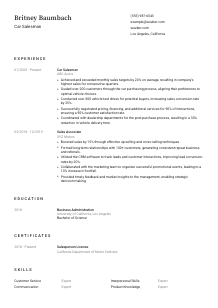
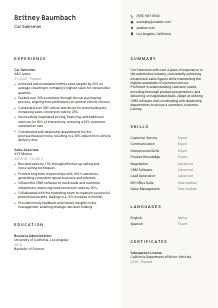
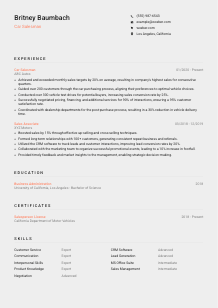
Closing deals, but your resume isn't in the driver's seat? Check out this Car Salesman resume example, built with Wozber free resume builder. It shows how to align your sales savvy with job requirements, so your career drives as smoothly as the cars you sell!
Car sales resumes are strongest when they show how you move a buyer from first conversation to signed paperwork. Dealerships want more than general sales confidence. They want to see customer discovery, product presentations, test drives, financing conversations, follow-through with F&I or delivery teams, and a track record of closing deals without losing the customer experience.
A tailored resume changes how quickly that sales process becomes visible. When your wording matches the posting's language around targets, CRM use, negotiation, and customer service, hiring teams can separate dealership-ready candidates from broader retail sales applicants much faster. Wozber's free resume builder helps you shape that experience into an ATS-compliant resume, so the resume makes your sales results, dealership workflow, and customer-facing strengths easy to recognize.
In dealership hiring, your contact section should be clean and businesslike. Sales managers do not need flair here. They need to know you are reachable, local when required, and presenting yourself like someone who can handle customer interactions professionally from day one.
Put your full name at the top in a clean, easy-to-read format. Right beneath it, use the target title "Car Salesman" if that matches the posting, or a close variant such as Automotive Sales Consultant when that is the employer's wording. This immediately places you in the right lane for dealership hiring.
Use the job title shown in the posting when it fits your background. That helps both ATS parsing and human review, especially when a dealership is hiring for a specific floor role rather than general sales. Here, using "Car Salesman" keeps the resume aligned with the employer's language.
Every contact detail should support fast follow-up after an interview screen or sales manager review.
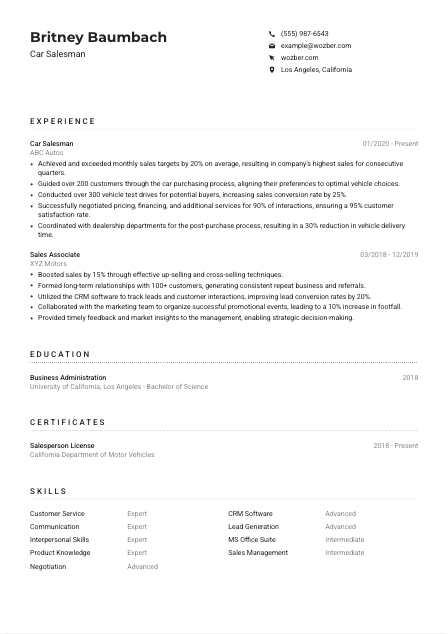
If the employer asks for candidates in a specific area, include city and state. For this example, "Los Angeles, California" directly addresses the location requirement and saves the hiring team from guessing about commute or relocation.
A LinkedIn profile can help if it reflects your dealership history, customer-facing experience, certifications, and measurable sales results. If you include it, make sure the dates, titles, and achievements match the resume exactly.
Keep this section tight, accurate, and aligned with the posting. It should confirm that you are a real local candidate with a professional presence, not create extra questions before the hiring manager reaches your sales record.




This is the section dealership leaders read most closely. They want proof that you can handle the showroom floor, build trust quickly, present vehicles clearly, manage objections, and close business while coordinating the details that keep delivery smooth.
Start by marking the actions and outcomes the employer repeats. In this posting, that includes achieving sales targets, guiding customers through the purchase process, conducting test drives, negotiating pricing and financing, and using CRM software. Those points should appear in your experience section as real accomplishments, not copied phrases.
List your most recent dealership or sales role first, with employer, title, and dates easy to scan. That structure works well in an ATS-friendly resume format and also helps a sales manager quickly track how recently you've worked with live leads, inventory, and closing activity.
Focus each bullet on actions that matter in automotive sales. Good examples include qualifying buyer needs, matching customers to inventory, leading walkarounds and test drives, explaining trim or financing options, and coordinating delivery paperwork. The sample resume does this well with points like guiding more than 200 customers and conducting over 300 test drives, which make the customer journey tangible.
Metrics carry weight in car sales because performance is measured constantly. Include numbers tied to quota attainment, units sold, close rate, upsell revenue, lead conversion, customer satisfaction, referral volume, or delivery turnaround. "Exceeded monthly sales targets by 20%" and "increased sales conversion rate by 25%" are strong examples because they show both sales pace and effectiveness.
Keep older or less relevant experience brief unless it adds something useful, such as negotiation, high-volume customer service, lead management, or finance-related selling. Your experience section should keep the reader focused on showroom performance, customer handling, and revenue contribution.
Your experience should read like someone who can take an upswing from greeting to delivery without dropping the customer or the paperwork. If the section shows sales results, customer handling, and dealership coordination in concrete terms, it is doing its job.
Education usually plays a supporting role in car sales hiring, but it still helps frame your business foundation. A degree is useful when it strengthens your story around sales, customer behavior, marketing, or business operations.
If the posting does not ask for a specific degree, list your highest completed education clearly and move on. For many car sales roles, proven sales results matter more than formal education, so this section should support your candidacy without taking focus away from performance.
Include degree, school, and graduation year or completion date. Avoid crowding this section with unnecessary detail. Hiring teams should be able to read it in seconds while staying focused on your dealership background.
A degree in Business Administration, Marketing, Communications, or a similar field can reinforce your understanding of customer behavior, pricing, and selling. In the example, a business degree works well because it complements a resume already grounded in sales numbers and customer-facing work.
If you are early in your career, a short mention of coursework in sales, negotiation, consumer behavior, or finance can help fill gaps. Once you have solid dealership experience, those details usually matter less than quota results and customer metrics.
Honors, leadership roles, or business competitions are worth adding when they show initiative, communication, or commercial thinking. Leave them out if they make the section longer without adding anything useful for a dealership employer.
Keep education concise and relevant. In automotive sales, it should support your commercial credibility, not compete with the section that proves you can sell cars, manage customer expectations, and hit targets.
Licensing can be a practical hiring requirement in dealership work, not a bonus line. This section should quickly show that you meet legal or state-level requirements and that you stay current on credentials tied to automotive sales.
If the posting mentions a salesperson or dealership license, put that credential first. For this role, a California Salesperson License is directly relevant and should be easy to find. Required credentials belong above optional training because they affect whether you can legally work the role.
Prioritize credentials tied to auto sales, finance products, compliance, negotiation, or manufacturer training. A generic certificate is only worth keeping if it sharpens your value in the showroom, on the lot, or during deal structuring.
Show issue dates and, if relevant, active periods or expiration dates. That matters for licenses and regulated credentials because hiring managers need to know whether you can step into dealership operations without delays.
If you have training in CRM workflows, financing, objection handling, or new vehicle product knowledge, include it when it strengthens your case. Car sales changes with model cycles, incentives, and financing options, so current learning shows professional upkeep.
Use certificates to remove doubt about compliance and reinforce role-specific capability. When the right license and relevant training are visible, the employer can focus on your selling ability instead of administrative gaps.
Dealership skills need to reflect how the job is actually done. A useful skills section shows how you handle buyers, manage leads, work the CRM, explain vehicles clearly, and move a deal toward close without losing accuracy or rapport.
Read the requirements and responsibilities for the exact terms worth mirroring. Here, communication, negotiation, interpersonal skills, customer service, CRM software, and MS Office are all explicit. Those should appear if they match your actual experience.
Lead with skills tied to revenue and customer handling, such as customer service, product knowledge, negotiation, lead follow-up, objection handling, and CRM discipline. Technical tools matter too, but in car sales they work best when paired with front-end selling ability.
Group the most important strengths near the top, starting with customer-facing and closing skills, then adding tools and supporting abilities. The example skill list works because it starts with customer service and communication, then moves into product knowledge, negotiation, CRM software, and sales management.
Choose skills that reflect dealership work you can discuss in detail. If a sales manager asks how you use your CRM, handle financing conversations, or build repeat business, every skill on the page should hold up in that conversation.
Language skills can add real value in car sales, especially in diverse markets where trust and clarity shape the buying experience. This section matters most when it helps you serve a broader customer base or meet a stated job requirement.
If the posting requires English proficiency, list English clearly with an honest level. That immediately answers one of the employer's stated requirements and keeps the resume aligned with the role.
Extra languages can be a real advantage in high-volume or multilingual markets. In Los Angeles, Spanish can strengthen customer communication, help during walkarounds and financing discussions, and widen your referral base.
Terms like Native, Fluent, Advanced, or Conversational are usually enough. Keep them realistic and consistent so the hiring team knows whether you can handle sales conversations, paperwork explanations, or casual rapport-building in that language.
Overstating fluency can become obvious during an interview or on the showroom floor. In a role built on trust, it is better to present a solid conversational level honestly than to claim full fluency you cannot support.
Include languages when they help with customer service, local market reach, or relationship building. If a second language helps you explain features, answer objections, or maintain repeat business, it has clear resume value.
In automotive sales, language ability can improve rapport, reduce confusion, and open more opportunities with local buyers. List it when it genuinely helps you serve customers and close business more effectively.
Your summary should sound like someone a dealership manager would trust with fresh leads and walk-in traffic. In a few lines, it should establish your sales background, your customer approach, and the kind of results you deliver on the floor.
Start with your title and years of relevant experience, such as car sales, automotive sales, or closely related high-value selling. This gives immediate context before the reader gets into the details of your work history.
Choose two or three strengths that matter most for the target role, such as customer discovery, vehicle presentations, negotiation, financing coordination, or CRM follow-up. The sample summary does this effectively by combining customer needs analysis, product presentations, and negotiated deals.
A summary lands better when it includes performance, not just traits. You might mention exceeding sales targets, maintaining a strong customer satisfaction score, improving conversion rates, or building repeat and referral business.
Aim for three to five lines with direct language and role-specific detail. A dealership manager should be able to read it fast and understand your level, your selling style, and your likely value on the floor.
This section should frame you as someone who can sell vehicles, manage customer conversations professionally, and contribute to dealership revenue quickly. If it sounds grounded in real results and real floor experience, it is ready.
A car salesman resume works best when every section supports the same message: you can attract buyers, guide the purchase process, handle objections, and close deals while keeping the experience smooth. Tailor your wording to the posting, use measurable sales outcomes, and keep the structure clean enough for both hiring managers and ATS screening.
Wozber can help you do that efficiently with its ATS-friendly resume template, ATS resume scanner, and AI-powered tailoring tools that surface missing requirements and strengthen alignment with dealership language. The finished resume should make one thing easy to judge: whether you can step onto the floor and produce sales.




