



Use Wozber and land your dream job
Create Resume
No registration required
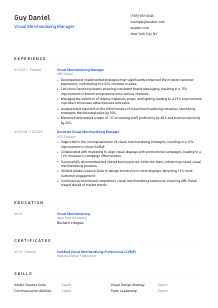
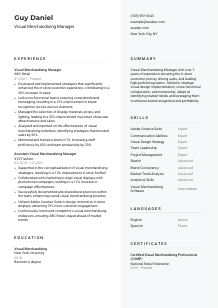
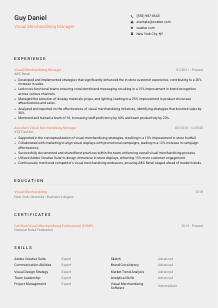
Curating in-store magic, but your resume isn't wowing? Peek at this Visual Merchandising Manager resume example, created with Wozber free resume builder. Learn how to weave your display design skills into job expectations, making your career journey as eye-catching as your shopfronts!
Visual merchandising leadership sits at the point where brand storytelling meets sales performance. Hiring teams want to see that you can turn floor sets, fixtures, props, and lighting into a stronger in-store experience, while keeping execution consistent across campaigns, product launches, and store teams. Your resume needs to show both the creative judgment and the commercial thinking behind your displays.
When that story is tailored well, the reader can quickly tell whether you have managed brand standards, led merchandising teams, and tracked results such as sell-through, customer engagement, or sales lift. Wozber's free resume builder helps shape that experience into an ATS-compliant resume, so the right merchandising language, measurable outcomes, and clean structure come through clearly in both ATS screening and human review.
Visual merchandising is detail-sensitive work, and that expectation starts at the top of the resume. This section should be clean, direct, and aligned with practical hiring filters so nothing distracts from your store experience, design background, or leadership scope.
Set your name at the top in a readable size and simple format. For a Visual Merchandising Manager, polished presentation matters, but this is still an identification element, not a design exercise. Keep it sharp and professional, the same way you would keep signage visible and uncluttered on a selling floor.
Place "Visual Merchandising Manager" directly under your name if that is the role you are pursuing. This immediately aligns your resume with the opening and helps ATS systems connect your profile to the right leadership track in retail, display strategy, and in-store brand execution.
Include a reliable phone number and a professional email address. Add a portfolio, LinkedIn, or personal site if it shows store displays, campaign rollouts, planograms, or visual direction work that supports your application. Make sure every link works and reflects the same title and career history shown on the resume.
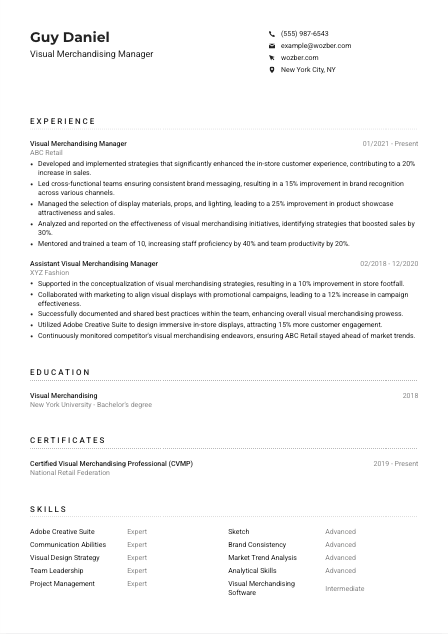
If the posting requires a specific location or relocation, state it clearly in this section. In the example, listing New York City, NY answers a stated requirement right away and removes an avoidable question before the reader gets to your experience.
A visual merchandising resume can benefit from a portfolio link more than many other management resumes. If you have one, feature work that shows window concepts, in-store installations, seasonal resets, branded environments, or campaign adaptation across locations. Keep the presentation consistent with your resume so the transition feels credible and well managed.
Your personal details should confirm that you are easy to contact, professionally presented, and already aligned with any basic location or title requirements. Clean setup here keeps the focus where it belongs, on your merchandising results and leadership track record.




For this role, experience carries the most weight when it connects visual choices to business outcomes. Hiring teams are looking for someone who can shape the customer journey on the floor, coordinate with marketing and operations, and show that displays, fixtures, and promotions translated into stronger performance.
Start by marking the responsibilities that define the role: building visual merchandising strategy, maintaining brand consistency across touchpoints, managing display elements, reviewing performance data, and leading the team. These are the themes your experience bullets should cover. The example resume does this well by addressing each area directly instead of describing retail duties in broad terms.
Use reverse chronological order and show job title, employer, and dates for each role. For merchandising careers, this helps the reader see progression from execution support to strategy ownership, storewide oversight, or multi-location leadership. Titles such as Assistant Visual Merchandising Manager and Visual Merchandising Manager already signal that growth when presented cleanly.
Each bullet should show what you planned, changed, launched, or improved. Focus on work such as seasonal floor sets, window concepts, campaign rollouts, visual standards, fixture selection, product placement, or collaboration with marketing and store leadership. In the example, bullets about cross-functional brand alignment and selecting props and lighting are strong because they describe work that is central to merchandising management.
Whenever possible, tie your work to sales lift, footfall, engagement, campaign performance, conversion, brand recognition, or team productivity. Metrics matter in visual merchandising because they show whether your creative decisions actually improved store performance. The sample's 20% sales increase, 25% improvement in product showcase attractiveness, and 30% sales boost from initiative analysis are the kind of numbers that make strategy feel real.
Keep the section focused on work that strengthens your case for visual merchandising leadership. If an older role does not connect to retail presentation, design execution, customer experience, or team coordination, reduce it or remove it. Space is better used on achievements that show trend awareness, execution discipline, and measurable store impact.
Your experience section should leave no doubt that you can move from concept to floor execution and measure the result. When your bullets connect display decisions, team leadership, and sales outcomes, the role becomes much easier to picture you doing.
Education matters here because it can reinforce your grounding in visual communication, consumer behavior, branding, and retail presentation. It does not need to overshadow your store results, but it should clearly show that you meet the baseline requirement and bring relevant training into the role.
If you hold a bachelor's degree in Visual Merchandising, Marketing, or a related field, present that clearly. When a job posting names a degree requirement, mirroring that language helps confirm eligibility early. The example does this cleanly with a Bachelor's degree in Visual Merchandising.
List the degree, field of study, school, and graduation year or date. Avoid extra detail unless it adds something relevant to merchandising, branding, retail marketing, or design. This section should be easy to scan in a few seconds.
If your degree title closely matches the job, make sure that match is visible. A field like Visual Merchandising immediately supports your knowledge of store layout, product presentation, consumer attention, and brand storytelling. If your degree is broader, such as marketing or design, use the exact official field name and let your experience carry the rest.
Early-career candidates can include selected coursework if it supports the target job. Prioritize classes tied to retail branding, visual communication, design software, consumer psychology, or marketing campaigns. For someone with several years of merchandising leadership, this is usually optional.
Honors, design competitions, retail clubs, or relevant projects can help if they connect to visual storytelling, display design, or market analysis. Keep these additions brief and only include them when they support your professional direction rather than filling space.
This section should confirm that you meet the academic requirement and, where relevant, show subject matter that supports your merchandising decisions. Once that is clear, let your experience and results do the heavier work.
Certifications can strengthen a merchandising resume when they show current training in retail presentation, brand execution, or related design and merchandising practice. They are especially useful when the employer lists certification as a plus or when you want to reinforce specialized knowledge beyond your degree.
Prioritize certificates that connect directly to visual merchandising, retail display, branding, or related design practice. In this opening, a visual merchandising certification is a stated plus, so it deserves space. The example's Certified Visual Merchandising Professional credential is a strong illustration because it maps directly to the role.
Do not overload this section with unrelated courses or general certificates. A short list of relevant credentials carries more weight than a long list that mixes in topics with no clear link to store presentation, customer experience, or team leadership.
Show the date earned, and if the certification is active or renewed regularly, indicate that clearly. Dates help the reader understand whether your training is current, which matters in a field shaped by changing retail formats, shopper behavior, and visual trends.
Visual merchandising shifts with new store concepts, omnichannel campaigns, sustainability standards, and changing customer expectations. Continued certification or structured learning can support your resume when it deepens your grasp of display strategy, design tools, or retail analytics.
Certificates work best when they reinforce the story already told by your experience and education. A relevant credential can add confidence around your merchandising foundation, especially when it reflects current industry practice.
The skills section should reflect how visual merchandising managers actually work. That means balancing design tools with commercial judgment, store execution, brand consistency, reporting, and team leadership rather than listing a generic mix of creative and managerial traits.
Start with the capabilities named in the posting, then keep only the ones you genuinely use. For this role, that includes Adobe Creative Suite or Sketch, visual design strategy, trend awareness, communication, and team leadership. These are not filler keywords. They point to everyday work such as building concepts, guiding execution, and partnering across marketing and retail operations.
Lead with the strongest role-specific skills instead of trying to cover everything. A Visual Merchandising Manager is usually judged more by display strategy, brand consistency, market trend analysis, reporting, and leadership than by broad claims like "hardworking" or "creative." The example skill list works because it stays close to actual job demands.
Organize the section so a recruiter can quickly scan technical tools, merchandising capabilities, and leadership strengths. For example, design software can sit alongside Adobe Creative Suite and Sketch, while strategic skills can cover visual design strategy, brand consistency, and market trend analysis. This gives the section structure without making it feel overdesigned.
When the right tools, merchandising capabilities, and leadership strengths are grouped clearly, this section supports both ATS matching and human review. It should feel like a concise summary of how you operate in a retail environment, not a leftover keyword dump.
Language matters in visual merchandising because the role depends on clear communication with store teams, marketers, vendors, and sometimes regional or international partners. This section is usually short, but it should still reflect the communication demands of the job.
If the posting calls for strong English communication, list English prominently and use an accurate proficiency level. For a management role, this connects to presenting concepts, writing guidance, reporting results, and coaching the team, not just everyday conversation.
Use plain, recognized labels such as Native, Fluent, Advanced, or Conversational. Clear levels help the reader understand whether you can lead meetings, coordinate with vendors, or support multilingual store environments without guessing.
Additional languages can be useful in retail settings with diverse customer bases, vendor networks, or multicultural store teams. In the example, Spanish adds value because it broadens communication reach without distracting from the primary requirement of English.
Only claim the level you can actually use at work. If you would be expected to train staff, discuss campaign direction, or negotiate production details in that language, your rating should reflect that reality.
If your target employers operate in multilingual markets, tourist-heavy retail zones, or international brand environments, language skills can add practical value. Include them when they support store communication, customer engagement, or cross-border collaboration.
For most visual merchandising resumes, languages are a supporting detail, not the headline. Use the section to confirm required communication ability and highlight any added language range that strengthens your retail leadership profile.
A Visual Merchandising Manager summary should quickly establish your level, your market value, and the kind of retail outcomes you influence. The best ones combine creative direction with measurable performance, showing that your displays and brand execution do more than look good on the floor.
Before writing, identify the few themes that matter most in the posting. Here, those themes include in-store customer experience, brand consistency, display execution, performance analysis, and team leadership. Use those priorities to decide what belongs in the opening lines.
Lead with your current professional identity and years of experience. Then add one or two areas of scope, such as driving sales through visual strategy, leading merchandising teams, or aligning displays with brand campaigns. The example summary does this effectively by pairing 7+ years of experience with customer journey, sales, and leadership.
Bring in role language from the posting, but keep it readable. Phrases such as visual merchandising strategies, cross-functional collaboration, market trends, Adobe Creative Suite, or brand consistency can strengthen ATS optimization when they reflect your real background. Wozber's AI resume builder can help surface missing terminology and align wording without making the summary sound forced.
Aim for a brief paragraph that creates a clear picture fast. Two to four sentences are usually enough. Focus on scope, strengths, and results, then let the experience section supply the fuller proof with campaign examples, team metrics, and sales outcomes.
A well-written summary should make the reader expect strong merchandising execution, commercial awareness, and team leadership in the sections that follow. If those themes are clear in the first few lines, the rest of your resume has a much stronger foundation.
A Visual Merchandising Manager resume works best when it shows how your design choices affected the selling floor, the brand, and the numbers behind the display. Keep the focus on strategy, execution, analysis, and team leadership, then support each area with tools, examples, and measurable outcomes that match the target role.
Wozber can help you turn that experience into a tailored, ATS-friendly resume format with stronger ATS optimization, clearer role language, and faster revisions through its ATS resume scanner and resume-building workflow. When the structure is clean and the content is aligned, hiring teams can quickly see your ability to lead merchandising that performs.




