



Use Wozber and land your dream job
Create Resume
No registration required
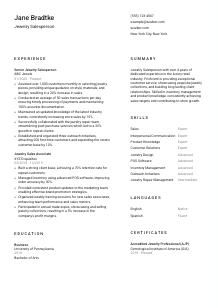
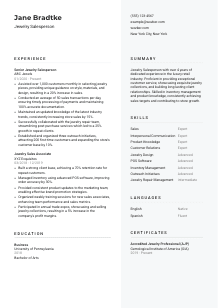
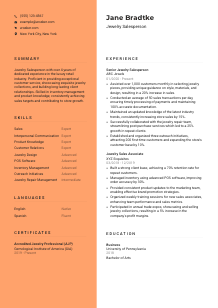
Crafting statements in gems, but your resume feels unpolished? Check out this Jewelry Salesperson resume example, created with Wozber free resume builder. Learn how to solder your sales acumen with precious job specifications, setting your career sparkle as brilliantly as a diamond in the sun!
Jewelry sales is personal, high-trust work. Hiring teams want to see whether you can guide a client through style, gemstones, metals, sizing, and price with enough confidence to close the sale and protect the brand experience after purchase. Your resume should make that client-facing judgment, product knowledge, and sales consistency visible right away.
When the resume is tailored to the posting, the difference shows up fast in screening. A store can quickly tell whether your background is closer to fashion retail in general or to fine jewelry sales with POS accuracy, inventory discipline, and post-purchase service coordination. Wozber's free resume builder helps organize that language into an ATS-compliant resume, so the hiring team can immediately see your relevance for the floor, the client book, and the transaction process.
Luxury retail starts with presentation, and your header sets that tone before anyone reads your sales results. For a Jewelry Salesperson, this section should be clean, professional, and easy to scan, while also covering practical details the employer has stated upfront.
Place your full name at the top in a clear, readable format. In jewelry sales, presentation matters, and a cluttered header suggests the same kind of inattention that would hurt a client interaction or transaction record. If you're using Wozber, choose an ATS-friendly resume template that keeps your contact details sharp and orderly.
Add "Jewelry Salesperson" below your name if that is the role you are pursuing. Matching the posted title helps frame your background correctly, especially when your previous positions include close variants such as Jewelry Sales Associate or Senior Jewelry Salesperson. It also gives ATS systems a direct match on the role name.
List a current phone number and a professional email address. In a client-facing retail role where follow-up, appointment coordination, and event outreach may matter, recruiters should not have to work to contact you. Use a simple email format, ideally based on your name, rather than anything casual or outdated.
If the employer requires candidates to be based in a specific market, state your city and state clearly. Here, "New York City, New York" directly addresses a stated requirement. That is a tailoring move, not a universal rule for every jewelry sales resume, but when location is part of eligibility, make it visible in the header.
Include LinkedIn or a professional portfolio link only if it supports your candidacy. For jewelry sales, that might mean recommendations from luxury retail colleagues, retail event participation, or a polished work history that reinforces your in-store experience. Make sure the profile matches the tone and facts of your resume.
Your header should confirm that you are reachable, professionally presented, and aligned with any basic requirements the store has already named. That lets the hiring team move straight to your sales background and product knowledge.




This section carries the most weight for a Jewelry Salesperson because stores want proof that you can handle product conversations, sales volume, client relationships, and operational accuracy on the floor. Broad retail bullets are rarely enough. Your experience needs to show how you sell, what you sell, and what results followed.
Start by marking the job's core asks: at least 2 years of sales experience, jewelry or luxury retail exposure, gemstone and precious metal knowledge, client relationship building, POS use, inventory handling, and post-purchase coordination. These are not just keywords to paste in. They should shape which roles, bullets, and outcomes you emphasize so the resume reads like a match for a jewelry counter rather than general sales.
List your jobs in reverse chronological order and make the relevance obvious. Titles such as "Senior Jewelry Salesperson" or "Jewelry Sales Associate" immediately anchor your background in the right setting. Under each role, include the store name, dates, and bullets that reflect customer consultations, luxury product knowledge, and transaction handling rather than generic service tasks.
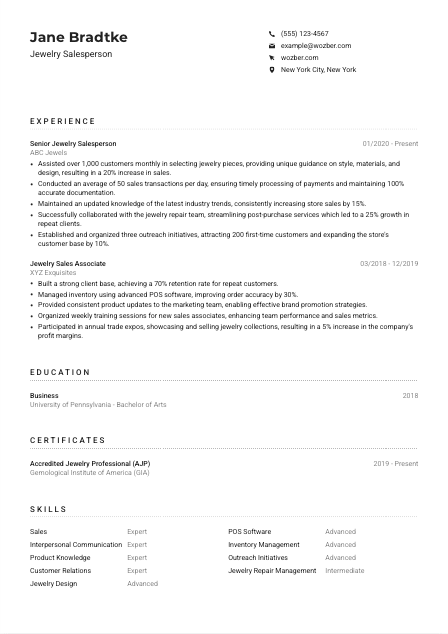
Use accomplishment bullets that show both service quality and business impact. The sample resume does this well by pairing client volume with outcomes, such as assisting more than 1,000 customers monthly and linking that work to a 20% sales increase. Metrics that fit this field include sales growth, average daily transactions, repeat-client rate, documentation accuracy, outreach response, and inventory accuracy.
Every bullet should help answer a likely hiring question: Can you advise on materials and design, close sales cleanly, and support the customer after purchase. Strong examples include processing payments accurately, coordinating resizing or repairs, and maintaining current product and pricing knowledge. Cut bullets that describe broad retail tasks unless they directly support luxury sales performance.
Jewelry clients often ask detailed questions about stones, metals, settings, and value. Include bullets that show you keep up with trends, collections, and pricing, especially if that knowledge improved conversions or store revenue. In the example, staying current with industry trends is tied to a 15% increase in store sales, which is exactly the kind of connection employers want to see.
By the end of your experience section, the reader should understand that you can sell jewelry with confidence, process transactions accurately, and help grow the client base through both service and follow-up. Keep that proof specific and measured.
Education usually plays a supporting role in jewelry sales hiring, but it still helps frame your commercial awareness and professional development. Present it cleanly, and use it to reinforce relevant business or product knowledge without overstating its importance.
If the posting does not require a specific degree, list your strongest completed qualification first. A degree such as a Bachelor of Arts in Business can support your profile by suggesting a grounding in customer behavior, retail operations, or commercial decision-making, even when most of the hiring weight still sits on your sales track record.
Include the degree, school, field of study, and graduation year or date. This section should be quick to scan. For example, "Bachelor of Arts, Business, University of Pennsylvania, 2018" gives the employer the academic context they need without pulling attention away from your store experience and sales results.
If your education relates to business, retail, merchandising, design, or gemology, let that connection work quietly in your favor. There is no need to force a link if your degree is unrelated. For this role, practical jewelry knowledge, client handling, and sales execution will usually matter more than academic theory.
Include coursework, projects, or training only if they strengthen your case for the target role. For example, classes in retail marketing, consumer behavior, luxury branding, or product merchandising can help early-career candidates who need more context around their store readiness. Keep it brief and role-linked.
Jewelry-specific certifications often carry more direct weight than formal education in this field. If you hold credentials such as Accredited Jewelry Professional, list them in the certificates section and allow your education section to stay straightforward. Together, the two sections can show both commercial foundation and product-specific commitment.
Use education to support your sales profile, not to replace the proof in your experience section. A concise, relevant entry is enough when your jewelry retail results do the heavier lifting.
Certifications matter in jewelry sales because they help validate product knowledge in an area where customers often ask detailed questions before making a high-value purchase. If you hold a recognized credential, make it easy to find and easy to trust.
When a posting mentions certifications such as Accredited Jewelry Professional (AJP) or Certified Diamontologist, move those to the top if you have them. That shows direct alignment with the role and signals that your knowledge goes beyond sales technique into stones, metals, and jewelry standards.
List the certification name, issuing organization, and date earned or active period. For example, the sample resume names the Gemological Institute of America as the issuer of the AJP credential, which adds immediate credibility. Clear formatting matters here because recognized institutions carry weight in this market.
If a certification is current, renewed, or part of ongoing study, make that visible. Jewelry sales changes with trends, collections, sourcing conversations, and customer expectations, so current credentials can support your case that your product knowledge is not static.
If you are planning your next move in jewelry retail, consider certifications that deepen your understanding of diamonds, colored stones, valuation basics, or jewelry construction. They are especially useful if you want to move from general luxury retail into a store where clients expect more technical guidance at the point of sale.
A strong certificate entry tells the employer you can speak about jewelry with more authority on the sales floor. In a trust-based purchase, that extra credibility can directly support conversion and client confidence.
The best skills section for a Jewelry Salesperson blends customer-facing strengths with the operational habits that keep high-value retail running smoothly. Focus on abilities that translate directly to consultative selling, accurate transactions, inventory control, and relationship building.
Use the job description to identify the skills that actually drive performance in the store. Here, that includes interpersonal communication, client relationship building, jewelry product knowledge, POS software, inventory management, and written and spoken English. Those should sit above broader or softer traits that could apply to almost any retail role.
List skills you can back up elsewhere in the resume. If you claim expertise in sales, customer relations, or POS systems, your experience bullets should show transaction volume, repeat-client growth, or inventory accuracy. The sample resume does this well by pairing skills like POS Software and Inventory Management with a 30% improvement in order accuracy.
Do not overload this section with every ability you have picked up in retail. Prioritize the skills most likely to matter in fine jewelry sales: product consultation, luxury client service, outreach initiatives, repair coordination, inventory handling, and store systems. A selective list reads as more credible than a long, generic one.
Your skills section should quickly confirm that you can advise clients, close sales accurately, and support store operations without losing the polish expected in luxury retail. Keep every skill tied to the work you actually do.
Language ability can matter more in jewelry sales than in many other retail roles because purchases are personal, emotional, and often high value. Clear communication builds trust during consultations, helps prevent errors in sizing or repair requests, and can deepen relationships with a broader client base.
If the posting asks for spoken and written English, list English first and state your level clearly. For a Jewelry Salesperson, this is about more than basic conversation. It supports client consultations, product explanations, transaction accuracy, and service follow-up such as resizing, cleaning, or repair communication.
Additional languages can be valuable, especially in diverse luxury retail markets. Spanish, for example, may help you serve more walk-in customers, build rapport faster, and create a more comfortable buying experience for repeat clients. Include extra languages when they are strong enough to use in real customer interactions.
State your level with standard labels such as "Native," "Fluent," "Advanced," or "Intermediate." Avoid vague descriptions. Hiring teams want to know whether you can genuinely hold a product consultation, explain pricing and materials, or manage post-sale communication in that language.
In jewelry retail, multilingual ability is not just a bonus line. It can improve trust, reduce misunderstanding, and make high-consideration purchases feel more personal. If language ability has helped you build loyal customers or support outreach events, reinforce that in your experience section as well.
If you work in a market with international shoppers or a multilingual local clientele, improving a second language can be a practical career investment. Even modest gains in product vocabulary, service language, and conversational confidence can expand the kinds of clients you can serve effectively.
List the languages you can actually use in customer conversations and service follow-up. In jewelry sales, that can strengthen trust at exactly the moments when clients need reassurance and clarity.
Your summary should quickly place you in the right part of retail. For this job, that means signaling jewelry or luxury sales experience, client relationship strength, product knowledge, and commercial results in a few focused lines. Skip broad statements that could belong to any store associate.
Start with a direct line that names your profession and level, such as a Jewelry Salesperson with 4+ years in luxury retail. That immediately frames your background for both the recruiter and the ATS, especially when you are applying against candidates with wider retail experience but less jewelry specialization.
Use the next sentence to highlight the capabilities that shape jewelry sales performance: client advising, product knowledge, relationship building, sales consistency, and familiarity with high-touch service. In the sample summary, the strongest elements are luxury retail experience, customer service, jewelry collection presentation, and long-term client relationships.
Aim for three to four lines, not a paragraph full of adjectives. Mention outcomes where they fit naturally, such as consistently hitting sales targets or supporting store growth. That gives the summary a business edge instead of making it read like a generic personal statement.
Close on what you contribute in practical terms, whether that is higher conversion, repeat business, polished customer consultations, or stronger coordination around after-sales service. This final line should leave the reader with a clear sense of how you perform in a jewelry retail environment.
After reading your summary, the employer should already understand that you can sell fine jewelry with product confidence, client care, and reliable store execution. That is the standard to hit before they move into the rest of your resume.
A Jewelry Salesperson resume works when it shows more than enthusiasm for luxury products. It needs clear proof of client advising, product knowledge, transaction accuracy, relationship building, and measurable sales contribution. When those elements are tailored to the posting, your background reads as relevant from the first scan instead of generic retail experience.
Use Wozber to tighten that alignment with an ATS-friendly resume format, role-specific wording, and practical ATS optimization. The result should make it easy for the store to see that you can support the client experience, protect operational accuracy, and contribute to revenue from day one.




