



Use Wozber and land your dream job
Create Resume
No registration required
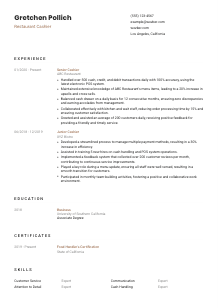
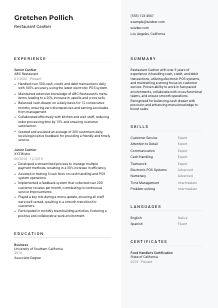
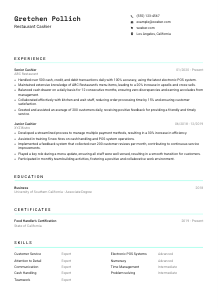
Juggling orders and payments, but your resume feels like just the appetizer? Check out this Restaurant Cashier resume example, made with Wozber free resume builder. It shows how to highlight your cash-handling skills to match job requirements, helping your career reach full-service satisfaction!
Restaurant cashier work moves quickly, and small mistakes show up fast. Hiring teams look for people who can keep lines moving, process payments accurately, answer menu questions, and stay composed while coordinating with kitchen and floor staff. Your resume should make that front-of-house reliability visible from the start.
Screening for this role often narrows fast when resumes are vague about POS systems, payment handling, or customer volume. Using Wozber's free resume builder helps you shape an ATS-compliant resume around the language employers use, so your background reads clearly for both ATS filters and the manager deciding whether you can handle the register, rush periods, and guest interaction.
For a restaurant cashier, the top of the resume should answer practical questions quickly. Can the employer contact you easily, are you applying for the right job, and do you meet any location requirement listed in the posting. Keep this section clean and direct.
Place your full name at the top in the most visible text on the resume. Restaurant hiring can move quickly, especially for front-of-house openings, so make it easy for a manager to remember you after scanning a stack of applications or printing several resumes for interviews.
If you are applying for a restaurant cashier opening, use "Restaurant Cashier" as your headline or target title. That makes your direction clear and helps ATS screening connect your resume to the role. If your recent title was "Cashier" or "Senior Cashier," you can still align the headline to the target position while keeping your work history accurate.
List one phone number you answer reliably and a professional email address. Front-of-house roles are often scheduled quickly, so missed calls and unclear contact information can cost you an interview. If you include a website or profile, make sure it supports your work history instead of distracting from it.
Some employers filter early by local availability. In the example opening, Los Angeles, California is specifically requested, so listing that location removes uncertainty right away. Only include location details that matter for the role you are targeting.
A LinkedIn profile can be useful if it matches your resume and shows steady hospitality or customer service experience. For most restaurant cashier roles, this is optional, so include it only when it adds something relevant such as longer work history, bilingual communication, or related restaurant experience.
This section does not need personality lines or extra detail. It should confirm who you are, how to reach you, and whether you meet any immediate screen such as location or role alignment.




This section carries most of the hiring decision for a restaurant cashier. Managers want to see evidence that you can handle transactions accurately, work through busy periods, support service flow, and communicate well with guests and teammates.
Before writing bullets, identify the operational parts of the job that matter most. For restaurant cashier roles, that usually means cash handling, POS use, customer greeting, menu knowledge, shift balancing, and coordination with kitchen or wait staff. Build your experience around those points instead of listing generic cashier duties.
Start with your most recent position and work backward. That format helps employers quickly see your current level of restaurant or hospitality experience and whether you have recent exposure to busy service environments, payment processing, and front-counter customer interaction.
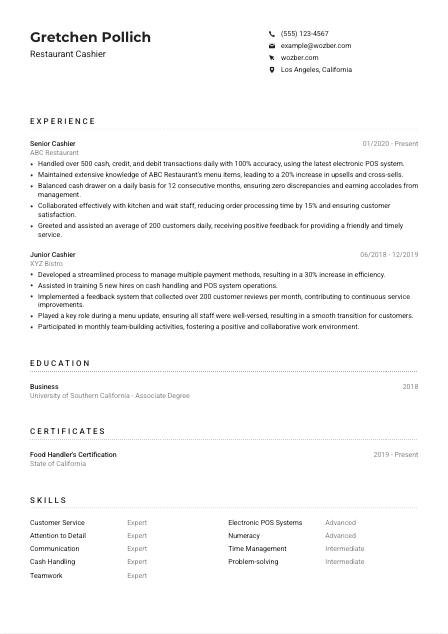
Each bullet should show what you handled and how well you handled it. Use numbers when they reflect the work naturally, such as transaction volume, customer count, upsell results, drawer accuracy, or speed improvements. The sample resume does this well with details like 500+ transactions a day, zero discrepancies, and a 15% reduction in order processing time.
Mirror the terms used in the posting when they match your real background. If the employer asks for a "friendly and positive demeanor" or experience with multiple payment methods, show that in your bullet points through guest interaction, debit and credit processing, and teamwork during busy shifts. That kind of phrasing helps both ATS matching and human review.
Use concise bullet points that focus on service, accuracy, teamwork, and operational consistency. Leave out tasks that do not support cashier hiring decisions. A restaurant manager will care more about how you balanced drawers, handled rush periods, or improved order flow than about vague statements about being hardworking.
A useful experience section makes it easy to picture you on the register during a busy shift. If your bullets show transaction accuracy, menu knowledge, customer volume, and coordination with staff, you are giving the employer the information they need most.
Education usually plays a supporting role for restaurant cashier jobs, but it still helps frame your background. Present it clearly and keep the focus on information that adds context to your service, business, or hospitality experience.
Some cashier openings ask for a diploma or a specific credential, while others focus much more on experience and certifications. Start by checking the posting. If education is not a major requirement, keep the section straightforward and let experience carry more weight.
List your school, degree or program, field of study if relevant, and graduation year or completion date. That is enough for most restaurant cashier applications. The sample resume keeps this section simple with an associate degree and school name, which works well for a role centered on customer service and cash handling.
If your coursework relates to business, hospitality, retail operations, or customer service, it can support your candidacy, especially early in your career. Do not force extra detail if the connection is weak. A short, relevant education entry is better than a padded one.
If a Food Handler's Certification or similar credential is required, place it in the certificates section rather than burying it under education. That makes compliance easier to spot. Education should stay focused on school-based learning unless the resume format combines both sections.
You do not need class lists, GPAs, or extra academic detail unless they clearly strengthen your case. For this kind of front-of-house role, concise presentation works best. The hiring question is whether your background supports reliable service, not how much academic detail you can add.
Education should support the resume, not compete with the sections that matter more for this job. A clear entry is enough when your experience and certifications already show restaurant readiness.
For restaurant cashier roles, certifications are often practical rather than decorative. If the posting mentions food handling or another local compliance requirement, make that credential easy to find and clearly current.
Read the posting carefully and pull out any certification that is specifically requested. In the example, a valid Food Handler's Certification is named directly, so it should appear on the resume if you hold it or are in the process of obtaining it. Lead with required compliance before optional training.
List certificates that are active and connected to restaurant operations, food safety, customer-facing service, or payment handling. Older or unrelated certificates can dilute the section. Employers want to see credentials that matter on shift, not a broad archive.
For each certificate, give the name, issuing organization, and date or validity range. That helps a hiring manager confirm the credential quickly. In a compliance-related area like food handling, current status matters as much as the certificate name itself.
If you are missing a commonly requested credential, note progress only when it is real and near completion. Beyond required certifications, short training in food safety, service standards, or POS workflows can strengthen an early-career resume, especially when your work history is brief.
A well-listed certificate section shows that you can meet health-code or operational requirements without extra follow-up. For restaurant employers, that saves time and removes a common hiring objection.
The skills section should reflect the actual rhythm of the job. Restaurant cashiers need technical accuracy at the register, clear communication with guests, and enough composure to keep service moving when the line builds.
Use the job description as your filter. For this role, skills like electronic POS systems, cash handling, numeracy, communication, teamwork, and working in a fast-paced environment are central. Include the skills you genuinely use, and use the employer's wording when it matches your experience.
A restaurant cashier is part transaction specialist and part customer-facing service worker. Show both sides. Technical skills might include POS operation, handling cash, credit, and debit payments, and drawer balancing. Service skills might include menu knowledge, upselling, communication, and staying calm during rush periods.
Group or order your skills so the most relevant ones stand out first. Avoid long lists filled with vague filler. The sample resume works because it keeps the section anchored in cashier-specific strengths such as customer service, cash handling, electronic POS systems, numeracy, and teamwork.
The best skill lists sound like real restaurant work. If someone reading the resume can imagine you handling the register, answering menu questions, and coordinating with the team during peak hours, the section is doing its job.
Language ability matters in restaurant cashier work because the role sits at the point where payment, service, and customer communication meet. English proficiency is often essential, and any additional language can be useful in high-volume or multilingual service environments.
If the posting asks for fluent English, list English clearly with an accurate proficiency level. This is especially important in customer-facing roles where you need to explain menu items, confirm orders, answer payment questions, and communicate with coworkers during busy service.
Additional languages can be valuable, particularly in diverse markets or neighborhoods with regular multilingual customer traffic. Spanish, for example, may strengthen a restaurant cashier application in some locations, but it should be presented as an added service advantage rather than a universal requirement.
Describe your level with standard terms such as native, fluent, intermediate, or basic. Accurate labels matter because guest interaction depends on real communication ability, not inflated claims. If you can only manage simple greetings, do not present the language as fluent.
Feature languages more prominently when they are likely to improve service on the floor or at the register. A second language can help with order clarification, hospitality, and smoother transactions, especially in casual dining, takeout counters, or neighborhood restaurants with repeat local customers.
Keep this section short and factual. Language ability is useful because it improves customer interaction and service flow, not because it needs a long explanation. In the sample resume, English and Spanish are listed cleanly, which is enough to show added communication range.
For a restaurant cashier, language skills matter when they help customers feel understood and keep service moving. Present them clearly, and let them reinforce your front-of-house value.
The summary should give a quick, credible picture of how you work. For a restaurant cashier, that usually means combining transaction accuracy, customer service, POS familiarity, and the ability to handle pace without losing composure.
Start with your title or professional identity and the amount of relevant experience you have. Keep it specific to restaurant, hospitality, or customer-facing cashier work. A line such as "Restaurant Cashier with 3+ years of experience handling high-volume transactions and guest service" tells the reader far more than a generic statement about being motivated.
Use the next sentence to cover the most important strengths for the target role. That may include electronic POS systems, cash and card transactions, menu knowledge, end-of-shift balancing, or working closely with kitchen and floor staff. The sample summary does this well by focusing on payment handling, fast-paced environments, and smooth operations.
If space allows, include a measurable outcome or standout strength, such as zero drawer discrepancies, strong customer feedback, or upsell contribution. Concrete results help your summary sound earned rather than generic, especially when the rest of the resume backs them up.
Aim for three to five lines. Restaurant managers often review resumes quickly between operational tasks, so your summary should deliver the essentials without becoming a paragraph of broad claims. Focus on what you handle well and what kind of shift environment you are used to.
A useful summary tells the employer, within a few seconds, whether you can step into the register area and perform with accuracy, pace, and solid customer service. That is the standard to hit.
Once each section reflects the actual demands of restaurant cashier work, read the resume as a hiring manager would. You should be able to spot payment accuracy, POS experience, customer service volume, menu familiarity, and teamwork without searching for them.
Wozber helps you tighten that alignment with ATS optimization, role-matched phrasing, and an ATS-friendly resume format that keeps the content easy to scan. The finished resume should make one thing clear right away: you can handle the register, support service flow, and represent the restaurant well at the front counter.