



Use Wozber and land your dream job
Create Resume
No registration required
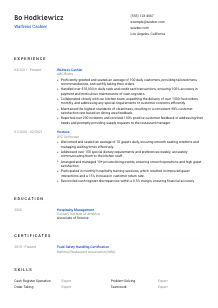
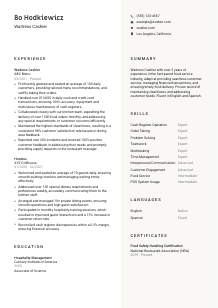
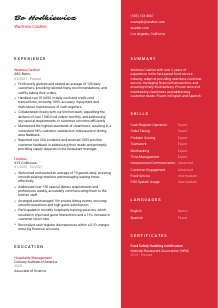
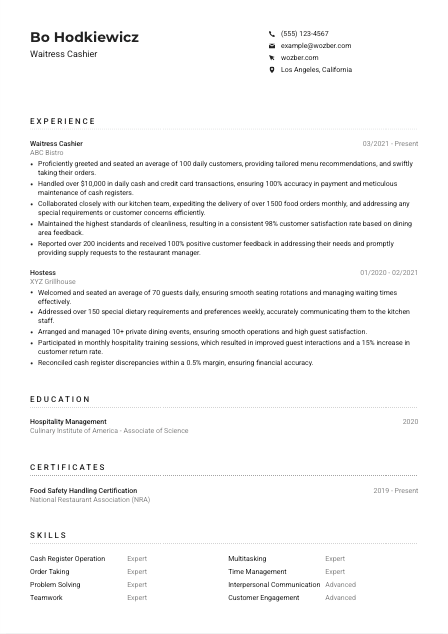
Juggling trays and tabs, but your resume feels short on tips? Check out this Waitress Cashier resume example, created with Wozber free resume builder. It shows how to blend your service charm with cash-handling know-how, ensuring your career serves up both customer satisfaction and a healthy bottom line!
Waitress Cashier work is measured in moments that leave little room for error. You are greeting guests, taking accurate orders, processing payments, relaying special requests to the kitchen, and keeping the front of house clean while service keeps moving. A resume for this role needs to show that you can handle that pace without letting accuracy, customer care, or table flow slip.
When your resume is tailored to the job ad, the hiring team can quickly separate general customer service experience from restaurant-ready experience. Wozber's free resume builder helps you line up the right food service wording, build an ATS-compliant resume, and surface details like POS use, cash handling, and guest-facing volume so your application reads like someone who can step into service and contribute early.
Restaurants move quickly, and the top of your resume should do the same. Your personal details only need to make you easy to identify, easy to contact, and aligned with practical requirements that matter for the opening.
Use your full name as the clearest visual anchor at the top of the page. Keep the formatting clean and professional so the hiring manager can immediately see who the resume belongs to before moving into your service background.
Use the title "Waitress Cashier" if that is the role you are applying for. It signals direct relevance right away and helps frame the rest of your experience around table service, order taking, register work, and customer interaction instead of broader hospitality duties.
List a phone number you answer and a professional email address without nicknames or outdated handles. In restaurant hiring, interviews are often scheduled quickly, so one typo in your number or email can cost you a same-week opportunity.
If the employer wants someone already based in a specific area, include your city and state. In the example, listing Los Angeles, California directly supports the employer's location requirement. For other applications, only add location details that help remove doubt about your availability.
A LinkedIn profile or personal website is optional for this role. Include one only if it supports your restaurant or customer service background and matches the same job titles, dates, and experience shown on your resume. If it is sparse or outdated, leave it off.
This section should answer basic hiring questions fast: who you are, how to reach you, and whether you meet any location requirement. Then let your experience do the real work.




For a Waitress Cashier, experience is where hiring managers look for pace, accuracy, and guest-facing judgment. They want to see what kind of service environment you worked in, how much volume you handled, and whether you can balance hospitality with payment accuracy and coordination with the kitchen.
Before writing bullets, isolate the tasks that define the job. Here, that means greeting and seating customers, recommending menu items, taking orders accurately, processing cash and card payments, coordinating with kitchen staff, maintaining dining area cleanliness, and reporting issues to a manager. Your experience section should mirror those responsibilities where they reflect your real work.
Start with your most recent role and include your job title, employer, and dates for each position. That simple structure matters in food service hiring because managers often skim quickly for recent front-of-house experience, customer-facing continuity, and whether you have worked in a similar environment before.
Generic bullets like "served customers" or "handled payments" miss what actually matters. Show scale and accuracy instead. The sample resume does this well with details such as greeting around 100 customers a day, handling more than $10,000 in daily transactions, and supporting over 1,500 orders a month. Numbers like these make your speed, reliability, and workload easier to judge.
Even if a previous title was Hostess, Server, Crew Member, or Cashier, pull forward the tasks that overlap with Waitress Cashier work. Order accuracy, guest communication, special request handling, register balancing, table turnover support, and dining area upkeep all count when they are presented clearly and tied to outcomes.
Hiring teams usually care most about current or recent work in customer-facing environments where timing and accuracy matter. Older jobs can stay if they add useful context, but give the most space to recent restaurant, café, diner, or retail service roles that show you can work under pressure and keep service consistent.
Your experience section should show more than where you worked. It should show guest volume, payment accuracy, teamwork with the kitchen, and the kind of service rhythm you can maintain during a busy shift.
Education is usually not the deciding factor for a Waitress Cashier job, but it can still strengthen your application when it connects to hospitality, food service, or customer-facing work. Keep it concise and relevant.
Some restaurant jobs do not require a degree, so avoid overbuilding this section. If you have hospitality, culinary, business, or customer service education, include it because it can add context to your training and professionalism. In the example, an Associate of Science in Hospitality Management supports front-of-house readiness without overstating its importance.
Include the school name, degree, field of study, and graduation year or date. That is enough for most food service roles. Keep the layout simple so it does not distract from the experience section, which usually carries more weight in this profession.
If you are newer to restaurant work, relevant coursework can help fill out the picture. Classes in hospitality operations, customer service, sanitation, or cash management can support your fit, especially when your work history is still developing.
If your education included food safety, service standards, or restaurant operations, that context helps. Still, place formal certifications in the certificates section where they are easier to spot. Use education to show foundation, not to duplicate other sections.
Review this section for clarity and trim anything that does not support the role. A Waitress Cashier resume benefits from a quick, relevant education entry rather than a long academic history that pulls attention away from guest service and register experience.
A short, relevant education section works best here. It should reinforce your hospitality background or training, then get out of the way so your service record stays front and center.
Certifications carry more weight in restaurant hiring when they connect directly to sanitation, safe food handling, or local compliance. This section is especially useful when the employer mentions food safety training as preferred.
When the job ad calls out a certification, include it clearly if you have it. In this case, Food Safety Handling certification directly matches a stated preference and supports trust in how you work around food, cleanliness standards, and customer well-being.
Choose certifications that support front-of-house or food service work. Food handler cards, sanitation training, alcohol service certification where relevant, or customer service training can all add value. Leave out unrelated certificates that do not help explain your fit for service, payments, or restaurant procedures.
If a certification is current, make that easy to see. Listing a date range or renewal status helps employers understand that your training is still valid. The sample resume handles this well by showing an active Food Safety Handling Certification.
Restaurants often need staff who can start quickly and meet safety expectations from day one. Keeping this section current can help you avoid delays in the hiring process and shows that you stay aligned with operating standards in food service.
A food service certification will not replace experience, but it can give your resume an immediate lift when the employer wants someone who understands sanitation and safe handling practices.
The best skills section for a Waitress Cashier is specific enough to sound like restaurant work. Focus on the abilities that affect service flow, order accuracy, payment handling, guest communication, and coordination during busy periods.
Pull the practical skills from the job description first. For this kind of role, that usually includes cash register operation, POS use, order taking, change calculation, multitasking, communication, and customer service in a fast-paced setting. These are the terms most likely to align with both hiring managers and ATS screening.
Lead with the skills that make you effective on the floor. In the example, cash register operation, order taking, multitasking, teamwork, and interpersonal communication all support the role directly. Prioritize hard and workflow-based skills first, then add soft skills that clearly affect service quality.
Do not overload this section with every strength you have. A tighter list is more convincing, especially when the same skills are backed up in your experience bullets. Choose skills you can support with real examples such as transaction accuracy, handling guest requests, maintaining service speed, or working smoothly with kitchen staff.
A useful skills section should sound like someone who knows the front of house, the register, and the pace of meal service. If the skills on the page match the work you have already done, the section will hold up.
Language skills matter in customer-facing restaurant roles because they affect how clearly you can take orders, explain menu items, handle concerns, and keep service moving. Include them when they help explain your communication range.
If the posting requires English, put it at the top with an honest proficiency level such as Native or Fluent. For a Waitress Cashier, this matters because order accuracy, payment communication, and guest interactions all depend on clear spoken English.
Additional languages can be useful in restaurants with diverse guest traffic. In the example, Spanish adds practical value because it can help with menu explanations, special requests, and smoother service for more customers. That said, extra languages are a bonus unless the employer specifically asks for them.
Use clear levels such as Native, Fluent, Conversational, or Intermediate. Avoid overstating your ability. If a guest asks detailed questions about ingredients, pricing, or changes to an order, your true level will show quickly on the floor.
If language ability is likely to help in the restaurant's customer base, include it. If not, keep the section short. The point is to show communication range that improves guest service, not to fill space.
List each language once with its proficiency level and avoid long explanations. This section works best when a manager can see in a second whether you meet the English requirement and whether you bring any added value in guest communication.
For this role, languages matter when they improve order clarity and guest comfort. Present them simply and honestly, and they become a useful part of your customer-facing profile.
Your summary should quickly tell the employer what kind of service professional you are. For a Waitress Cashier, that means combining guest service, payment accuracy, pace, and teamwork in a few lines that feel grounded in actual restaurant work.
Look at what the employer needs most and build around that. Here, the key themes are customer-facing experience, accurate cash handling, multitasking in a fast-paced setting, and strong communication. Those points should shape the summary instead of generic statements about being hardworking or friendly.
Start with a direct line that names your role and years of experience. The example summary uses "Waitress Cashier with over 2 years of experience," which works because it immediately places the candidate in the right lane for restaurant hiring.
Choose strengths that connect to daily responsibilities. Good options include handling cash and card transactions accurately, taking orders efficiently, coordinating with kitchen staff, maintaining dining area standards, or supporting high guest volume with consistent service. If you mention achievements, keep them short and relevant.
Aim for 3 to 5 sentences. That is enough space to establish your service background, mention a few role-specific strengths, and note any useful edge such as bilingual communication or food safety training. A focused summary helps the reader reach your experience section with the right expectations.
A good summary for this role should sound like someone who can greet guests, handle the register, and stay composed through a busy service window. Keep it short, concrete, and tied to the work.
A Waitress Cashier resume works when each section reinforces the same picture: you can welcome guests, take orders accurately, process payments without errors, support the kitchen flow, and keep the dining area presentable during busy shifts.
Use Wozber's free resume builder to organize your experience, strengthen role-specific wording, and create an ATS-friendly resume template that keeps service skills, cash handling, and food service qualifications easy to read. The final version should make one thing clear fast: you are ready to handle the front of house with speed, accuracy, and professionalism.




