



Use Wozber and land your dream job
Create Resume
No registration required
Mastering the store's style, but your resume seems out of fashion? Check out this Clothing Store Manager resume example, created with Wozber free resume builder. Learn how to flaunt your retail flair in line with job prerequisites, ensuring your career journey is as trendy as your displays!
A Clothing Store Manager is hired to keep the sales floor running smoothly while protecting margin, coaching staff, and turning customer demand into sell-through. Resume space should make that operational range visible. Hiring teams want to see how you led associates, handled inventory flow, improved the customer experience, and translated store traffic into revenue, not just that you held a management title.
When those priorities are reflected in the same language the employer uses, your background is easier to sort in both human review and ATS screening. Wozber's free resume builder helps shape that wording into an ATS-friendly resume format, so store leadership, POS fluency, inventory control, and sales strategy stand out early. That matters when a hiring manager is deciding whether you can run daily store operations with confidence.
Retail hiring moves quickly, and the top of your resume needs to answer the practical questions first. For a Clothing Store Manager, that means presenting your name, target title, contact details, and location in a clean format that supports fast outreach and confirms any local requirement without clutter.
Use your full name in a slightly larger font so it is easy to find at a glance. Store management resumes are often reviewed quickly alongside many candidates, and a clear header helps keep your application memorable and easy to track through interview scheduling.
Place "Clothing Store Manager" directly below your name when that matches the role you are pursuing. This immediately positions your background around apparel retail leadership instead of broader retail experience, which is useful when employers are comparing candidates from fashion, big-box, and general store environments.
Hiring managers and recruiters need fast ways to reach you for interviews, schedule changes, or follow-up questions about availability and store experience. Make every contact detail accurate and professional.
If the job requires you to be based in a specific market, include your city and state. For the example role, listing Los Angeles, California helps confirm alignment with the local requirement right away. You do not need a full street address unless an employer specifically asks for it.
Include LinkedIn or a professional website only if it supports your case with consistent retail experience, leadership progression, or brand-facing work. If your profile highlights store openings, sales growth, visual merchandising projects, or multi-location responsibility, it can strengthen the first impression.
This section should confirm who you are, what role you are targeting, and how to contact you without delay. For a Clothing Store Manager, clean personal details help the employer move quickly from initial screening to a conversation about your store performance and team leadership.




This is the section that carries the most weight for store management hiring. Employers want to see whether you have led teams, hit sales targets, managed inventory, handled daily operations, and supported a customer experience that keeps shoppers coming back. Your bullets should read like store results, not a copy of the job description.
Mark the responsibilities and tools that appear repeatedly in the posting, then reflect them in your experience bullets where they are true to your background. For this role, that includes daily store operations, staff training, inventory management, customer experience, collaboration with buying teams, and sales strategy across in-store and online channels.
List your positions in reverse chronological order with title, company, and dates. That layout helps hiring teams quickly follow your progression from assistant management into full store leadership, which is often an important distinction in apparel retail hiring.
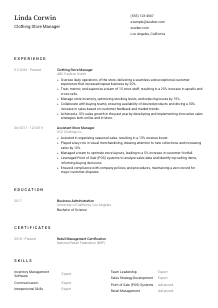
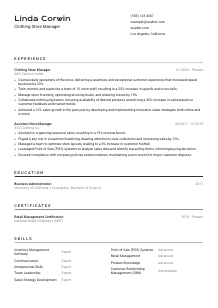
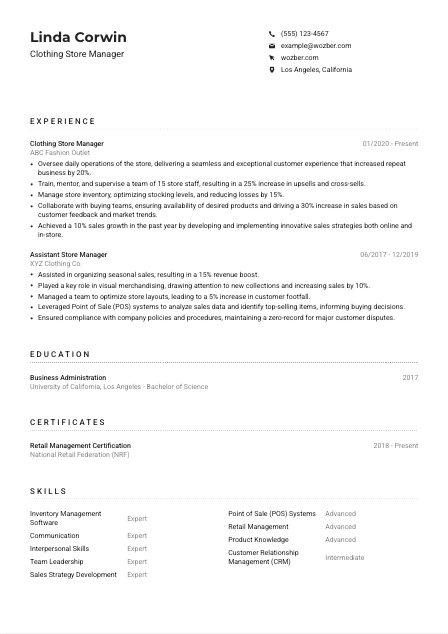
Each bullet should show what you owned and what changed because of your work. Instead of saying you "supervised staff," show the result of that supervision through sales, service, or training outcomes. The sample resume does this well by tying team leadership to a 25% increase in upsells and cross-sells.
Numbers are especially persuasive in store management because performance is measured constantly. Include metrics such as sales growth, repeat business, shrink reduction, conversion-related gains, average transaction improvements, inventory loss reduction, footfall changes, or team size. Results like 20% higher repeat business, 15% lower losses, or 10% annual sales growth tell a hiring manager far more than general claims about strong performance.
Prioritize achievements that match fashion retail operations. Team coaching, visual merchandising support, POS analysis, seasonal campaigns, stock optimization, and buyer collaboration belong near the top. Less relevant work can stay shorter or fall off entirely if it does not help prove you can manage a clothing store profitably and smoothly.
Your experience section should make it easy to picture you on the floor, in the back room, and in the daily numbers. When your bullets connect leadership, inventory discipline, customer experience, and sales performance, the employer can quickly see you operating at store-manager level.
Education will not outweigh weak store results, but it can strengthen your candidacy when the employer prefers business or retail-related study. Present it clearly so recruiters can confirm the credential fast and move back to the experience that shows how you run sales, staff, and operations.
Start by identifying whether the posting names a degree or field of study. Here, a bachelor's degree in Business, Retail Management, or a related field is strongly preferred, so candidates with that background should make it easy to find.
Include degree, field of study, school, and graduation year or date. Keep the format simple and consistent. In retail management resumes, this section works best when it confirms your academic background without competing with your measurable store achievements.
If your degree aligns with business, merchandising, retail management, or another related field, make that connection obvious. The example resume's Bachelor of Science in Business Administration is a strong match for a management-focused store role and should be presented clearly.
Most experienced store managers do not need a long list of classes. Include coursework only if it adds something useful, such as retail operations, merchandising, supply chain, consumer behavior, or sales management, especially if you are earlier in your career.
Academic honors, retail competitions, or projects tied to merchandising, analytics, or customer behavior can help if they reinforce your management profile. Keep them brief and relevant. Once you have several years of apparel retail leadership, these details should stay secondary to business results on the floor.
For this profession, education is supporting material unless the employer places unusual weight on it. Make the credential easy to verify, especially when it matches a preferred business or retail background, then let your operating results do the heavier lifting.
Certifications can strengthen your profile when they sharpen the employer's picture of your retail knowledge, systems fluency, or management training. They are especially useful if the posting mentions them as a plus or if you want to reinforce expertise in store operations, POS tools, loss prevention, or team leadership.
Review the posting for any direct mention of certifications or related knowledge areas. This job lists retail management certification as a plus, so credentials in retail operations, store leadership, merchandising, or POS systems make sense to feature.
List the certifications that support apparel store management most clearly instead of including every course you have completed. A Retail Management Certification or a POS-related credential carries more weight here than a general seminar unrelated to sales floor operations or inventory control.
Add issue or renewal dates when they show current relevance. This helps employers understand whether your training is recent and whether your knowledge of store systems, sales practices, or retail leadership has been maintained over time.
Retail changes quickly through new POS workflows, omnichannel selling, stock visibility tools, and customer service expectations. Updating your certifications shows that you stay current with how stores actually operate, which matters more than collecting outdated credentials that no longer reflect the floor environment.
A well-chosen certificate section adds practical depth to your resume. For a Clothing Store Manager, it should support your command of retail operations, systems, and team leadership, not distract from the sales and service results you have already delivered.
A Clothing Store Manager needs a mix of floor leadership, commercial judgment, and system fluency. Your skills section should reflect how the store actually runs, from POS reporting and stock control to staff coaching and customer-facing communication. Keep it focused on capabilities that matter in apparel retail.
Read the posting closely and note the skills tied to execution. In this case, POS systems, inventory management software, leadership, communication, interpersonal skills, and sales strategy development all belong near the top because they connect directly to daily store performance.
Store managers are expected to move between systems and people all day. Include operational tools such as POS systems, inventory platforms, CRM, or retail reporting alongside leadership skills like coaching, team supervision, product training, and customer issue resolution. That balance reflects how the job is actually performed.
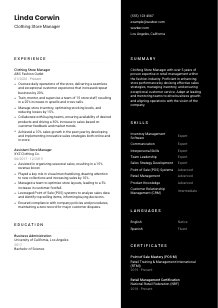
Do not overload this section with generic traits. Choose skills that connect to revenue, service, and execution in a clothing store. The example resume works because it combines inventory software, team leadership, sales strategy development, POS systems, and product knowledge rather than relying on broad claims alone.
This section should read like the toolkit of someone who can lead associates, manage inventory, and drive sales. If the skills on your resume match the way an apparel store actually operates, the rest of your experience becomes easier to trust.
Language ability matters in retail because service quality depends on clear communication with customers, staff, and management. If the posting names a required language, make it easy to find. Additional languages can also add value in markets where the customer base is diverse and service depends on quick, natural interaction on the sales floor.
Start with any language the employer explicitly asks for. Here, English proficiency is vital, so English should appear clearly with an honest proficiency level.
If you speak additional languages that can help with selling, service recovery, or team communication, include them with clear proficiency labels. In a market with varied customer traffic, Spanish or another widely used language can be a practical advantage, especially in apparel retail where conversation drives recommendations and add-on sales.
Extra languages are worth listing when they support the store environment or broader brand operations. If they have little practical relevance and your section is becoming crowded, keep the list focused on the languages you would actually use in customer interactions or staff communication.
Use straightforward labels such as "Native," "Fluent," "Intermediate," or "Basic." Accuracy matters. If you claim fluency, assume you may need to handle customer questions, returns, styling help, or staff conversations comfortably in that language.
Language value depends partly on where the store operates and whom it serves. While English may be the only required language, multilingual ability can be especially useful in urban retail settings or neighborhoods with regular foot traffic from diverse communities.
For a Clothing Store Manager, language skills matter when they help you sell, solve problems, and lead people more effectively. Present them clearly and honestly so the employer can judge how they support the store environment.
Your summary should give a quick, grounded picture of the kind of store manager you are. In a few lines, show your level of experience, your retail setting, and the business outcomes you tend to influence. This is the place for apparel retail leadership, not broad personality statements.
Start with a direct statement that identifies your title and background. A line such as "Clothing Store Manager with 5+ years in fashion retail" immediately gives hiring teams the context they need and separates you from candidates whose management experience comes from other retail segments.
Include two or three strengths tied to store performance, such as sales growth, repeat business, inventory control, staff development, or customer experience. The example summary works best where it points to sales strategies, inventory management, and team leadership because those are core parts of the job.
Stay within 3 to 5 lines and use language that reflects the target role. If the employer emphasizes apparel retail, POS proficiency, staff coaching, and in-store plus online sales, those themes belong here if they match your background. Remove anything generic that does not help explain how you run a store.
End with a line that shows how you contribute at management level, such as aligning operations with sales goals, leading high-performing teams, or improving the customer journey. Keep it practical. The summary should leave the reader expecting strong floor execution and commercial accountability.
A well-written summary should quickly connect your apparel retail experience to the outcomes the employer needs. When it names your level, your environment, and your results, it sets up the rest of the resume to confirm that you can lead the store effectively.
A Clothing Store Manager resume should now present a clear case for your ability to lead staff, manage inventory, deliver strong customer experiences, and hit sales goals. When each section reflects real store metrics, apparel retail context, and the employer's language, your application becomes much easier to shortlist.
Wozber's free resume builder and ATS resume scanner can help you tighten that alignment, surface missing keywords, and shape your experience into an ATS-compliant resume without losing the practical detail that matters in retail hiring. The final result should make one thing easy to judge: you can run a clothing store with commercial discipline and confident team leadership.




