



Use Wozber and land your dream job
Create Resume
No registration required
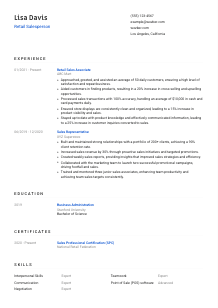
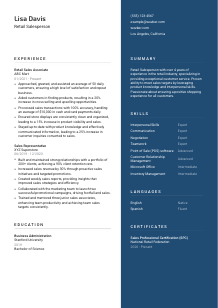
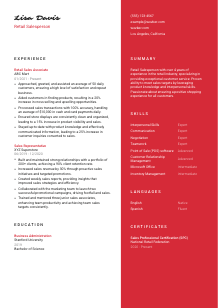
Selling sneakers, but your resume isn't making the right fit? Check out this Retail Salesperson resume example, created with Wozber free resume builder. Learn how to lace up your sales feats with job requirements, so your career story is just as appealing as the latest kicks on the shelf!
Retail sales work is judged in the moment. You are expected to welcome shoppers quickly, learn what they need, recommend the right product, close the sale, and keep the floor organized while promotions and stock change around you. A Retail Salesperson resume should make that pace visible. Hiring teams want to see real customer-facing experience, comfort with transactions, and proof that you can support both revenue and the in-store experience.
Small wording choices change how your background is read, especially when a store is hiring for customer service, POS accuracy, and schedule flexibility. Wozber's free resume builder helps you shape an ATS-compliant resume around the language of the job ad, so retail managers can quickly see whether you have handled customer interactions, sales transactions, and day-to-day floor duties at the level they need.
Retail hiring often moves fast, so your header should answer the practical questions first. Make it easy to see who you are, what role you do, and whether you meet straightforward requirements such as location and contact availability.
Use your full name in a clear, readable format at the top of the page. Keep it more prominent than the rest of the header so the hiring manager can identify your application quickly when reviewing a stack of retail candidates for floor and cashier coverage.
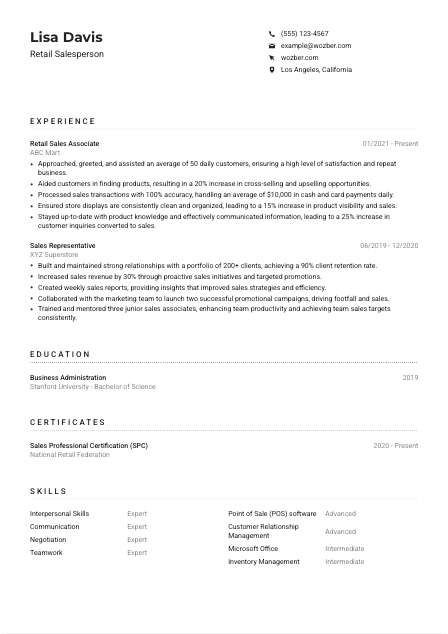
Place the job title directly under your name when it matches the role you are pursuing. Using "Retail Salesperson" immediately tells the reader that your background is aligned with customer assistance, product recommendations, transaction handling, and sales support rather than a broader or unrelated sales path.
List a phone number and professional email address you check regularly. Retail interviews are often scheduled quickly, and missed calls can cost you a shift-based opportunity. Double-check every digit and character before sending your resume.
If the employer asks for candidates in a specific area, show your city and state clearly. Here, listing "Los Angeles, California" helps confirm that you meet the stated location requirement without forcing the employer to guess about commute or relocation.
A LinkedIn profile or personal website can help if it reflects the same retail experience shown on your resume. If you include one, make sure the job titles, dates, and core achievements match, especially around customer service, sales performance, and store operations.
Your personal details should remove friction, not create it. When the header confirms your role, contact information, and any location requirement right away, the hiring manager can move straight to your customer service and sales experience.




For retail roles, the experience section carries most of the hiring weight. Managers look for people who can serve customers well, process transactions accurately, support store standards, and contribute to sales without heavy supervision.
Read the posting closely and note the daily work behind the wording. In this case, that includes greeting customers, helping them choose products, using POS systems, handling cash, keeping displays organized, and staying current on promotions. Your bullets should reflect those same operating tasks when they match your real experience.
List your jobs in reverse chronological order and prioritize positions that involved direct customer contact, store sales, cashier work, merchandising, or stock support. A role such as Retail Sales Associate should naturally sit ahead of less relevant work because it shows day-to-day familiarity with the store environment.
Retail resumes get stronger when each bullet shows both the task and the result. Instead of saying you helped customers or maintained displays, show the scale or outcome. The example resume does this well with details such as assisting around 50 customers a day, handling $10,000 in daily payments with 100% accuracy, and improving product visibility enough to support sales growth.
The most convincing metrics in retail usually involve sales lift, transaction accuracy, customer volume, conversion, upselling, retention, or merchandising results. Choose numbers that reflect how your store measured performance. A 20% increase in cross-selling or a 25% rise in inquiries converted to sales says much more than a generic claim about strong service.
Customer-facing work from other industries can still help if it proves communication, cash handling, or sales ability, but keep the focus on retail-relevant responsibilities. If an older role does not support the target job, shorten it or remove it so the resume stays centered on store operations, shoppers, and revenue contribution.
Your experience section should make it easy to picture you in the store. When your bullets connect customer interaction, POS work, merchandising, and sales outcomes, the hiring manager can see how you would perform in the role from day one.
Education usually sits behind experience for retail hiring, but it still adds context. It can reinforce business awareness, communication skills, and the discipline to learn products, promotions, and store procedures quickly.
Some Retail Salesperson postings focus almost entirely on experience, schedule availability, and customer service. When no specific degree is required, include your education clearly but let it support rather than overshadow your sales floor background. A Business Administration degree, for example, adds commercial context without replacing proof of store performance.
List the school, degree, field of study, and graduation year in a straightforward format. Retail managers and recruiters often skim quickly, so this section should be simple to read in a few seconds.
If your degree connects to business, sales, marketing, or customer behavior, keep that field visible. In the sample, a Bachelor of Science in Business Administration supports the candidate's retail background by showing formal exposure to commerce and business fundamentals.
You do not need to list classes unless they strengthen your case, especially early in your career. Courses in sales, consumer behavior, merchandising, or marketing can help if you have limited retail experience, but skip them if your work history already proves those abilities more clearly.
Honors, leadership roles, or relevant student activities can help when they connect to service, teamwork, or commercial settings. Keep them brief and include them only if they add something your work history does not already show.
Use education to support your retail story, not to carry it. For most Retail Salesperson applications, this section works best when it is concise, relevant, and easy to scan.
Certifications are rarely the deciding factor in entry-level or mid-level retail hiring, but they can strengthen your profile when they relate to sales technique, product knowledge, or customer service standards.
If the posting does not require a certificate, treat certifications as supporting material rather than the centerpiece of the resume. A credential such as Sales Professional Certification works because it reinforces selling ability and professional commitment, which are useful in many customer-facing retail environments.
Prioritize certificates that connect to sales, retail operations, customer service, inventory, or product categories tied to the store. One relevant certification adds more value than a long list of unrelated courses.
List the certificate name, issuing organization, and date or active period. That gives the hiring manager enough context to understand whether the training is current. In the example, including the National Retail Federation and the active date range makes the credential more credible.
Retail changes with new products, systems, and customer expectations. If you work in a specialized store, ongoing training in product lines, visual merchandising, loss prevention, or service standards can strengthen future applications and internal promotion prospects.
A relevant certificate can sharpen your profile, especially when your experience already shows strong store performance. Keep this section focused on training that helps you sell, serve, and operate effectively in a retail setting.
A Retail Salesperson skills section should read like a summary of how you work on the floor. Focus on abilities tied to customers, transactions, product knowledge, and day-to-day store execution instead of filling the section with broad claims.
Start with the language the employer uses. Here, that includes interpersonal skills, customer-focused communication, negotiation, POS software, Microsoft Office, and clear English communication. Matching those terms where they honestly reflect your experience improves both relevance and ATS optimization.
Put the most role-critical skills first. For many retail positions, that means customer service, sales communication, product knowledge, cash handling, POS systems, merchandising, and teamwork. The example resume balances soft skills with operational tools by pairing communication and negotiation with POS software and inventory management.
Do not overload the section with every skill you have ever used. A shorter list of skills you can defend in an interview is far more effective. Each item should connect back to real situations such as assisting customers, processing purchases, organizing displays, or supporting promotions.
The best retail skills lists are specific enough to match the job and practical enough to match the floor. When your skills section reflects customer interaction, transaction accuracy, and store support work, it strengthens the rest of your resume.
Language ability matters in retail because every shift depends on clear communication with customers, coworkers, and supervisors. If a posting names a required language, make that visible immediately and treat additional languages as service and sales advantages.
When English is specifically required, list it clearly with your proficiency level. For a Retail Salesperson, that supports customer conversations, product explanations, promotions, policy communication, and transaction accuracy at the register.
Additional languages can be a real advantage in stores that serve multilingual communities. For example, pairing English with Spanish may help with product questions, upselling, and smoother service across a broader customer mix.
Use clear labels such as Native, Fluent, Advanced, or Conversational. Do not overstate your ability. In retail, language skill is tested quickly in live customer interactions, so honest labeling matters.
Language skills are most useful when they improve the shopping experience. They can help you explain product features, resolve concerns, and build rapport with repeat customers, especially in busy urban markets and community-based retail settings.
Include languages when they help you perform the job better, not just to fill space. If you can genuinely support sales and service across more customer interactions, this section adds meaningful value to your application.
For retail hiring, language skills matter when they improve service, trust, and sales conversations. Keep this section honest and relevant to the customers you are likely to serve.
The summary should give a hiring manager a fast read on your level, your retail strengths, and the kind of store contribution you can make. Keep it short, specific, and grounded in customer service and sales results.
Before writing the summary, identify the recurring priorities in the posting. Here, those include customer assistance, product knowledge, POS transactions, communication, and dependable store support. Use those themes to decide what belongs in your opening lines.
Start with your title or specialization and your years of relevant experience. A line such as "Retail Salesperson with over 4 years of experience in retail sales and customer service" immediately positions you within the right hiring lane.
Follow with one or two concrete strengths tied to outcomes. The sample summary works because it links product knowledge and interpersonal skill to sales targets and a positive shopping experience. You can also reference strengths such as transaction accuracy, upselling, or merchandising support if those are central to your background.
Aim for a compact paragraph that can be read in seconds. Retail managers are not looking for a long personal statement. They want a concise overview that tells them you can work with customers, support sales, and handle the pace of the store.
A well-written summary should tell the reader, quickly and clearly, that you can serve customers, support revenue, and operate confidently on the sales floor. That is the standard the rest of your resume should reinforce.
A Retail Salesperson resume works when it reflects how stores actually hire: customer service first, sales contribution close behind, and reliable execution across transactions, merchandising, and daily floor duties. Use clear examples, relevant metrics, and the language of the job ad so your experience reads as immediately usable.
Wozber's free resume builder can help you shape that content into an ATS-friendly resume template, strengthen ATS optimization with role-matched phrasing, and refine each section with its ATS resume scanner and AI resume builder workflow. The end result should make one thing easy to judge: whether you can step onto the floor, help customers confidently, and support store performance from your first shift.




