



Use Wozber and land your dream job
Create Resume
No registration required
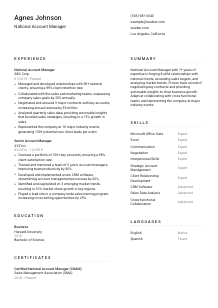
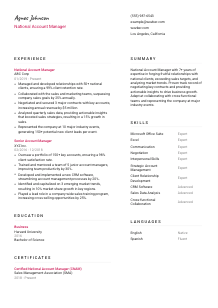
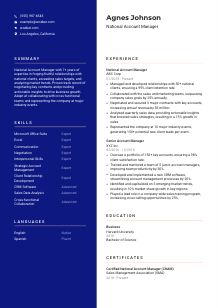
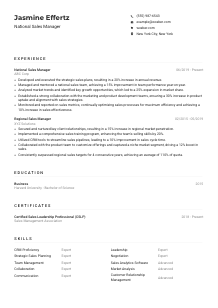
Navigating the big leagues, but your resume feels local? Scale up with this National Account Manager resume example, created with Wozber free resume builder. Learn how to present your strategic sales plays and market mastery in a way that resonates with top-level job requirements, positioning your career as a national champion!
National Account Manager hiring usually turns on one question fast: can you grow revenue across complex client relationships without losing control of retention, pricing, or execution? A resume for this work needs to show ownership of major accounts, steady commercial results, and the ability to coordinate internal teams around client commitments, not just general sales experience.
When that story is tailored well, the resume is easier to sort in both human review and ATS screening because core terms like account growth, contract negotiation, CRM reporting, and sales analysis appear in the right context. Wozber's free resume builder helps shape that language into an ATS-compliant resume, so hiring teams can quickly see whether your background lines up with national account coverage and revenue responsibility.
For a National Account Manager, the top of the resume should confirm professional credibility and remove any friction around contactability or logistics. Keep this section clean, businesslike, and aligned with the practical requirements named in the posting.
Your name should be the most visible text on the resume, using a clear font and enough spacing to anchor the document. In sales and account-facing roles, presentation matters. A polished header signals the same professionalism clients would expect in a proposal or account review.
Place the exact role title, "National Account Manager," under your name when that is the position you are pursuing. This helps recruiters and ATS systems connect your resume to the opening immediately and sets the right commercial context before they read your experience.
Hiring for account leadership moves quickly, especially when a candidate has relevant revenue ownership or national client exposure. Make every contact field easy to trust and easy to use.
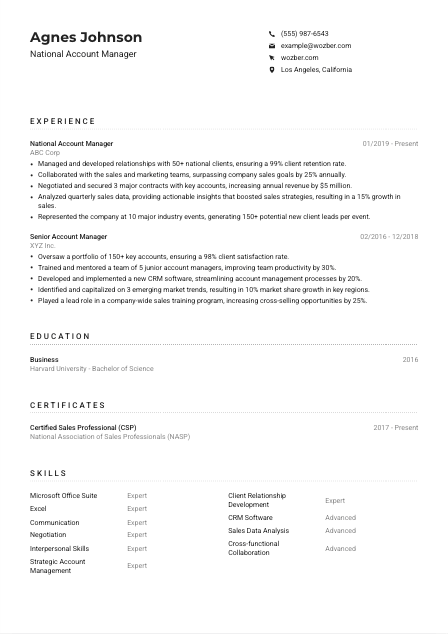
Some National Account Manager roles are tied to a territory, headquarters, or travel base. Here, Los Angeles, California is listed as a requirement, so showing that location in your header immediately clears a practical filter. Treat this as tailoring to the posting, not a rule for every national account role.
If your LinkedIn profile reflects account wins, industry relationships, portfolio scope, or trade show activity, include it. A personal website can also help if it presents sales leadership, speaking appearances, or measurable business results. Just make sure the content matches the resume and feels current.
This section should confirm that you are reachable, professionally presented, and operationally aligned with the role. When those basics are clear from the first line, the reader can focus on your client portfolio, revenue results, and account leadership.




National Account Manager resumes are read through a commercial lens. Employers want to see the size of the accounts you handled, the revenue or retention outcomes you influenced, how you negotiated terms, and how well you worked across sales, marketing, operations, or service teams to deliver for major clients.
Before writing bullets, identify the core work the employer cares about most: managing national clients, negotiating contracts, analyzing sales performance, collaborating across teams, and representing the brand in the market. Then make sure your experience section reflects those same responsibilities through actual results. In the example, "Managed and developed relationships with 50+ national clients" works because it directly maps to client ownership instead of speaking in vague sales terms.
List roles in reverse chronological order with job title, company, and dates first. Under each role, lead with accomplishments rather than duties. For account management positions, that usually means portfolio size, retention, revenue growth, contract value, channel expansion, or process improvements tied to CRM and forecasting workflows.
Numbers matter in account management because they show whether you protected and expanded business. Use metrics like retention rate, annual revenue growth, contract value, sales target attainment, lead generation from industry events, or account portfolio size. The sample bullet about securing 3 major contracts worth $5 million in annual revenue is effective because it shows both negotiation success and business outcome.
Choose accomplishments that reinforce national account work, even if you have broader sales experience. Prioritize enterprise or multi-location clients, pricing discussions, renewals, cross-functional execution, category insights, and strategic planning. If a bullet does not strengthen your case for managing key accounts at scale, cut it or rewrite it with more relevant emphasis.
Strong wording for this field includes phrases such as "negotiated pricing and terms," "grew key accounts," "improved client retention," "analyzed sales trends," "developed account plans," and "partnered with internal teams to execute client strategy." This is where ATS alignment matters too. Mirror the employer's phrasing naturally, especially around CRM use, sales analysis, and account development, as long as it reflects work you have actually done.
Your experience section should leave no doubt that you can handle important accounts with commercial discipline. When account scope, results, negotiation wins, and cross-functional execution are all visible, the resume reads like someone ready to own national business.
Education will not carry a National Account Manager application on its own, but it can quickly confirm that you meet the academic baseline. When a posting asks for a bachelor's degree in business, sales, or a related field, make that qualification easy to find and easy to match.
If the role asks for a bachelor's degree in Business, Sales, or a related field, list your degree clearly without forcing the reader to infer relevance. A "Bachelor of Science in Business" immediately satisfies the requirement in this example and helps the resume pass an early screen.
Use a straightforward entry with degree, field, school, and graduation year. National account hiring teams are usually scanning for qualification match first, not looking for a creative education layout. Clear formatting also supports ATS readability.
When your education lines up closely with the job description, use the accurate field name rather than a broader shorthand. The example does this well by naming Business directly, which removes ambiguity. If your degree is in a related discipline such as marketing, communications, or economics, list it honestly and let your experience carry the sales relevance.
For experienced candidates, coursework is usually optional. Include it only if it reinforces account management, pricing, market analysis, business strategy, or sales operations. Early-career applicants can use relevant coursework or projects to show commercial thinking before they have a large client portfolio.
Academic distinctions, sales competitions, leadership programs, or business-focused extracurriculars can add value if they are genuinely relevant. Keep them brief. At this career level, employers will care far more about account growth and client results, so education should support the resume, not overtake it.
This section should quietly establish that you meet the educational requirement and let the rest of the resume carry the heavier proof. Clear degree information keeps the focus where it belongs, on your ability to manage and grow major accounts.
Certifications are not mandatory for every National Account Manager role, but the right ones can strengthen your case by showing continued development in sales strategy, account leadership, or customer management. They work best when they support the commercial story already visible in your experience.
Choose credentials tied to selling, negotiation, strategic account management, customer success, or commercial planning. In the example, CSP and CNAM fit naturally because they reinforce core responsibilities already shown elsewhere on the resume.
Use the certification name, issuing organization, and date or active period. Keep the order practical, usually by relevance or recency. This makes it easy for a recruiter to connect the certification to your broader account management background.
In client-facing commercial roles, current credentials can suggest that your methods stay aligned with modern selling practices, relationship management, and market expectations. If a certification expires or requires renewal, show the active dates accurately.
National account work changes with buying behavior, sales technology, channel strategy, and reporting expectations. Relevant certifications can underline that you keep sharpening your approach to negotiation, account planning, and strategic selling instead of relying only on past experience.
The right credentials add another layer of credibility when they align with the work you already do. Keep this section focused on certifications that strengthen your case for handling high-value accounts, client strategy, and revenue growth.
The skills section should quickly show whether you have the toolkit for managing large client relationships and commercial performance. For this role, that means balancing relationship-driven skills with practical tools such as CRM systems, Excel-based analysis, forecasting, and negotiation.
Pull the required skills directly from the posting and match them to your actual background. Here that includes CRM software, Microsoft Office Suite, Excel, communication, negotiation, and interpersonal skills. If those are part of your day-to-day work in account planning, reporting, pricing discussions, or client reviews, they belong in the section.
Lead with the capabilities that define effective national account management: strategic account management, client relationship development, contract negotiation, sales data analysis, forecasting, cross-functional collaboration, and business development. These are more useful than broad filler terms because they connect to how the role is actually measured.
A grouped structure can help. For example, place tools like CRM software, Excel, and Microsoft Office together, then cluster business skills such as negotiation, account planning, and data analysis, followed by people-facing strengths like communication and stakeholder management. This gives the reader a fast view of both operational and client-facing ability.
A well-built skills section should make it obvious that you can manage both the relationship side and the reporting side of a national account book. Choose skills that support account growth, client retention, and disciplined sales execution.
Language skills matter in account management when they affect client communication, market coverage, or relationship building. Even when the role is primarily domestic, the language section can help confirm that you meet communication requirements and can work effectively across a broader client base.
If the posting specifies advanced English speaking and comprehension, show that clearly in the language section. For a National Account Manager, that requirement connects directly to presentations, contract conversations, internal coordination, and client communication.
Additional languages can strengthen your profile if they support regional relationships, distributor communication, multicultural account coverage, or trade show interactions. In the example, fluent Spanish adds practical value, especially in client-facing environments where bilingual communication can help deepen relationships.
Use levels that accurately reflect how you work, such as Native, Fluent, Conversational, or Basic. In account management, overstating language ability can become obvious quickly in client calls, presentations, or negotiation settings.
Some national account positions involve diverse customer groups, cross-border business, or coordination with international stakeholders. In those cases, language ability can become a real advantage. If the role is more regionally focused, the section can still help distinguish you, but it should remain secondary to your account results.
The value of language skills here is practical. They can improve relationship building, reduce friction in client discussions, and help you represent the company more effectively in meetings or events. List languages as communication assets, not as filler.
For this role, languages should reinforce your ability to manage client relationships clearly and credibly. Lead with the required English proficiency, then add other languages that genuinely expand your account coverage or relationship-building reach.
The summary should read like a concise account of the business results you bring. For a National Account Manager, that means quickly establishing years of experience, client scope, sales performance, and the strategic strengths that matter most for managing key accounts.
Start by identifying what the role emphasizes most. In this case, the priorities are national client management, exceeding sales targets, contract negotiation, data analysis, and cross-functional collaboration. Your summary should touch those themes in a few tight lines, using language that reflects your actual background.
Lead with a clear descriptor such as "National Account Manager with 7+ years of experience" or a similar phrasing grounded in your track record. This helps the reader place your level quickly and sets the commercial context for the achievements that follow.
Choose highlights that speak directly to account growth and client leadership, such as exceeding sales targets, negotiating major contracts, improving retention, or turning sales data into strategy. The sample summary works because it mentions both relationship management and measurable business contribution, rather than using only broad leadership language.
Aim for a short paragraph that can be read in seconds. Skip generic traits and focus on scope, outcomes, and relevant strengths. If you are using Wozber's AI resume builder, this is a strong place to refine wording around job-relevant keywords so the summary aligns with the posting without sounding copied.
Your summary should make the reader expect strong experience in client growth, negotiation, and account performance before they reach the first job entry. When written well, it frames the rest of the resume around commercial impact and national account responsibility.
A National Account Manager resume should show that you can keep important clients, grow revenue, negotiate effectively, and turn account data into action. Every section should support that picture, from the location detail required by the posting to the metrics in your experience and the tools in your skills section.
Use Wozber to turn that experience into an ATS-friendly resume template with clear structure, stronger keyword alignment, and practical ATS optimization. The finished resume should make one thing easy to judge: whether you can step into a national account book and deliver commercial results with confidence.




