



Use Wozber and land your dream job
Create Resume
No registration required
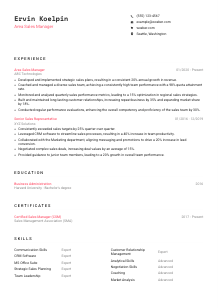
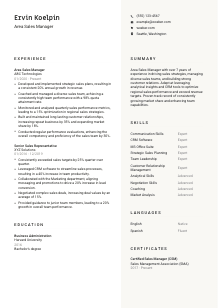
Navigating markets, but your resume isn't sealing deals? Check out this Area Sales Manager resume example, created with Wozber free resume builder. It shows how to spotlight your territorial triumphs and revenue wins to align with job requirements, driving your sales career to new heights!
Area Sales Managers sit at the point where revenue targets, field execution, and team performance meet. Hiring teams want to see how you turn territory plans into booked business, coach reps to stronger quota attainment, and use customer and pipeline data to adjust strategy when a region starts to stall. Your resume should make that operating range visible fast.
A tailored resume changes how quickly a reader can connect your background to regional sales leadership. When your titles, metrics, CRM experience, and team scope mirror the language of the opening, Wozber's free resume builder helps you shape an ATS-compliant resume that highlights the right sales signals early, so the employer can immediately see whether you can lead the territory, grow market share, and develop the team.
For a sales leadership role, the header should remove friction. Keep it clean, direct, and aligned with the position so the employer can confirm who you are, how to reach you, and whether you meet any practical requirement such as location.
Use your full name in a clear, readable format at the top of the page. There is no need for decoration here. For a client-facing management role, a straightforward presentation sets the right tone and keeps attention on your commercial track record.
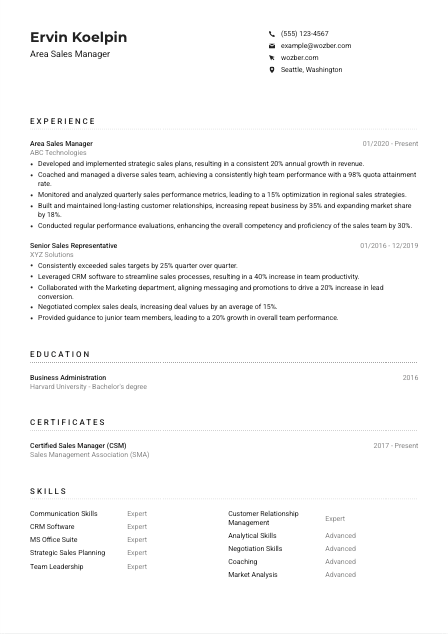
Place the target title directly under your name when it accurately reflects your background. Using "Area Sales Manager" tells the reader you are applying as a regional sales leader, not as a general salesperson or a broader operations candidate. It also helps ATS matching when the posting uses that exact title.
Include a current phone number, a professional email address, and your city and state. If the posting specifies a location requirement, address it here. In the example, listing "Seattle, Washington" immediately supports the employer's request for a candidate already based there or ready to relocate.
Include LinkedIn or a professional website only if it reinforces your sales leadership profile. That page should echo the same employment dates, titles, and results shown on the resume, especially revenue growth, team size, territory scope, and major account wins.
Skip personal details that do not affect hiring decisions, such as age, marital status, or a full street address. For an Area Sales Manager, the valuable information is your professional identity, contact access, and any location detail that matters to territory coverage.
Your header should confirm the basics in seconds and support the practical requirements of the role. Once that is clear, the rest of the resume can stay focused on revenue growth, team management, and regional execution.




This is the section that carries the most weight for an Area Sales Manager. Employers look for evidence that you can set regional direction, coach reps, read performance data, and move revenue, not just maintain an account list.
Read the job description closely and underline the responsibilities that define success in the role. Here, that includes strategic sales planning, managing and coaching sales reps, analyzing sales performance metrics, working with Marketing, growing customer relationships, and conducting performance reviews. Those themes should shape the examples you choose from your own history.
List roles in reverse chronological order and make the progression easy to follow. For this kind of opening, a move from senior individual contributor work into multi-rep leadership is especially persuasive. The sample resume shows that progression well, moving from Senior Sales Representative to Area Sales Manager.
Each bullet should show an action and a business outcome. Instead of writing that you "managed a sales team," show what your management delivered, such as quota attainment, rep development, shorter sales cycles, higher conversion rates, or revenue growth. The example does this by pairing leadership with a 98% quota attainment rate and stronger team competency.
Numbers matter here because commercial roles are measured that way. Prioritize revenue growth, quota performance, repeat business, market share gains, deal size, conversion rate, forecast accuracy, retention, or productivity improvements from CRM adoption. The example's 20% annual revenue growth, 35% repeat business increase, and 18% market share growth are strong models because they tie effort to commercial impact.
Choose examples that support the opening you are targeting. For an Area Sales Manager, the best bullets usually involve territory planning, cross-functional coordination, rep coaching, performance analysis, customer expansion, and negotiation. Even earlier roles should be framed through that lens. In the sample, the Senior Sales Representative role includes CRM process improvement, marketing coordination, and mentoring, which all help bridge into management.
By the end of this section, a hiring manager should be able to picture you leading reps, reading the numbers, and adjusting regional strategy with confidence. If your bullets show business movement rather than job duties alone, the section is doing its job.
Education usually plays a supporting role for experienced sales leaders, but it still matters when the posting asks for a specific degree. Present it clearly so the employer can confirm the baseline requirement without hunting for it.
If the employer requests a bachelor's degree in Business, Marketing, or a related field, make sure your degree is easy to find and clearly labeled. A Business Administration degree, as shown in the example, fits that requirement well and aligns naturally with sales planning, market analysis, and commercial management.
List the degree, field of study, school, and graduation year. That is enough for most Area Sales Manager applications. A clean format keeps the section easy to scan and avoids distracting from the experience section, where most of your selling power sits.
If your degree directly supports the role, let that alignment work for you. Business, marketing, management, and related commercial disciplines all reinforce your ability to understand territory planning, customer acquisition, and sales performance analysis.
Most mid-career candidates do not need course lists, but they can help if your background is less direct or if the role leans heavily on a certain specialty. Courses in market research, sales management, consumer behavior, or business analytics can add context when they strengthen your story.
Honors, competitions, and student leadership can stay on the resume if they are genuinely relevant, especially for earlier-career candidates. Once you have several years of sales results and team leadership behind you, those details should stay secondary to revenue, coaching, and regional performance outcomes.
For an Area Sales Manager, education should quickly verify that you meet the stated academic requirement and then get out of the way. Let it support the story, while your experience carries the commercial case.
Certifications are not always mandatory in sales management, but the right ones can reinforce leadership range, sales methodology, or commitment to ongoing development. Keep this section selective and closely tied to the job you want.
When a posting does not require a specific certification, include credentials that deepen your management profile. A certification such as Certified Sales Manager fits well because it supports coaching, planning, performance management, and sales leadership rather than unrelated general training.
List only the certifications that strengthen your candidacy for regional sales leadership. Good choices usually connect to sales management, negotiation, customer strategy, CRM adoption, or leadership development. A shorter, sharper list works better than a long catalog of low-value badges.
Show the year earned and, if relevant, whether the credential is current. That helps an employer see whether your training is recent and still active. In fields shaped by changing sales technology, reporting tools, and management practices, current learning adds credibility.
Sales environments change with market conditions, CRM workflows, forecasting methods, and team structures. Your certifications can reflect that you keep building on your management approach instead of relying only on past performance. This matters most when the role involves coaching and strategy, not just direct selling.
A well-chosen certification section tells the employer that your sales leadership approach is current and intentional. Keep it focused on credentials that support how you lead teams, grow accounts, and improve regional performance.
The skills section should reflect how Area Sales Managers actually operate. That means a mix of commercial judgment, people leadership, reporting discipline, and the tools used to manage pipelines, accounts, and performance.
Build your list from the posting before you add anything else. Here, that includes analytical ability, communication, negotiation, CRM software, and MS Office. Those are core operational skills for reviewing performance, leading conversations with customers, and managing forecasts, plans, and reporting.
Do not separate people leadership from execution skills. An Area Sales Manager is expected to coach reps and also work comfortably with CRM data, spreadsheets, presentations, and regional reporting. The sample resume balances both by listing strategic sales planning, team leadership, customer relationship management, CRM software, and market analysis.
Trim any skill that does not help explain your readiness for area management. A concise set of relevant skills reads better than a crowded list. If a skill supports territory growth, account development, rep coaching, pipeline analysis, or cross-functional collaboration with Marketing, it likely belongs here.
The best skills list makes the rest of the resume feel consistent. It should support the story that you can lead a team, interpret sales data, work through CRM systems, and drive results across a region.
Language ability matters in sales when it affects customer communication, team leadership, or market coverage. Present it clearly, especially when the posting explicitly asks for English proficiency.
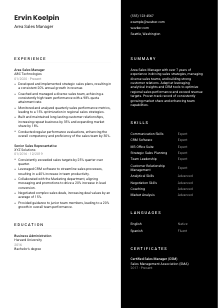
If the job description states that spoken and written English is essential, list English prominently and describe your proficiency accurately. "Native" or "Fluent" works when true and directly supports your ability to lead reps, present strategy, negotiate, and communicate with customers and internal partners.
Place the most important language first, then add others that could support account development or regional communication. For many Area Sales Manager roles, the required language should lead the section even if you speak several others.
Extra languages can be valuable when they help with customer relationships, distributor communication, or team leadership across diverse territories. In the example, Spanish adds useful commercial range, though it is an advantage rather than a stated requirement for this particular opening.
Use honest labels such as Native, Fluent, Intermediate, or Basic. In a sales role, overstating language ability can backfire quickly during interviews, customer calls, or written communication tasks.
If your territory includes multilingual customers or cross-border business, language ability can support trust, smoother negotiations, and faster relationship-building. If the role is fully local and English-only, keep the section brief and factual.
For this role, language details should support communication credibility, not distract from sales performance. Lead with what the employer requires, then add any extra language strength that could help you cover the market more effectively.
The summary is where you frame your commercial story before the reader reaches the detail. For an Area Sales Manager, it should quickly establish your level, your scope, and the kind of sales results you have led.
Start with a direct description of who you are professionally. "Area Sales Manager with 7+ years in sales" works because it sets seniority and function immediately. Avoid vague self-description and lead with the role you actually perform.
Use the next line or two to connect your background to the opening's core demands. For this job, that means strategic sales planning, managing diverse sales teams, analyzing performance metrics, and building customer relationships. The example summary handles this well by linking leadership, analytics, CRM use, and revenue performance.
Aim for a short paragraph that can be read in seconds. Three to five lines is enough to establish your management profile, industry strength, and a few measurable outcomes. Every phrase should earn its place by tying back to regional sales leadership.
Close with the kind of result that matters in a sales leadership hire. That might be repeated target overachievement, market share growth, stronger team capability, or sustained regional revenue gains. A line about consistently growing market share or improving team performance gives the summary real weight instead of leaving it at general claims.
A strong summary should make the reader expect solid metrics, disciplined team leadership, and clear regional ownership in the sections that follow. When it is written well, the rest of your resume feels like proof of the opening paragraph.
An Area Sales Manager resume should read like a record of commercial ownership. Every section needs to support the same picture: you can set regional direction, coach people to better performance, build durable customer relationships, and deliver the numbers.
Before you send it, check that your language matches the posting, your metrics are specific, and your CRM, leadership, and analytical strengths are easy to spot. Wozber's free resume builder can help you organize that into an ATS-friendly resume format with sharper ATS optimization, so the hiring team can quickly recognize your readiness to lead the area.




