



Use Wozber and land your dream job
Create Resume
No registration required
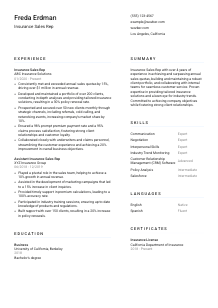
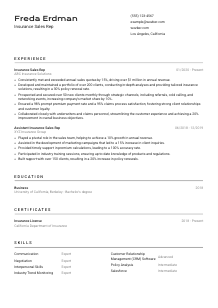
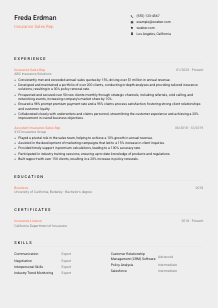
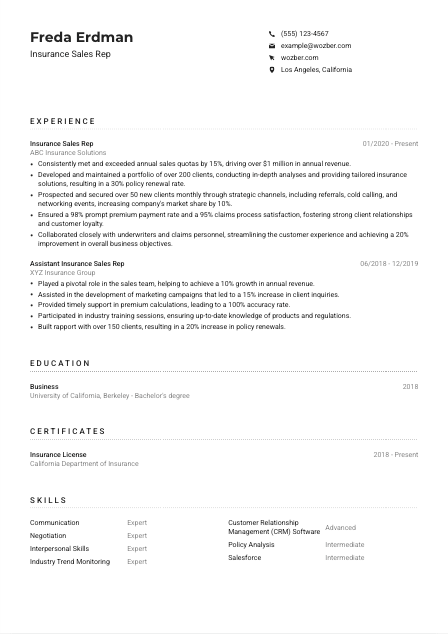
Shielding clients, but your resume coverage feels incomplete? Check out this Insurance Sales Rep resume example, created with Wozber free resume builder. It shows how to align your sales savvy and policy expertise to clearly meet job requirements, making sure your career protection is as solid as your premium offerings!
Insurance sales hiring moves quickly when a resume makes two things obvious right away: you can bring in business, and you can keep clients confident through renewals, payments, and claims support. For this profession, vague sales language is not enough. Hiring teams want to see how you build a book of business, how you recommend coverage based on real client needs, and how you work with underwriters or claims teams to keep service smooth after the policy is sold.
A tailored resume changes how your background is read in that first pass. With Wozber's free resume builder and an ATS-compliant resume structure, you can match the posting's language around quota attainment, needs-based analysis, client portfolio management, and licensing without forcing keywords. That makes it easier for the employer to quickly recognize that your sales results and client handling experience translate directly into an Insurance Sales Rep seat.
Insurance sales is a relationship-driven role, so the header of your resume should already look reliable, local when required, and easy to contact. This section is simple, but it still affects whether a hiring manager can immediately place you in the right market, license context, and communication channel.
Use your full name in a clean, readable format at the top of the page. In a client-facing profession built on trust, a polished header sets the tone before the reader gets to your production numbers or portfolio history.
Place "Insurance Sales Rep" directly under your name if that matches the role you want. This helps recruiters and ATS software connect your background to the opening immediately, especially if your previous title was slightly different, such as Assistant Insurance Sales Rep or Account Representative.
List a phone number you answer, a professional email address, and any relevant professional link if it is current. If you include LinkedIn or a personal website, make sure it supports your sales background with the same employers, dates, and client-facing achievements shown on the resume.
Some insurance roles are tied to a specific market because licensing, local client relationships, and in-person networking matter. In the example posting, being based in Los Angeles, California is a stated requirement, so listing "Los Angeles, California" removes an avoidable question early in the review.
A LinkedIn profile can strengthen your application when it reflects your sales track record, insurance focus, recommendations, or license information. Skip empty or outdated links. Every item in this section should support credibility and make follow-up easy.
Your personal details should do one practical job well: make you easy to contact and easy to place in the right insurance market. When this section is accurate and aligned, the reader can move straight to your sales results and client portfolio experience.




For Insurance Sales Rep roles, the experience section carries the most weight. Hiring managers look here for quota performance, client acquisition methods, policy retention, and the day-to-day discipline behind renewals, payments, and claims coordination. Generic statements about customer service will not compete with clear production and portfolio results.
Mark the responsibilities and performance themes in the job description before you edit your bullets. For this role, that includes prospecting through referrals and cold calling, conducting needs-based analyses, maintaining a client portfolio, supporting renewals and claims processes, and collaborating with underwriters or claims teams. Those are the ideas your experience bullets should reflect in plain language.
List your jobs in reverse chronological order with employer name, title, and dates. Insurance hiring often looks for progression, such as moving from support or assistant sales work into direct production, account ownership, or broader client portfolio responsibility.
Focus each bullet on work that matters in insurance sales: bringing in new clients, recommending appropriate coverage, keeping accounts renewed, resolving policy issues, and supporting claims or payment accuracy. The example resume does this well by tying client portfolio management to tailored insurance solutions instead of leaving it as a generic relationship-building claim.
Numbers make your production easier to judge. Include quota attainment, annual revenue, number of clients managed, new clients secured per month, renewal rate, payment timeliness, satisfaction scores, or market-share contribution when you have them. Results like exceeding annual quotas by 15% or managing 200+ clients tell a much clearer story than "responsible for sales growth."
Prioritize achievements that connect to insurance production, retention, client advising, or cross-team coordination. If an older bullet does not show sales discipline, policy knowledge, client service, or measurable business growth, trim it or rewrite it so the section stays focused on the work this profession is hired to do.
When your experience section is tailored well, a hiring manager can quickly see how you sell, how you retain accounts, and how you support clients after the sale. That combination matters in insurance because revenue and service quality are tightly linked.
Education is usually a supporting section in insurance sales, but it still matters when a posting asks for a bachelor's degree in Business, Finance, or a related field. Present it clearly so the reviewer can confirm the requirement without searching for it.
If you have the requested degree, name it clearly and use the exact field where appropriate. In the example, "Bachelor's degree in Business" aligns neatly with the posting and confirms the academic baseline right away.
List your degree, field of study, school, and graduation year or date. Insurance sales resumes benefit from clean structure because the reader's attention is usually on licensing, sales performance, and client portfolio scope.
When your education lines up closely with the posting, make that alignment easy to spot. A business, finance, economics, or related degree supports the analytical side of insurance advising, from coverage discussions to client needs assessment.
Relevant coursework can help if you are newer to insurance sales and want to reinforce knowledge in finance, risk management, marketing, or business communication. Once you have solid production history, coursework usually matters less than quota results and portfolio growth.
Honors, scholarships, leadership roles, or sales-related extracurriculars can be useful when they show communication, business judgment, or initiative. Keep them if they add context. Leave them out if they distract from stronger professional proof.
This section does not need flourish. It should quickly confirm that you meet the educational baseline and then let your license, sales history, and client results do the heavier lifting.
In insurance sales, certification is not a decorative extra. An active license can be the difference between being considered now and being screened out immediately. Present this section with enough precision that the employer can tell you are ready to operate in the required market.
If the posting requires an active insurance license, put that first. For many insurance sales jobs, this matters more than any optional course certificate because it directly affects your ability to sell and advise within state rules.
List the credentials that carry hiring value for this profession, especially state-specific insurance licenses or recognized insurance designations. The example resume places the California insurance license front and center, which is exactly the right move for a California-based opening.
Add the issuer and date or active period so the employer can quickly understand the credential's status. For insurance roles, this helps confirm current eligibility and shows attention to compliance, which matters when regulations and product rules change.
Renew licenses on time and add newly earned credentials that strengthen your marketability, such as product-line licenses or insurance-focused professional development. Ongoing learning matters because products, regulations, and client expectations do not stay still in this field.
A well-presented certifications section tells the employer you are licensed, current, and prepared to work within the regulatory realities of insurance sales. That is practical hiring value, not resume decoration.
Insurance Sales Rep skill sections work best when they reflect how the job is actually done. The mix usually includes selling ability, relationship management, policy analysis, and the operational tools that keep client communication and follow-up organized.
Read the posting closely and note both explicit and implied skills. Here, communication, negotiation, interpersonal strength, and industry awareness are stated directly, while prospecting, needs analysis, renewal follow-up, and cross-team coordination are clearly part of the work.
Choose skills that support the actual responsibilities of the role. That may include client relationship management, policy analysis, lead generation, objection handling, premium and renewal follow-up, CRM use, and collaboration with underwriters or claims personnel. Tools like Salesforce or other CRM systems are especially useful when they connect to outreach and account management.
Do not overcrowd this section with every general business skill you have. Prioritize the skills that help a hiring team picture you prospecting effectively, advising clients on suitable coverage, maintaining policyholder relationships, and moving business through the sales pipeline.
The best skills section reads like the operating toolkit of an Insurance Sales Rep. It should reinforce that you can win business, manage accounts, and support clients through the full policy lifecycle.
Language ability matters in insurance sales when it affects how well you explain coverage, answer questions, and build trust with your market. This section should stay practical and connected to communication needs, not become a long list of casual proficiencies.
If the posting requires strong English proficiency, list English clearly and use an honest proficiency level such as Native or Fluent. In a role built on explaining policies, handling objections, and guiding clients through claims or renewals, communication strength is operational, not cosmetic.
Order languages by hiring importance. For this opening, English belongs first because it is explicitly required and central to client communication, documentation, and collaboration with internal teams.
Extra languages can strengthen your application when they help you serve a broader client base or work effectively in multilingual communities. In some markets, Spanish or another widely spoken language can support referrals, trust-building, and retention, even when it is not listed as a formal requirement.
Use clear labels such as Native, Fluent, Advanced, or Intermediate. That gives employers a realistic sense of how comfortably you can hold sales conversations, explain policy terms, and handle service issues.
If languages genuinely support your book of business or target territory, they belong here. If not, keep the section lean. Insurance hiring teams care most about whether your communication ability helps you sell, advise, and retain clients effectively.
For insurance sales, language skills matter when they improve client communication and market reach. Present them in a way that supports how you actually build and maintain accounts.
The summary at the top of your resume should quickly establish your level, sales record, and insurance-specific strengths. This is where you frame yourself as someone who can generate business, manage client relationships, and support policyholders with informed recommendations.
Build your summary around the hiring themes in the job description. For an Insurance Sales Rep, that usually means sales performance, client portfolio management, tailored insurance solutions, and working knowledge of industry or regulatory changes.
Lead with your years of experience and your identity as an insurance sales professional. A line such as "Insurance Sales Rep with 4+ years of experience" gives immediate context and sets up the more specific achievements that follow.
Include two or three details that reflect how you perform in the field, such as exceeding quotas, growing a client portfolio, improving renewal rates, or coordinating with underwriters and claims teams. The example summary works because it combines production, client management, and tailored recommendations rather than speaking in broad sales clichés.
Aim for three to five lines with direct language. Skip broad adjectives and focus on what you sell, how you manage accounts, and what outcomes you produce. A concise summary with real insurance context will set up the rest of the resume far better than a generic statement about being motivated or results-driven.
Your summary should tell the reader, within seconds, that you understand insurance sales from both the revenue and service side. When it is tailored well, the rest of the resume reads as proof of that claim.
An Insurance Sales Rep resume works when it connects production numbers with client care, licensing, and market-ready communication. Using Wozber's free resume builder, ATS-friendly resume templates, and ATS resume scanner, you can align your wording with the posting, strengthen ATS optimization, and organize your experience in a clean ATS-friendly resume format.
Before you apply, check that your resume clearly shows three things: you can win new business, you can retain and support clients after the sale, and you are licensed and ready to work in the required market. That is the hiring picture your resume should leave behind.




