



Use Wozber and land your dream job
Create Resume
No registration required
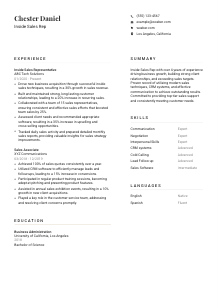
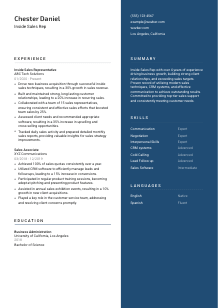
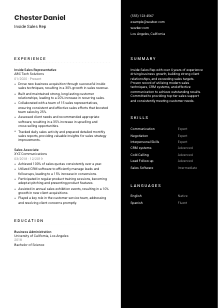
Hitting targets, but your resume isn't closing deals? Check out this Inside Sales Rep resume example, created with Wozber free resume builder. Learn how to present your sales savvy to match job requirements, ensuring your career trajectory is as impressive as your monthly sales record!
Inside sales hiring moves quickly because the work itself moves quickly. Managers want to see whether you can open conversations, qualify needs, handle objections, and keep a clean follow-up rhythm inside a CRM without losing momentum on quota. Your resume should make that commercial discipline visible, especially through pipeline activity, customer retention, and revenue contribution.
A tailored resume changes how your sales background is interpreted. When your wording reflects the employer's sales motion, reporting needs, and customer-facing responsibilities, an ATS can connect your experience to the role more accurately, and Wozber's free resume builder helps shape that into an ATS-compliant resume with language that makes your prospecting strength and quota performance easier to recognize.
Personal details are simple, but they still do screening work. For an Inside Sales Rep, this section should confirm who you are, how to reach you quickly, and whether you meet any straightforward logistical requirement without making the reader hunt for it.
Use your full name in a slightly larger font than the rest of the page. Sales hiring often involves several fast resume reviews in a row, so your name should be immediately visible and professional, much like the clear first impression you would aim for on a cold call.
Place "Inside Sales Rep" directly under your name if that is the job you are targeting. Matching the title used in the posting helps position your background correctly from the start and keeps your resume aligned with ATS searches tied to inside sales, telesales, account development, and similar terms.
Add a reliable phone number and a professional email address. Since inside sales work depends on timely response and consistent communication, your contact details should look current and business-ready. A straightforward format like "firstname.lastname@email.com" works well.
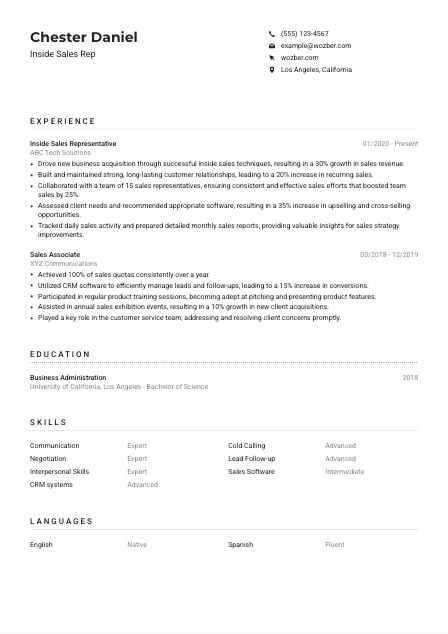
If a role specifies a city or state, include yours clearly. In the example, listing Los Angeles, California directly addresses the employer's stated location requirement and removes an avoidable question early in the process. Use this only when location is genuinely relevant to the opening you are pursuing.
If you include LinkedIn or a personal site, make sure it reinforces your resume with the same job titles, dates, and sales story. For inside sales candidates, a profile that shows consistent experience, product familiarity, or customer-facing achievements can strengthen credibility before the first screening call.
This section should answer the basics fast: who you are, how to contact you, and whether you meet any practical requirement tied to the opening. Keep it clean so the hiring team can move straight to your sales results.




Experience is the core of an Inside Sales Rep resume because this is where hiring teams look for quota history, prospecting volume, CRM discipline, and customer outcomes. Broad statements about being persuasive are far less useful than showing how you generated pipeline, converted leads, and supported revenue over time.
Before editing your bullets, identify the operating themes in the posting. For this role, those include new business acquisition, cold calling, lead follow-up, client relationship management, collaboration with the wider sales team, and monthly sales reporting. Those are the themes your experience bullets should reflect in plain sales language.
List roles in reverse chronological order and give the most space to positions closest to the target job. Recent inside sales work carries the most weight because it shows current familiarity with outbound cadence, CRM updates, and quota execution. In the example, the current role at ABC Tech Solutions naturally anchors the section because it aligns directly with the employer's responsibilities.
Each bullet should show what you achieved through a sales activity. Instead of saying you were responsible for lead follow-up, show the result of that follow-up in conversion rate, recurring revenue, upsell growth, or quota attainment. The sample resume does this well by tying account management and product recommendation work to gains like 20% more recurring sales and 35% more upselling opportunities.
Inside sales is measured constantly, so metrics belong throughout this section. Revenue growth, quota attainment, conversion improvement, recurring business, lead response effectiveness, and team sales lift are all useful proof points. A line such as "achieved 100% of sales quotas consistently" or "increased conversions by 15% through CRM-driven follow-up" gives a hiring manager something concrete to compare against their own targets.
Keep the section centered on experience that supports inside sales performance. Customer service work can stay if it shows objection handling, retention, or issue resolution that protected revenue, but unrelated jobs should be minimized unless they fill an experience gap. Prioritize bullets with cold outreach, lead management, CRM use, product pitching, reporting, and measurable sales impact.
By the end of this section, a sales manager should be able to trace how you build pipeline, move prospects forward, and produce numbers. If your bullets show activity, tools, and outcomes together, your experience will read like someone who can contribute quickly.
Education matters less than performance in most inside sales hiring, but it still helps when a posting asks for a specific degree background. Present it clearly so the employer can confirm the requirement and move back to your commercial track record.
If the employer asks for a bachelor's degree in Business Administration, Marketing, or a related field, mirror that language where it applies. In the example, a Bachelor of Science in Business Administration lines up directly with the posted requirement, which makes the screening step simple.
List the degree, field of study, school name, and graduation year or date. Keep the formatting easy to scan. This section is usually reviewed quickly, so clarity matters more than extra wording.
When your degree directly supports the role, do not bury the field of study. Business Administration, Marketing, communications, or related commercial disciplines help reinforce familiarity with customer behavior, market positioning, and sales fundamentals.
Most experienced inside sales candidates do not need course lists. Add coursework, honors, or projects only if they genuinely support your candidacy, such as sales management, consumer behavior, negotiation, or business communication, especially if you are earlier in your career.
Awards, leadership roles, or student sales competitions can help if they show initiative or commercial interest. For someone with several years of quota-carrying experience, though, those details are secondary to sales results and can stay brief.
This section should confirm that you meet the academic requirement without competing with your sales achievements for attention. If the degree matches the posting, make that easy to spot and move on.
The skills section should echo how the job is actually performed. For an Inside Sales Rep, that usually means a mix of sales execution skills, CRM fluency, communication strength, and follow-up discipline rather than a generic list of personality traits.
Read beyond the obvious keywords. This job explicitly asks for communication, negotiation, interpersonal skills, sales software, and CRM systems. It also implies comfort with prospecting, lead qualification, customer needs analysis, team coordination, and monthly reporting. Those should shape your list.
Use wording that reflects both your background and the posting. If the job says "CRM systems" and your experience backs that up, use that phrase. The example resume also includes cold calling and lead follow-up, which are useful additions because they map directly to the role's business development work.
Only include skills that show up in your experience, summary, or certifications. That consistency matters for both ATS optimization and human review. A hiring manager should be able to see "negotiation," "CRM systems," or "sales software" in the skills section and then find proof of those capabilities in your bullet points.
A tight skills list helps frame your profile before the deeper reading starts. Keep it close to the employer's terminology and grounded in the sales work you have actually done.
Language ability can matter in inside sales because calls, demos, follow-ups, and relationship-building all depend on clear communication. This section should reflect what the employer requires first, then any added language reach that could help with customer coverage.
If the posting asks for strong English, list English clearly and state your level honestly. In the example, "Native" English directly addresses the requirement and removes any uncertainty about core communication ability in calls, emails, and sales presentations.
Lead with the language that is essential to the role, then list any others that may expand your customer reach. The order itself helps the reader understand which language supports day-to-day sales performance most directly.
A second language can be valuable when you sell into diverse customer bases or support regional accounts. Spanish, for example, may be useful in some markets and client segments, but it should be presented as an added commercial advantage rather than assumed as a universal requirement.
Choose simple levels such as Native, Fluent, Advanced, Conversational, or Basic. Sales roles rely on precision in communication, so inflated language claims can create problems quickly once interviews move into live discussion or role-play.
If you have used another language in prospecting, account support, or relationship management, that context can be useful elsewhere in the resume. It shows practical application, not just passive familiarity, and can be especially relevant for teams serving multilingual customers.
For inside sales, language skills matter when they improve communication with prospects and customers. Start with the required language, then add others that genuinely expand your reach.
Your summary sets the tone for the rest of the resume. For an Inside Sales Rep, it should quickly establish experience level, sales focus, and the kind of results you have delivered, without drifting into vague claims about being driven or people-oriented.
Focus on the fundamentals that define inside sales performance: new business generation, relationship management, quota attainment, CRM use, and product or service recommendation based on client needs. That keeps the opening aligned with what a sales manager is trying to confirm in the first few lines.
Start with your title and experience level, then add one or two defining strengths. The example summary does this effectively by leading with more than 4 years of experience and a record of driving business growth and exceeding sales targets. That gives immediate context without wasting space.
A good summary includes a few specifics that set up the rest of the resume. Mention quota performance, revenue contribution, relationship-building, prospecting, or CRM-based follow-up if those are real strengths. Referencing modern sales techniques and CRM systems works well here because those are central to many inside sales environments.
Aim for a short paragraph that can be scanned in seconds. You are not retelling your whole career. You are giving the reader a clear reason to expect strong evidence of sales execution in the experience section that follows.
Your summary should read like the opening pitch of a capable sales professional: specific, confident, and tied to results. If it quickly establishes your sales scope and performance, the rest of the resume has a much easier job.
An effective Inside Sales Rep resume makes the commercial case quickly. It shows where you have generated new business, how you have managed leads and customer relationships, which tools you use to keep the pipeline moving, and what numbers followed.
Use Wozber's free resume builder, ATS-friendly resume templates, and ATS resume scanner to tailor your wording, improve ATS optimization, and present your background in a clean ATS-friendly resume format. The finished resume should make one thing clear to the hiring team: you know how to turn activity into revenue.




