



Use Wozber and land your dream job
Create Resume
No registration required
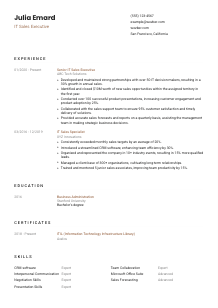
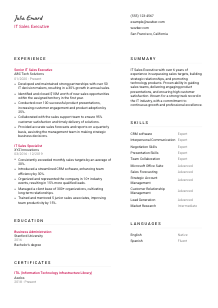
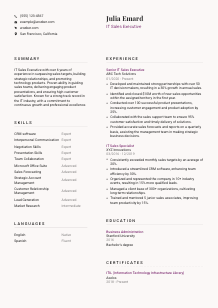
Closing tech deals, but sales pitches need a reboot? Check out this IT Sales Executive resume example, built with Wozber free resume builder. Learn how to align your sales savvy with the job's technical aims, scripting a career that consistently clicks "add to cart!"
IT sales resumes are strongest when they show commercial results in a technical buying environment. Hiring teams want to see how you open doors with CIOs, IT managers, and procurement stakeholders, how you move opportunities through the pipeline, and how you turn product knowledge into revenue, renewals, and account growth.
For this kind of role, resume tailoring changes which candidates look credible fast. When your wording reflects the sales cycle, territory ownership, CRM discipline, and presentation work named in the posting, an ATS-compliant resume is much easier to rank and a reviewer can quickly connect your numbers to the employer's priorities. Wozber's free resume builder helps structure that alignment cleanly so your track record in IT sales is the first thing they see.
For an IT Sales Executive, the top of the resume should feel business-ready and easy to contact. This section does not need flair. It needs clean information, a professional title, and any location detail the employer explicitly asks for so there is no friction before they even reach your sales results.
Use your full name in a slightly larger font than the rest of the header so it is immediately identifiable. In sales, your name is part of your professional brand, especially if you network at industry events, present to clients, or manage named accounts.
Place "IT Sales Executive" directly under your name if that is the role you are pursuing. This helps frame the rest of the resume around enterprise sales, solution selling, and account development rather than broader business development or generic sales work.
Include one reliable phone number and a professional email address. If a hiring manager wants to move quickly after seeing target attainment, deal size, or territory growth, your contact details should not slow that down by a single step.
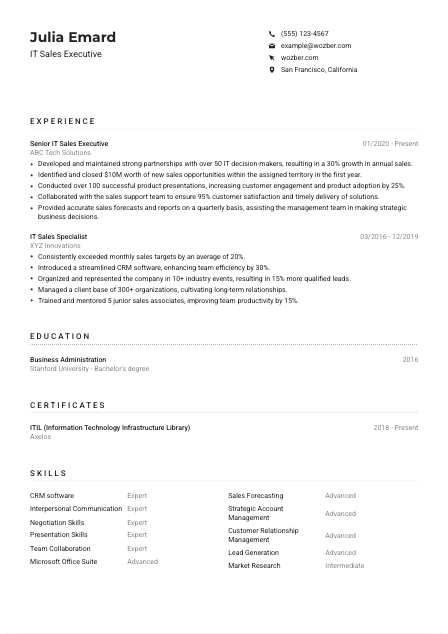
If the employer requires a specific location, list it clearly in your header. Here, "San Francisco, California" matters because it answers a stated requirement up front. Treat that as targeted tailoring, not a rule for every IT sales resume.
A LinkedIn profile or professional website can reinforce your sales background with recommendations, certifications, territory history, or major wins. Make sure the content matches your resume, especially your titles, dates, and measurable results.
This section should answer the practical questions first: who you are, what role you do, how to reach you, and whether you meet any stated location requirement. Then the reader can move straight to your pipeline wins, customer relationships, and revenue performance.




This is the section that usually decides whether an IT sales candidate moves forward. Employers are looking for revenue impact, quota performance, stakeholder management, territory ownership, and the ability to present technical solutions in a way buyers trust. Your bullets should read like commercial outcomes, not a list of routine tasks.
Read the posting for the commercial work that matters most, then mirror that language where it matches your real background. In this case, the priorities include building relationships with IT decision-makers, qualifying and closing new opportunities, running product presentations, working with sales support, and reporting forecasts to management. Those are the themes your experience should surface first.
List positions in reverse chronological order and keep the focus on roles tied to technology products, solutions, or services. Titles such as Senior IT Sales Executive or IT Sales Specialist immediately support your fit, but the real value comes from showing account scope, territory responsibility, and the kind of buyers you worked with.
Each bullet should show what you sold, who you sold to, and what changed because of your work. Revenue won, quota exceeded, accounts expanded, adoption increased, retention improved, or sales cycle efficiency gained all speak clearly in IT sales. The sample resume does this well with points like developing relationships with 50+ IT decision-makers and closing $10M in new opportunities.
Metrics are central in this field, so use them whenever you can support them. Percent growth, annual quota attainment, deal value, number of demos delivered, customer satisfaction scores, and forecast accuracy are all useful. A bullet such as "increased annual sales by 30%" or "exceeded monthly targets by 20%" tells far more than "responsible for sales growth."
Keep the section centered on selling results and supporting activities that matter in technology sales, such as CRM usage, client training, cross-functional coordination, and account expansion. If a bullet does not help explain how you win business, manage relationships, or support delivery, it probably belongs elsewhere or should be removed.
A hiring team should be able to scan your experience and quickly understand your territory, your customer level, your sales results, and how you work with technical and internal teams. If those four points are clear, your experience section is doing its job.
Education usually sits behind experience for seasoned IT sales professionals, but it still matters when the employer asks for a degree. Keep this section straightforward and relevant so it confirms the academic foundation behind your commercial work without distracting from your track record.
If the posting asks for a bachelor's degree in Business, Sales, or a related field, present that information plainly. A degree in Business Administration, marketing, information systems, or another relevant discipline supports your background in selling, account planning, and business communication.
List the degree, school, field of study, and graduation year or date range. Recruiters should be able to confirm the requirement in seconds, especially when they are reviewing experienced candidates whose main differentiator will still be revenue performance.
If your degree directly connects to sales or business, make the field visible. In the example, "Bachelor's degree in Business Administration" aligns neatly with the employer's request and supports the commercial side of the role.
Most mid-career IT sales resumes do not need course lists. Include relevant coursework only if it sharpens your story, such as sales management, business communication, enterprise technology, or channel strategy, especially if you are lighter on direct experience.
Honors, leadership roles, or major projects are worth mentioning when they add something specific, such as presentation ability, market analysis, or early sales leadership. If you already have 5+ years of strong IT sales results, keep this section concise.
For an experienced IT Sales Executive, education confirms that you meet the stated baseline. Once that box is checked, the rest of the resume should return quickly to pipeline performance, client-facing work, and revenue outcomes.
Certifications can strengthen your profile when they show product, platform, or service knowledge that matters to technical buyers. In IT sales, they are especially useful when a posting mentions preferred credentials or when your certification helps bridge commercial skill with industry credibility.
When an employer lists preferred certifications, surface those first if you hold them. Here, ITIL and Cisco Sales Expert are helpful examples because they suggest familiarity with IT service environments and technology sales conversations, not just generic sales technique.
Choose certifications that support the way you sell. Product certifications, cloud or networking sales credentials, IT service knowledge, and consultative selling programs usually carry more weight here than unrelated short courses.
Include the year earned and, when appropriate, whether the certification remains active. This helps the employer gauge whether your knowledge is current, which matters in fast-moving categories like infrastructure, SaaS, cybersecurity, or managed services.
A current certification section tells hiring teams you keep pace with the market, the solutions you represent, and the language your buyers use. That is especially useful when your sales role involves demos, trainings, or conversations with technically informed stakeholders.
Certifications will not replace a sales record, but they can reinforce your credibility in front of IT buyers and employers alike. Keep the section tight, current, and tied to the kind of solutions you sell.
The best skills sections in IT sales balance customer-facing ability with sales operations discipline. Employers want to see that you can build relationships, run persuasive presentations, negotiate terms, and keep pipeline data accurate in the tools the team relies on.
Use the job description to identify the capabilities the employer is actively screening for. In this case, CRM software, Microsoft Office Suite, communication, interpersonal skill, and negotiation all belong in the section because they support forecasting, client engagement, and day-to-day execution.
Lead with the abilities most connected to winning and growing business. For an IT Sales Executive, that often includes strategic account management, lead qualification, product presentations, negotiation, customer relationship management, pipeline forecasting, and territory development.
Keep the section easy to review. You can group technical and commercial skills or present them in a clean flat list, but avoid burying the essentials. The example works because it combines CRM software and Microsoft Office with sales forecasting, presentation skills, and strategic account management, which reflects the real mix of the job.
Your skills section should make it obvious that you can manage both the human side of selling and the operational side of the pipeline. That combination matters in IT sales, where relationship quality and process discipline both affect revenue.
Language ability can be valuable in IT sales when territories, accounts, or internal teams span regions. It is rarely the main qualification, but when a posting names a required language, your resume should answer that directly and without ambiguity.
If the role calls for English competency, list English clearly and near the top of this section. In a sales role, language is tied to presentations, negotiations, client follow-up, training sessions, and written reporting, so the requirement carries practical weight.
Extra languages can support work across broader territories or more diverse customer bases. Spanish, for example, may be useful in some markets or account sets, but treat added languages as an advantage rather than a substitute for core sales performance.
Use clear labels such as Native, Fluent, Advanced, or Intermediate. Inflated language claims are easy to expose in interviews, especially in roles that depend on live demos, stakeholder calls, and objection handling.
If your target role covers multinational accounts, channel partners, or cross-border business, language skills can become more relevant. Mention them when they support the actual market scope of the job, not just to fill space.
If you are actively improving a language that matters to your market, you can mention it briefly with an honest proficiency level. Keep the focus on business usefulness, such as client communication or regional account support.
For most IT Sales Executive roles, language skills are a supporting asset. Present them clearly, meet the stated requirement first, and let them reinforce your ability to communicate across customers, teams, and territories.
An IT Sales Executive summary should read like the opening of a strong client pitch. In a few lines, it should establish your level, your sales record, and the type of technology-selling environment where you perform best. Vague descriptors are less useful here than concrete scope and results.
Before writing the summary, identify the few priorities the role emphasizes most. For this posting, that means exceeding sales targets, building relationships with IT decision-makers, presenting solutions well, and working through CRM-driven reporting and forecasting.
Begin with a direct professional identity line such as "IT Sales Executive with 6+ years of experience." That quickly places you at the right level and helps distinguish you from entry-level sales candidates or broader account management profiles.
Use the next sentences to highlight your strongest relevant wins. That might include quota performance, new business closed, enterprise relationships built, demo effectiveness, or customer satisfaction results. The sample summary points in the right direction, but you can sharpen it further by adding one concrete metric or market scope.
Aim for a compact paragraph that earns the reader's attention without repeating bullets from the experience section. Focus on the commercial story you want attached to your name: what you sell, who you sell to, and the results you consistently deliver.
A good summary gives the employer a quick read on your level, your market-facing strengths, and your sales impact. When it is tailored well, the rest of the resume feels like proof of a clear commercial proposition.
An effective IT Sales Executive resume makes the numbers easy to find, the customer-facing work easy to picture, and the match to the target role easy to confirm. With Wozber's free resume builder, ATS resume scanner, and ATS-friendly resume format, you can tailor each section around the sales motions, tools, and results the employer actually asked for.
Once your resume clearly shows quota performance, relationship depth, presentation strength, and forecast discipline, you are ready to apply with confidence.




