



Use Wozber and land your dream job
Create Resume
No registration required
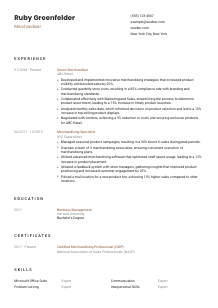
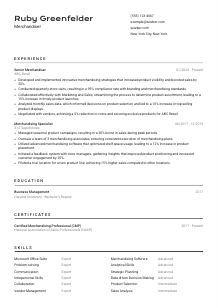
Weaving aisle routes, but your resume feels off-display? Unfold your potential with this Merchandiser resume example, created with Wozber free resume builder. Learn how to line up your product-placement prowess with job specs, making sure your career stands out as prominently as the latest sale signage!
Merchandising work gets measured in visible business results. Better assortment choices, cleaner execution in stores, stronger promotional alignment, healthier sell-through, and smarter vendor decisions all show up quickly on the floor and in sales reports. Your resume should make that commercial judgment easy to see, not bury it under generic retail tasks.
When merchandising resumes are tailored well, the hiring team can quickly tell whether you have handled the same mix of store execution, data analysis, and cross-functional coordination they need. Wozber's free resume builder helps shape that experience into an ATS-compliant resume with language that matches the posting, so the first read surfaces the work that matters most for a Merchandiser.
Merchandising is a detail-sensitive function, and that expectation starts at the top of the page. Your personal details should be clean, current, and aligned with the role so recruiters can immediately place you in the right market and contact you without friction.
Your name should be the clearest element in the header. Use a slightly larger font than the rest of the page so it is easy to spot during a quick review, especially when hiring teams are scanning multiple retail and merchandising resumes in one sitting.
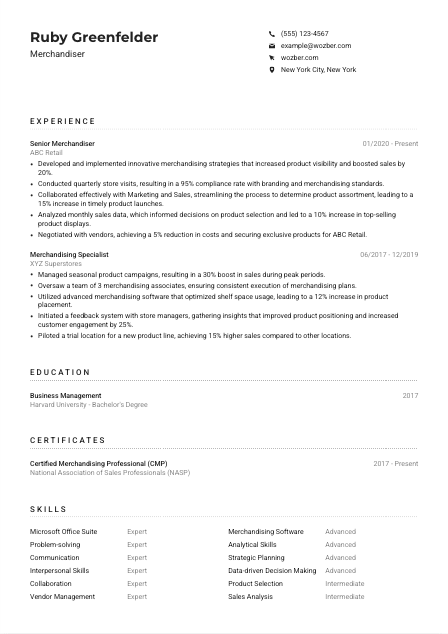
If you are applying for a Merchandiser role, say "Merchandiser" in your header. If your background is broader, titles like "Senior Merchandiser" or "Retail Merchandiser" can also work when they accurately reflect your level. The sample resume handles this well by stating the role clearly instead of forcing a vague branding line.
List a working phone number and a professional email address in a format that is easy to parse. Avoid casual handles. Merchandising teams often move quickly when scheduling interviews around store calendars, vendor meetings, or field visits, so your contact information should be easy to use on the first try.
Some merchandising roles are market-specific because they involve regular store visits, local vendor coordination, or in-person collaboration with Sales and Marketing. Here, New York City, New York is explicitly requested, so showing that location in the header immediately removes doubt about availability. If you plan to relocate, make that clear in a concise way.
A LinkedIn profile or personal website can support your application if it reinforces your retail background, category scope, or measurable achievements. Make sure the job titles, dates, and accomplishments match your resume. Consistency matters, especially when employers are checking progression from merchandising specialist work into more strategic assortment or vendor-facing responsibilities.
This section does not need flair. It needs accuracy, professionalism, and any practical detail that supports the application, including location when required. With Wozber's free resume builder, you can format these basics in an ATS-friendly resume template that keeps the focus on your merchandising experience from the first line.




For a Merchandiser, experience is where hiring teams look for commercial judgment. They want to see how you improved product visibility, influenced sales, worked with store teams, interpreted data, and negotiated with vendors. General retail activity is not enough. Your bullets need to show decisions, execution, and results.
Read the job description for the operational themes behind the wording. In this case, the employer wants someone who can build merchandising strategy, assess in-store compliance, collaborate across teams, analyze sales data, and negotiate vendor terms. Those priorities should guide which roles and bullets you lead with. The sample resume mirrors this well by emphasizing strategy, store visits, analysis, and vendor wins instead of listing routine responsibilities.
List your most recent role first, then work backward with job title, employer, and dates in a consistent format. Merchandising careers often show progression from execution-focused work to broader ownership of assortment, promotions, and vendor management. A clean timeline helps recruiters see that growth without having to piece it together.
Each bullet should show what you did, how you did it, and what changed because of it. Replace vague lines like "responsible for displays" with specifics such as improving compliance rates, increasing seasonal sell-through, refining product placement, or accelerating launches through better coordination with Marketing and Sales. In the example, "Developed and implemented innovative merchandising strategies that increased product visibility and boosted sales by 20%" works because it ties action to a business result.
Numbers carry weight when they reflect how merchandising work is actually measured. Sales lift, compliance rate, cost reduction, launch timing, shelf-space optimization, campaign performance, and customer engagement are all useful signals. The sample resume uses metrics naturally, including a 95% compliance rate, a 15% increase in timely product launches, and a 5% vendor cost reduction. Use that approach only where you can back it up.
Prioritize experience that shows assortment planning, store execution, promotional coordination, vendor management, consumer insight, or sales analysis. If an older role does not support the story, shorten it or remove it. The goal is a resume that reads like someone ready to manage product visibility and sales performance, not a general retail profile with unrelated duties mixed in.
Your experience section should leave no guesswork about whether you can influence product performance in stores and support decisions with data. Wozber's free resume builder and ATS-friendly resume templates make it easier to organize those achievements clearly, while keeping the phrasing aligned with how merchandising roles are actually described.
Education matters most here as a qualification check, but it can also reinforce your commercial foundation. For merchandising positions, employers usually want to see a degree connected to business, marketing, retail, or a related field that supports product planning, analysis, and coordination across teams.
If the posting asks for a bachelor's degree in Business, Marketing, or a related field, make sure your degree is listed clearly. The sample resume does this well with a Bachelor's Degree in Business Management, which fits the stated requirement without needing extra explanation.
List the degree, field of study, school, and graduation year or date range. Keep the structure consistent and easy to scan. Recruiters reviewing merchandising resumes are usually checking quickly for qualification match before moving back to your store, sales, and vendor achievements.
If your degree is adjacent rather than exact, such as economics, supply chain, communications, or retail management, keep the field visible and do not hide it behind abbreviations. The connection should be obvious because merchandising often sits at the intersection of analysis, customer demand, and commercial planning.
Early-career candidates can include coursework in consumer behavior, retail marketing, pricing, data analysis, inventory planning, or brand management if it helps bridge limited hands-on experience. For experienced Merchandisers, this usually adds less value than results from store visits, product launches, or vendor negotiations.
Honors, relevant student projects, or retail-focused extracurricular work can be useful if they connect to merchandising judgment or analysis. For example, a capstone on consumer purchasing behavior or a market research project can support your profile when professional experience is still developing.
This section should confirm that you meet the academic baseline and, when relevant, add a little commercial context. If your experience already shows strong execution in assortment, compliance, and sales analysis, let education stay concise. Wozber's ATS resume scanner can help you check that the degree language lines up cleanly with the posting.
Certifications are rarely the deciding factor in merchandising hiring, but the right one can strengthen your profile, especially when it points to category knowledge, retail operations, sales strategy, or vendor management. Include certificates that add substance, not filler.
Start with the posting. If no certification is required, treat this section as supporting material rather than a main selling point. For a Merchandiser, the most useful certificates usually connect to retail, sales, planning, analytics, or merchandising practice. The sample's Certified Merchandising Professional credential works because it directly reinforces the role.
Do not crowd the section with unrelated training. Choose credentials that strengthen the same themes shown in your experience, such as merchandising strategy, retail execution, category management, or commercial analysis. A short, relevant list reads much better than a long mixed one.
If a certification is active, renewed regularly, or recent enough to matter, include the date. That helps hiring teams see whether the knowledge is current, especially for credentials tied to evolving retail tools, planning methods, or industry standards.
Retail environments shift quickly with changes in consumer behavior, promotional channels, and product strategy. Adding recent training in retail analytics, negotiation, or merchandising systems can sharpen your resume when you are competing for roles with broader scope or stronger data expectations.
A certificate should support the case your experience is already making. If it strengthens your credibility in merchandising, retail strategy, or analysis, include it. If it does not, leave it out. Wozber helps you keep that section concise and aligned with the language employers use in merchandising postings.
A Merchandiser's skills section should read like the toolkit behind better store execution and stronger product performance. That means balancing software and analytical capability with the communication needed to work across vendors, Sales, Marketing, and store teams.
Start with the terms the employer actually uses. Here, that includes merchandising software, Microsoft Office Suite, analytical skills, problem-solving, communication, and interpersonal strength. Those are the skills most likely to matter for both ATS matching and human review. The sample resume reflects this closely without overloading the section.
Put the most relevant skills first. For a merchandising role, software proficiency, sales analysis, strategic planning, vendor management, and data-driven decision-making usually deserve more space than broad traits. If the job leans heavily on field execution, skills tied to store audits, compliance, and display standards may also deserve stronger placement.
Choose skills you can support elsewhere in the resume. If you list "Vendor Management" or "Strategic Planning," your experience section should show negotiation outcomes, assortment decisions, or execution plans. A tight, role-specific list works better than a long inventory of soft skills with no evidence behind them.
This section should echo the real demands of the role, from merchandising systems and Excel-based analysis to communication with vendors and internal teams. Wozber's free resume builder and ATS resume scanner can help you tune the wording so the skills section supports both ATS optimization and a sharper hiring read.
Language skills matter in merchandising when the role depends on clear communication with vendors, store teams, and internal stakeholders. If a posting names a required language, treat that as a direct qualification point and make it easy to find.
If the job states that English speaking skills are mandatory, list English prominently with an accurate proficiency level. That requirement should never be buried below optional languages because it is part of the employer's baseline screen.
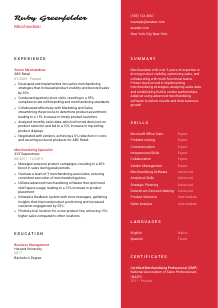
Put the language most important to the role first, then add others that could help in vendor communication, multicultural retail markets, or broader customer-facing environments. The sample resume places English first and Spanish second, which is a clear and sensible structure.
Additional languages can be useful in merchandising, especially in diverse urban markets, cross-border sourcing environments, or businesses with multilingual store teams. They are most valuable when they support actual communication needs, not when they are added just to fill space.
Use clear labels such as Native, Fluent, Intermediate, or Basic. Merchandising often involves practical communication, from vendor discussions to store-level feedback, so overstating proficiency can create problems quickly in interviews or on the job.
If your language skills have supported supplier negotiations, regional coordination, or customer insight gathering, that context can strengthen the value of this section. Keep the resume entry itself short, then let your experience bullets carry the applied examples where relevant.
For this kind of role, language ability is about communication in real commercial settings, not decoration. Lead with required English proficiency, add other languages that support the market, and keep the levels honest. An ATS-friendly resume format from Wozber helps that information stay clear and easy to scan.
Your summary should quickly tell the reader what kind of Merchandiser you are. Focus on scope, strengths, and business results. In a few lines, you should connect merchandising strategy with sales impact, store execution, analysis, and collaboration.
Before writing, identify the two or three themes driving the role. Here, the major threads are merchandising strategy, sales and consumer analysis, cross-functional coordination, and vendor negotiation. Those themes should shape the summary more than generic statements about being hardworking or detail-oriented.
Start with a direct professional label and your years of experience. For example, "Merchandiser with 5+ years of experience in retail merchandising" immediately places you. The sample summary does this effectively, then moves into product visibility and sales outcomes, which are exactly the right commercial anchors for the role.
After your opening line, mention the capabilities most relevant to the target job. That could include developing merchandising strategies, analyzing sales data, coordinating with Marketing and Sales, or building vendor relationships. Keep the wording close to your actual background so the summary feels credible and supported by later bullets.
Aim for a short paragraph that can be read in seconds. Avoid broad claims that repeat the skills section. A useful summary sounds like a concise snapshot of how you improve product visibility, support assortment decisions, and drive sales performance, not a list of personality traits.
When this section is done well, the reader understands your merchandising level, your operating strengths, and the kind of results you have delivered before they reach the first job entry. Use Wozber's ATS optimization tools, including the ATS resume scanner, to sharpen that opening paragraph and keep it aligned with the language of the role you want next.
A Merchandiser resume works when it connects retail decisions to measurable outcomes. Product visibility, sales lift, store compliance, vendor results, and cross-team coordination should all show up in clear language backed by numbers where possible.
Use Wozber's free resume builder to shape that experience into an ATS-friendly resume template, then refine it with the ATS resume scanner so the final version reflects the posting's priorities without sounding forced. The result should make it easy to judge your readiness to manage assortments, displays, and sales performance.




