



Use Wozber and land your dream job
Create Resume
No registration required
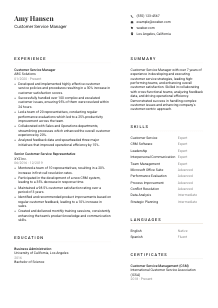
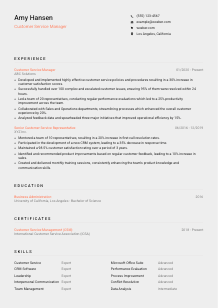
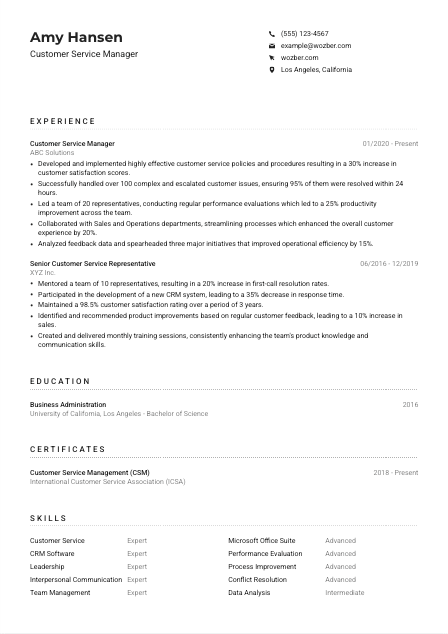
Leading service squads but feel like your resume is on hold? Check out this Customer Service Manager resume example, created with Wozber free resume builder. Learn how to show your managerial strengths in line with the job's service standards, ensuring your career journey is always in the express lane of success!
Customer Service Managers are hired to steady the front line when service breaks down, coach teams through daily volume, and turn customer feedback into better processes. A resume for this role needs to show more than people skills. It should make your leadership, escalation handling, service metrics, and cross-functional coordination easy to recognize.
When those details are tailored to the posting, the resume is easier to rank in an ATS and easier for a hiring team to connect to the actual work of the role. Wozber's free resume builder helps you align titles, keywords, and measurable service results in an ATS-friendly resume format, so your experience reads clearly against priorities like CRM fluency, team management, and operational improvement.
This section does a simple but important job. It confirms who you are, how to reach you, and whether you meet practical requirements before the reader gets into your service leadership background.
Use your full name as the main header in a clean, readable font. For management roles, clarity matters more than styling. Keep it prominent so the resume opens with a professional, business-ready presentation.
If you are applying for a Customer Service Manager role, state that title beneath your name. This helps frame the rest of the resume around team leadership, escalations, service operations, and customer experience ownership rather than general support work.
List a current phone number and a professional email address. A straightforward format such as "firstname.lastname@email.com" works well. If a hiring manager wants to discuss your experience with CRM systems, service KPIs, or team supervision, your contact information should not slow that down.
Some openings include a location requirement, as this one does with Los Angeles, California. If you already meet that requirement, include city and state in your header. That immediately answers a practical screening question without taking space away from your management experience.
Include LinkedIn or a professional website only if it supports your application with consistent, current information. For a Customer Service Manager, that profile should reinforce the same story your resume tells, such as team leadership scope, customer satisfaction gains, process improvements, or service operations experience.
A clean header removes friction. It lets the reader move straight into your customer service leadership record, not basic follow-up questions.




This is the section that carries the most weight for a Customer Service Manager. Hiring teams want to see how you handled escalations, led service staff, improved customer outcomes, and worked with other departments to fix recurring issues.
Read the job description and underline the operating priorities. Here, that includes building customer service procedures, resolving escalated issues, coaching the team through performance reviews, partnering across departments, and using customer data to improve efficiency. Those points should shape which achievements you choose and how you phrase them.
List roles in reverse chronological order with title, employer, and dates. For this profession, progression matters. A move from senior representative work into team leadership or service management helps show that you have grown from handling customer cases yourself to managing people, workflows, and service standards.
Avoid generic lines such as "managed complaints" or "supervised staff." Show what happened because of your work. The sample resume does this well with bullets like resolving more than 100 escalated issues with 95% closed within 24 hours and improving customer satisfaction scores by 30% after implementing service policies. That kind of detail sounds like real management work.
Numbers matter most when they reflect how service teams are actually judged. Prioritize customer satisfaction scores, first-call resolution, response time, productivity, resolution time, team size, retention, and efficiency gains. Metrics like a 25% productivity improvement across a 20-person team or a 35% drop in response time through CRM improvements tell a much clearer story than broad claims about impact.
Choose experience that supports the role you want. For a Customer Service Manager, the strongest bullets usually involve escalations, QA or performance reviews, training, process redesign, service policy development, customer feedback analysis, and coordination with Sales, Operations, or Product. Trim work that does not help prove you can lead a service function.
Your experience section should leave no doubt about the scope of teams you led, the service issues you handled, and the business results you improved.
Education is usually a supporting section for this role, but it still matters when the posting asks for a specific degree background. Present it clearly so the reader can confirm the requirement in seconds.
If the role asks for a Bachelor's degree in Business Administration, Communications, or a related field, list that information exactly and clearly. In the example, a Bachelor of Science in Business Administration lines up neatly with the posting and removes any guesswork for the reviewer.
Include degree, field of study, school, and graduation year. Keep the order consistent and easy to read. This is not the place for dense detail unless something in your education directly strengthens your service management profile.
Spell out the full degree rather than shortening it too much. "Bachelor of Science in Business Administration" is more useful than a vague label because it connects directly to the employer's stated requirement and suggests training in operations, communication, and business processes.
Most experienced Customer Service Managers can keep this section brief. If you are earlier in your career, relevant coursework in communications, operations, management, or business analytics can help bridge that gap. Academic honors are worth adding if they are recent and credible.
Student leadership, service projects, or team-based work can be useful if they relate to coaching, communication, or process improvement. Keep it selective. Once you have several years of customer service experience, your operational results will matter far more than campus involvement.
For this role, education should confirm the required foundation and then get out of the way so your leadership and service results can lead the application.
Certifications are not always mandatory for Customer Service Manager roles, but the right one can reinforce your credibility in service operations, coaching, and customer experience management.
If the employer prefers a Customer Service Management certification or a similar credential, list it prominently. The sample resume uses a CSM certification, which is a direct match to the preference stated in the job description and strengthens the management profile immediately.
Choose certifications that support customer service leadership, CRM use, process improvement, coaching, customer experience, or conflict resolution. A short, relevant list is stronger than a long list of unrelated courses.
Add the certifying organization and the year earned, plus renewal information if it applies. That gives the reader useful context and shows whether the credential is current, active, or part of ongoing professional development.
Customer service leadership changes with new channels, tooling, and reporting expectations. If you have kept current through refreshed certifications or recent training in areas like CRM platforms, service analytics, or team coaching, include that progress to show you are still building relevant capability.
A well-chosen certification section supports your case as someone who can lead service teams with structure, current knowledge, and sound operational judgment.
A Customer Service Manager needs a mix of people leadership, service operations, and platform fluency. Your skills section should reflect that combination instead of reading like a generic customer support list.
Start with the terms the employer already uses. In this posting, that includes CRM software, Microsoft Office Suite, communication, leadership, and interpersonal skills. Those are the baseline terms to include when they match your actual background.
Group your strongest role-relevant skills near the top. For this profession, that often means customer service operations, team management, performance evaluation, conflict resolution, process improvement, escalation handling, and data analysis. The example resume does this well by combining leadership skills with operational ones such as CRM software and performance evaluation.
Avoid packing in every skill you have used. Choose the ones that help explain how you run a service team, track performance, and improve customer outcomes. A concise list is easier for both ATS screening and human review, especially when the language mirrors the job posting naturally.
Your skills section should make it clear that you can lead people, manage service workflows, and use the systems and reporting that keep customer operations running well.
Language ability matters in customer service because it affects escalation handling, team communication, and the consistency of the customer experience. Include this section with the same accuracy you would use for service metrics or CRM expertise.
If the posting requires English, list it first and state your level clearly, such as "Native" or "Fluent." Since customer-facing management often involves difficult conversations, coaching, and written communication, the level you claim should match how confidently you can actually operate in meetings, email, and escalations.
Additional languages can strengthen your profile, especially in multilingual markets or teams. For example, Spanish may be useful in many service environments, but include extra languages only when you can use them professionally or they add relevant context to your customer-facing range.
Use honest labels. If you can handle basic greetings but not service recovery calls or written customer communication, do not overstate your level. Customer Service Managers are often pulled into sensitive issues, and language ability is quickly tested in real interactions.
Some service teams support regional, national, or international audiences. When another language helps with coaching staff, speaking with customers, or coordinating with other markets, it is worth listing because it connects directly to service delivery rather than appearing as a personal extra.
If you are actively improving a language that matters to your customer base or internal team, that can support your long-term value in service leadership. Mention it only if the proficiency is usable or your progress is concrete enough to discuss honestly.
For customer service management, credible language proficiency can strengthen your application. Inflated language claims can weaken it fast.
Your summary should quickly establish your level, your management scope, and the kind of service results you deliver. In a role built around customer outcomes and team performance, the opening lines need to show both leadership and operational control.
Before writing, identify the core themes in the posting. Here, the employer wants someone who can lead a customer service function, resolve escalations, evaluate staff performance, collaborate across departments, and improve operations through data. Your summary should echo that mix of leadership and execution.
Lead with your title and years of relevant experience. A line such as "Customer Service Manager with 7+ years of experience" immediately tells the reader whether your background is senior enough for a posting that asks for 5 years in customer service and 2 years in management.
Use the next sentence to name the work you are known for. Good themes for this role include service policy development, team coaching, escalated issue resolution, CRM-driven process improvement, and customer satisfaction gains. The sample summary works because it combines strategy, leadership, cross-functional work, and customer experience improvement in a compact way.
Aim for a short paragraph, not a biography. Two to four sentences is usually enough. Skip broad claims about being passionate or results-driven unless they are backed by specifics. The summary should set up the rest of the resume by making your service leadership profile clear from the start.
A focused summary should quickly show that you can lead a team, manage difficult customer situations, and improve service performance at an operational level.
A Customer Service Manager resume works when each section supports the same message: you can lead people, handle escalations, improve service processes, and use customer data to raise performance. Keep the wording aligned with the posting, especially around CRM systems, team management, customer satisfaction, and cross-functional coordination.
Wozber can help you tighten that alignment through AI-assisted tailoring, ATS optimization, and an ATS resume scanner that highlights missing requirements and keyword gaps. Build the final version in an ATS-friendly resume template so hiring teams can quickly judge the management experience, service metrics, and operational judgment you bring to the role.




