



Use Wozber and land your dream job
Create Resume
No registration required
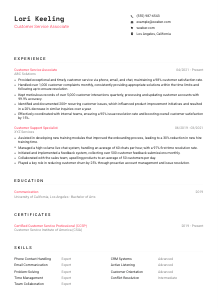
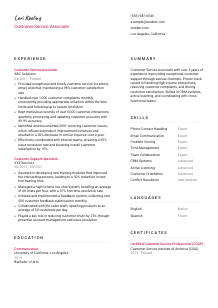
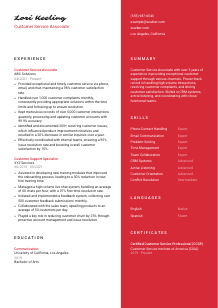
Handling queries, but puzzled by your resume? Check out this Customer Service Associate resume example, created with Wozber free resume builder. It shows how to put your problem-solving prowess and people skills to work so they match job demands, ensuring your career service receives five-star satisfaction!
Customer service hiring moves quickly, but the work itself is rarely simple. Teams need people who can handle a high volume of calls, emails, and chats, stay calm with upset customers, document issues accurately in a CRM, and keep service quality steady across every interaction. Your resume should make that operating standard easy to see, especially through response volume, resolution quality, follow-up habits, and the way you work with internal teams when an issue needs escalation.
A tailored resume helps separate general admin experience from actual customer support performance. When your wording reflects the channels, service metrics, and CRM work named in the posting, hiring teams can quickly tell whether you have handled the kind of queue, complaint resolution, and documentation the job requires. Wozber's free resume builder helps shape that into an ATS-compliant resume, so the screening process surfaces your customer-facing experience instead of burying it in broad claims.
This section is short, but it still carries screening value. For a Customer Service Associate role, it should immediately confirm who you are, how to reach you, and whether you meet any practical requirement that affects response time or availability, such as location in the example posting.
Place your full name at the top in a clean, readable format. Customer service roles depend on professionalism and clarity, and that expectation starts with a header that is easy to scan on screen and in print.
Add "Customer Service Associate" directly under your name when that is the job you are pursuing. Matching the target title helps frame the rest of your resume around customer support work rather than leaving the reader to interpret whether your background leans toward sales, reception, or operations.
List a phone number you answer reliably and a professional email address, ideally based on your name. Since this role involves phone handling and prompt communication, even your contact details should suggest responsiveness and professionalism.
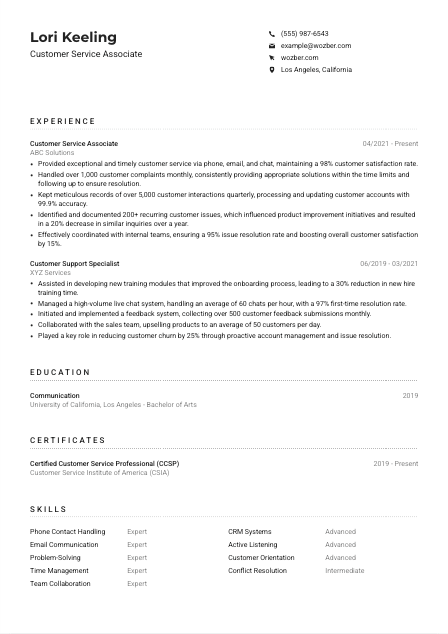
If the employer asks for candidates in a specific area, state your city and state clearly. In the provided example, "Los Angeles, California" answers a stated requirement right away and removes a basic screening question before the hiring team has to ask it.
Include LinkedIn or a professional website if it supports your application with recommendations, work history consistency, or customer-facing achievements. Skip anything outdated or casual. For service roles, online information should reinforce reliability, communication skills, and a stable work record.
Your personal details should remove friction, not create it. When this section is clean, current, and aligned with the posting, the hiring team can move straight to your service experience and response record.




For customer service roles, experience is where hiring teams look for real proof. They want to know how you handled volume, whether you resolved issues within service expectations, how accurately you documented customer activity, and whether your work improved satisfaction, retention, or recurring issue rates.
Start by marking the core tasks and language in the posting. For this role, that includes phone, email, and chat support, complaint handling, timely follow-up, CRM recordkeeping, recurring issue tracking, and escalation to internal teams. These are the terms an ATS and a hiring manager will both expect to see reflected in your own work history.
List your jobs in reverse chronological order and give the most space to positions where you handled customer inquiries, account updates, service recovery, or support queues. If an earlier title was "Customer Support Specialist" rather than "Customer Service Associate," keep it. The stronger move is to show overlapping responsibilities, not to rename your past role.
Each bullet should show what you handled and what happened because of it. The sample resume does this well with details like maintaining a 98% customer satisfaction rate and achieving a 95% issue resolution rate. That kind of phrasing tells the reader you did more than answer messages. You managed service quality at scale.
Quantify the parts of the job that matter in customer service: ticket or complaint volume, first-contact resolution, CSAT, response time, account accuracy, chat throughput, or reduction in repeat inquiries. "Handled over 1,000 customer complaints monthly" and "kept records of over 5,000 interactions quarterly with 99.9% accuracy" are strong examples because they show speed, workload, and precision together.
Prioritize bullets that show customer communication, problem resolution, CRM use, follow-up discipline, and cross-team coordination. If a point does not help explain how you improved the customer experience or supported service operations, trim it or rewrite it. Even an upselling bullet should stay only if the target role values account growth alongside support.
Your experience section should read like the record of someone who can step into a live support environment and perform. When the bullets show channel coverage, complaint resolution, documentation quality, and measurable service results, your fit becomes much easier to judge.
Education usually plays a supporting role in customer service hiring, but it still adds context. It can help explain communication strengths, industry familiarity, or early preparation for customer-facing work, especially if the job description does not require a specific degree.
Some Customer Service Associate openings focus almost entirely on hands-on support experience, while others value a degree or coursework tied to communication, business, or psychology. In this posting, education is not the lead requirement, so your experience should stay front and center while education remains clear and concise.
List your degree, school, field of study, and graduation year or date. This is enough for most customer service applications and keeps the section easy to scan alongside your more important service metrics and job history.
If your degree connects naturally to customer communication or relationship management, let that relevance speak. The example's Bachelor of Arts in Communication fits well because customer support depends on clear writing, listening, tone control, and navigating difficult conversations.
If you are early in your career or moving into customer support from another field, include courses or training that support the transition. Subjects such as interpersonal communication, conflict resolution, business writing, or consumer behavior can add useful context when your direct service history is still limited.
Leadership roles, peer mentoring, or recognition for communication-heavy work can strengthen this section when they reflect customer-facing strengths. Keep the link practical. A campus role resolving student issues or coordinating events says more for this profession than a general academic award with no service angle.
For most customer service resumes, education should support the story rather than carry it. Present it clearly, connect it to communication or service where relevant, and let your frontline experience do the heavier lifting.
Certifications are not mandatory for every Customer Service Associate role, but they can strengthen your case when they show customer care methods, communication training, platform knowledge, or commitment to ongoing development. They are especially useful when candidates have similar years of experience.
Review the job ad before choosing what to list. If a certificate is required or preferred, match that wording exactly. If none are mentioned, focus on credentials that support customer communication, complaint handling, service standards, or CRM-related work.
Prioritize certifications that clearly connect to the day-to-day work. A credential such as "Certified Customer Service Professional (CCSP)" fits this kind of role because it reinforces customer care knowledge and service professionalism without needing extra explanation.
Include issue dates, renewal periods, or active status when relevant. For customer service roles, current credentials can signal that your training is recent and that you stay engaged with service practices rather than relying only on older experience.
Customer expectations, channels, and support tools change constantly. A current certificate can support a broader story about staying sharp in phone handling, written communication, de-escalation, or service operations. That matters most when the role involves multiple support channels and structured documentation.
A focused certification section can help confirm your service standards and professional development. Keep it relevant to customer interactions, support workflows, or communication quality, and it will strengthen the overall picture rather than read like filler.
Customer service recruiters often scan the skills section before reading every bullet in your experience. They are looking for a practical mix of communication ability, support tools, and service judgment that matches the actual flow of the role, from phone handling to CRM updates to escalation decisions.
Read beyond the obvious requirements and note both stated and implied skills. Here, the posting directly names phone contact handling, active listening, CRM familiarity, customer orientation, adaptability, and English fluency. It also implies complaint resolution, documentation discipline, and the ability to shift tone across different personalities and channels.
Use skills that reflect how customer support is actually done. Include platform or workflow skills such as CRM systems, email communication, live chat, account processing, and conflict resolution alongside interpersonal skills like active listening and empathy. The sample list works because it balances tool-based capability with front-line communication strengths.
Place the most relevant skills first, especially the ones named in the ad or repeated across your experience bullets. For this kind of role, phone handling, CRM systems, active listening, problem-solving, and team collaboration usually deserve stronger placement than broad traits that could apply to any office job.
A well-built skills section should echo the support environment you are applying to. When the list reflects live customer channels, service judgment, and the systems used to track interactions, it strengthens both ATS matching and human review.
Language ability matters in customer service because it affects clarity, rapport, and how broadly you can support the customer base. When a posting calls out English proficiency and welcomes multilingual ability, this section becomes more than a formality.
If the job specifies spoken and written English, list it clearly and use an accurate proficiency label. When multilingual ability is noted as a plus, include any additional languages that you can use in real customer interactions, especially in phone or chat support where speed and precision matter.
Label each language in a way a hiring manager can interpret quickly, such as Native, Fluent, Intermediate, or Basic. Put the strongest and most relevant language first. In the example, English appears first and Spanish adds practical value for a customer-facing role in a diverse market.
Additional languages can widen the range of customers you can support, but only include them if you can communicate reliably in service situations. For customer support, that means understanding issues accurately, explaining next steps clearly, and maintaining the right tone under pressure.
Do not overstate fluency. Customer service depends on precision, especially when discussing billing, product issues, or complaint resolution. Honest proficiency levels set the right expectations and protect your credibility during interviews and on the job.
If another language helps you serve a specific customer base, mention that value where appropriate in your summary or experience. Language skill is especially useful when it improves first-contact understanding, reduces friction in difficult conversations, or helps customers feel more comfortable explaining their issue.
When listed clearly and honestly, language skills show more than communication range. They suggest broader customer coverage, smoother interactions, and stronger support in diverse service environments.
The summary should quickly establish what kind of customer service professional you are. For this role, that means years of experience, support channels handled, core strengths such as complaint resolution or CRM work, and one or two results that show service quality under real workload.
Before writing, identify the few points that matter most in the target role. Here, that means customer support experience, strong English communication, phone handling, CRM familiarity, and the ability to resolve complaints across multiple channels. Those priorities should shape the summary, not generic claims about being a people person.
Start with a clear line such as "Customer Service Associate with 3+ years of experience" or the equivalent that matches your background. This gives immediate context and helps position you at the right level for roles asking for 1 to 2 years of support experience or more.
Use the next sentence to connect your experience to the posting. Mention the channels you support, your comfort with CRM systems, and a result such as customer satisfaction, resolution rates, or high-volume handling. The example summary works because it combines multichannel support, complaint resolution, and CRM capability in a compact, role-specific way.
Aim for two to four lines with no wasted space. Avoid broad adjectives unless they are backed by substance. A hiring manager should finish the summary knowing your level, your support environment, and what you consistently deliver for customers and internal teams.
Your summary should make the rest of the resume easier to read by establishing your service background early. When it names your experience level, support channels, and customer outcomes with precision, it creates a clear starting point for the hiring team.
A Customer Service Associate resume works best when it shows how you handle real service conditions: steady contact volume, complaint resolution, accurate CRM updates, and coordination with the people who help close issues. Once each section reflects that reality, your application feels grounded in actual support work rather than general office experience.
Use Wozber's free resume builder to sharpen that alignment, build an ATS-friendly resume format, and check your wording with an ATS resume scanner before you apply. The final result should make one thing easy to see: you can step into a customer-facing support team and deliver clear, reliable service from day one.




