



Use Wozber and land your dream job
Create Resume
No registration required
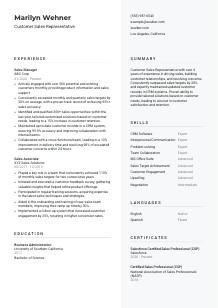
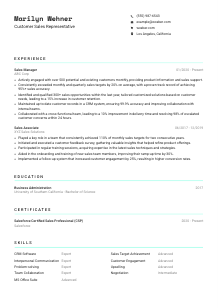
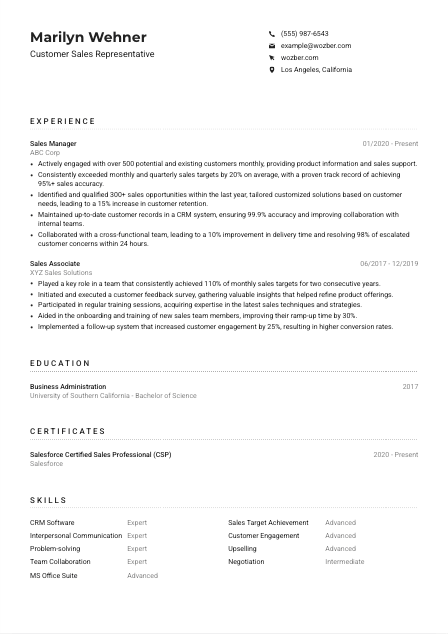
Sealing deals, but your resume doesn't close the loop? Check out this Customer Sales Representative resume example, created with Wozber free resume builder. It shows how to present your sales acumen and customer-centric approach to match job demands, positioning your sales career in its prime selling season!
Customer sales work gets measured in hard numbers and daily interactions. Hiring teams want to see whether you can turn product conversations into qualified opportunities, keep customer records clean in a CRM, and stay steady when monthly targets and service issues hit at the same time. Your resume should make that operating range visible from the first few lines.
When a Customer Sales Representative resume is tailored to the job ad, the screening process gets much clearer. Wozber's free resume builder helps you line up your wording with the role, keep an ATS-compliant resume structure, and surface the sales metrics, CRM work, and customer support scope that matter most for this kind of opening. That gives the employer a faster read on whether you can sell, follow through, and handle customer accounts accurately.
This section does simple but important work. For a Customer Sales Representative, it should immediately show that you are reachable, professional, and available for the market the employer is hiring in.
Use your full name as the clearest identifier on the page. Keep it easy to read and slightly larger than the rest of the text so it anchors the resume cleanly, just like a strong account introduction anchors a customer conversation.
Place "Customer Sales Representative" directly under your name if that is the role you are targeting. Matching the title helps frame your background around sales support, customer communication, and target-driven work instead of leaving the recruiter to guess which sales lane you are in.
Include a reliable phone number and a professional email address. Check them carefully. In sales hiring, missed calls and bounced emails create the wrong impression fast, especially for a role built around responsiveness and customer communication.
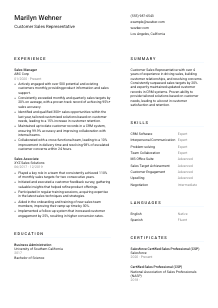
If the employer asks for a candidate in a specific area, reflect that clearly. Here, listing Los Angeles, California answers a stated requirement right away and avoids unnecessary questions about relocation or local availability.
Add LinkedIn or a professional website if it supports your candidacy. For sales roles, that profile should reinforce what your resume says, such as account growth, customer-facing experience, CRM familiarity, or industry focus. Keep titles, dates, and achievements consistent across both.
These details should confirm that you are easy to contact and properly aligned with the opening before the reader reaches your sales history. Once that is clear, your experience section can do the heavier work of proving performance.




For Customer Sales Representative roles, experience is where hiring managers look for commercial judgment. They want to see how you handled customer volume, whether you converted interest into revenue, and how well you worked across teams when delivery issues or escalations threatened the sale.
Read the posting closely and echo the terms that match your real work. In this case, phrases such as "provide product information," "qualify sales opportunities," "maintain customer records in CRM," and "exceed monthly and quarterly sales targets" belong in your experience bullets if you have done that work. This helps both the recruiter and the ATS connect your background to the opening.
List roles in reverse chronological order with job title, company name, and dates. Sales hiring often depends on recent performance, territory scope, and progression, so your most current target-driven work should appear first and be the easiest to scan.
A sales resume needs more than "responsible for customer support" or "handled accounts." Show what happened because of your work. The sample resume does this well with examples like engaging 500+ customers monthly, identifying 300+ qualified opportunities, and improving customer retention by 15% through tailored solutions.
Use numbers tied to revenue activity and service execution: quota attainment, conversion improvements, retention gains, response time, CRM accuracy, customer volume, or resolution rates. Metrics such as "exceeded quarterly targets by 20%" or "resolved 98% of escalated concerns within 24 hours" tell a hiring manager far more than generic claims about being results-oriented.
Keep bullets that strengthen your case for a customer-facing, target-carrying role. CRM upkeep, follow-up systems, upselling, opportunity qualification, cross-functional coordination, and customer issue resolution belong here. Less relevant experience can stay brief, especially if it does not connect to selling, account support, or customer retention.
By the end of this section, the reader should be able to trace your sales record in concrete terms. They should see customer volume, target performance, CRM discipline, and the kind of follow-through that keeps deals and relationships moving.
Education usually plays a supporting role in sales hiring, but it still matters when the posting calls for a degree. Present it clearly so the recruiter can confirm the requirement and move on to the parts of your resume that show commercial performance.
If the job asks for a bachelor's degree in Business, Sales, or a related field, make that easy to confirm. A Bachelor of Science in Business Administration, like the one in the example resume, aligns cleanly with the employer's requirement and supports a sales-focused background.
List your degree, field of study, school, and graduation year in a simple order. Education is a quick verification section, so clarity matters more than decorative formatting.
When your degree connects to sales, business operations, marketing, or customer management, let that connection work for you. It helps reinforce that your training supports the commercial and relationship side of the role.
Early-career candidates can include relevant coursework, sales competitions, business clubs, or customer-facing campus work if professional experience is still thin. Once you have several years of sales results, these extras usually become less important than quota history and customer outcomes.
Academic distinctions can help if they point to consistency, leadership, or business-related achievement. Keep them brief and only include them if they add real value beside your sales experience.
This section should confirm that you meet the academic requirement without distracting from your track record. For most Customer Sales Representative roles, education supports the story, but performance closes the case.
Certifications can sharpen a sales resume when they reinforce tools, methods, or product environments the employer cares about. They are especially useful when the role mentions CRM proficiency or when you want to show continued development beyond your degree and work history.
This posting does not require a certification, so only include ones that strengthen your fit. CRM-related credentials, sales methodology training, or platform certifications can be valuable because they support the day-to-day work of managing customer records, tracking opportunities, and moving deals through a pipeline.
Prioritize certifications that connect to customer sales activity instead of listing every course you have ever completed. The sample resume's Salesforce certification is a strong example because the job explicitly asks for CRM software proficiency.
Include dates or validity periods where appropriate. In sales and CRM environments, current knowledge matters because workflows, reporting tools, and platform features change over time.
If you are still growing in the role, look for certifications tied to CRM systems, consultative selling, account management, negotiation, or customer success. These additions can support your resume when they reflect the kind of sales process the employer uses.
Certifications should add texture to your sales profile, not replace experience. The best ones tell the employer that you stay current on the tools and selling practices that shape day-to-day customer work.
A Customer Sales Representative skills section should read like the toolkit behind your results. It needs to cover both the selling side of the job and the execution side, especially CRM upkeep, customer communication, follow-up, and coordination with internal teams.
Start with the language the employer already used. Here, that includes CRM software, MS Office Suite, communication, interpersonal skills, and customer-facing sales support. If these are genuine strengths in your background, use the same wording so your resume matches how the role is described.
Put the most relevant capabilities first. For this type of role, that usually means CRM management, opportunity qualification, customer engagement, objection handling, upselling, account follow-up, and cross-functional collaboration. These are the skills that connect directly to pipeline health and customer experience.
Avoid a long dump of generic traits. A shorter, targeted list makes more sense for sales hiring. The example resume works because it mixes systems knowledge like CRM software and MS Office with customer-facing strengths such as interpersonal communication, upselling, and negotiation.
This section should quickly confirm that you have the tools for the job: sales communication, CRM discipline, and the practical skills needed to move opportunities forward and support customers well.
Language ability can be a real advantage in customer sales, especially in markets with diverse customer bases. Present it clearly so the employer can tell whether you meet the required communication standard and whether you can serve a broader range of customers.
If the role asks for English competency, list English prominently with an honest proficiency level. That removes any ambiguity around a stated requirement and supports your ability to handle customer conversations, sales explanations, and internal coordination.
Extra languages can strengthen your resume when they are relevant to the customer base. In the example, fluent Spanish is a useful addition for a Los Angeles-based role because it may expand your ability to build rapport and support more customers directly.
Even when they are not required, additional languages can support prospecting, account support, and issue resolution. They are worth listing if you can use them in real customer interactions rather than only at a basic conversational level.
Use straightforward labels such as Native, Fluent, Advanced, or Conversational. Overstating language ability can become a problem quickly in a sales role where live calls, objections, and product explanations depend on accuracy.
Frame language skills as practical support for sales and service, not as a decorative extra. If a language helps you explain products, build trust, or reduce friction during support conversations, it belongs on the resume.
This section works best when it shows clear communication capacity. For customer sales roles, that can mean meeting the required English standard and, where relevant, showing added reach with another market-relevant language.
The summary is your opening sales pitch to the employer. For a Customer Sales Representative, it should quickly connect years of experience, target performance, customer relationship work, and the tools or processes you use to deliver consistent results.
Center the summary on the real blend of responsibilities in customer sales: driving revenue while supporting customers well enough to keep them engaged. That balance matters because many employers are looking for someone who can sell, answer questions, and maintain trust after the first contact.
Open with your title and years of experience, then move quickly to the level of work you handle. The sample summary does this effectively by stating more than 4 years of experience and tying that experience to sales growth, customer relationships, and concern resolution.
Use specific outcomes instead of broad traits. Strong examples include surpassing sales targets, improving retention, qualifying opportunities, or maintaining accurate CRM records. These details give the recruiter a quick commercial snapshot before they read your full experience section.
Aim for a short paragraph that sounds specific to customer sales, not a generic sales profile. Three to five lines is enough to cover your experience, strongest results, and one or two role-relevant skills such as CRM use, customer engagement, or tailored solution selling.
A well-written summary should prepare the reader for the rest of the resume in a few seconds. It should already tell them that you understand customer sales work, hit targets, and manage the customer side of the process with discipline.
A Customer Sales Representative resume should leave very little guesswork. The employer should be able to see your sales numbers, customer-facing scope, CRM habits, and degree of alignment with the posting without digging through vague language or broad claims.
Use Wozber's ATS-friendly resume templates and ATS resume scanner to tighten that alignment, surface the right keywords, and keep your resume in an ATS-friendly resume format. When the content is specific and the structure is clean, your application makes it much easier to judge whether you can step into the role and start producing.