



Use Wozber and land your dream job
Create Resume
No registration required
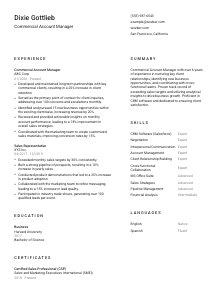
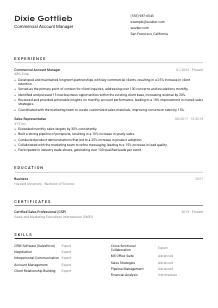
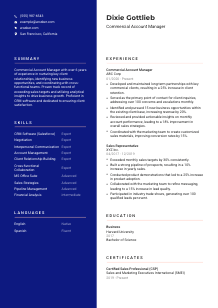
Closing deals, but your resume isn't sealing the right partnerships? Check out this Commercial Account Manager resume example, created with Wozber free resume builder. It shows how to line up your client-savvy skills with job requirements, ensuring your career revenue stream always flows steadily!
Commercial Account Managers sit at the intersection of revenue growth and client retention. Hiring teams want to see how you manage ongoing relationships after the sale, handle escalations without losing trust, and uncover expansion opportunities inside an existing book of business. Your resume should make that commercial judgment visible through account results, renewal strength, cross-functional coordination, and client-facing ownership.
When those details are tailored to the posting, the resume reads much more clearly in both human review and ATS screening. Wozber's free resume builder helps you align account-management language, sales outcomes, and CRM terminology with the job description while keeping an ATS-friendly resume format, so the hiring team can quickly see whether you can protect revenue, grow accounts, and manage commercial relationships with confidence.
For a Commercial Account Manager, the header needs to do one practical job well: confirm who you are, how to reach you, and whether you meet any immediate screening requirements. Keep it clean, accurate, and easy to scan so attention stays on your client portfolio, revenue results, and communication strengths.
Use your full name as the most visible text on the page. A simple, readable presentation works best because this role depends on professional credibility and client-facing polish, not design flourishes.
Place the exact role title under your name when it matches your background. Using "Commercial Account Manager" immediately aligns your resume with the opening and helps frame the rest of your experience around account growth, client retention, and commercial ownership.
List a phone number you answer, a professional email address, and if relevant, a current LinkedIn profile. In a role built on responsiveness and relationship management, basic contact details should feel reliable and business-ready.
Some openings include a firm location requirement, as this one does for San Francisco, California. If you already live there, say so clearly in your header. If relocation is part of your plan, state that directly instead of leaving the employer to guess.
A LinkedIn profile can strengthen your application when it reflects the same employers, dates, and commercial achievements shown on the resume. If it highlights account growth, client portfolio scope, or industry relationships, it adds useful context. If it is outdated, leave it off until it matches.
This section should remove small doubts fast. Clear contact information, a matching title, and any required location detail help hiring teams move straight to your account results and client management experience.




This is where Commercial Account Manager resumes usually separate themselves. Employers are not looking for a list of client-service tasks. They want proof that you retained business, expanded accounts, resolved issues, collaborated across teams, and turned account reviews into measurable commercial results.
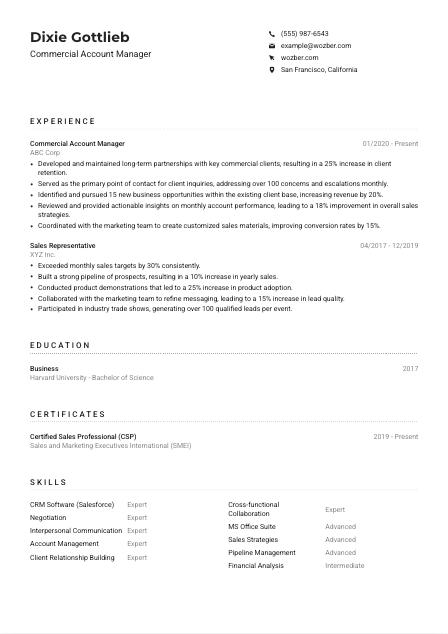
Start by marking the responsibilities that drive the job: long-term client partnerships, escalations, account reviews, growth opportunities, and coordination with sales and marketing. Then make sure your bullets speak to those exact parts of the account lifecycle. In the sample resume, retention gains, monthly inquiry volume, revenue growth, and tailored sales materials all map closely to what the employer asked for.
Lead with your most recent role and work backward. For commercial hiring, this helps employers quickly gauge the size of accounts you manage now, the type of clients you support, and how your sales or account responsibilities have expanded over time.
Replace generic phrases like "managed accounts" with specifics about what changed because of your work. Good bullets show retention, upsell activity, client satisfaction, renewal performance, response volume, or account growth. A line like "identified and pursued 15 new business opportunities within the existing client base" is effective because it ties relationship management to revenue expansion.
Numbers matter here because account management is measured through growth and client performance. Use metrics such as retention rate, renewal rate, revenue increase, pipeline contribution, number of managed accounts, escalation volume, conversion lift, or target attainment. The sample's 25% retention increase and 20% revenue growth are strong examples of how to make impact concrete.
Choose bullets that show both relationship depth and business judgment. That means balancing client-facing work with analytical review, cross-functional collaboration, and sales contribution. If you worked with marketing on account-specific collateral or reviewed monthly account performance to adjust strategy, include it. Those details show you can manage accounts as ongoing commercial partnerships, not just service tickets.
Your experience section should let a hiring manager picture you owning client relationships, protecting revenue, and finding room to grow accounts. If the bullets only describe activity, sharpen them until the business outcome is unmistakable.
Education usually plays a supporting role for Commercial Account Managers, but it still matters when the posting calls for a bachelor's degree in business, marketing, or a related field. Present it clearly so the requirement is easy to confirm and the focus can return to your client and sales performance.
If you hold a bachelor's degree in Business, Marketing, or a related discipline, make that credential easy to spot. In the example, a Bachelor of Science in Business aligns directly with the stated requirement and reinforces commercial fluency.
List degree, field of study, school, and graduation year in a consistent format. Hiring teams do not need extra explanation here. They need a clean read on whether your academic background supports the role's business and client-development focus.
When your degree title is broad, the field can do important work. "Business," "Marketing," or a related concentration helps connect your education to sales strategy, account planning, and client communication rather than leaving the relevance implicit.
If you are early in your career or your experience is lighter, a few relevant courses can help. Choose subjects tied to commercial work, such as sales management, marketing analytics, business communication, or customer strategy. Skip long course lists once your work history carries the argument.
Honors, leadership roles, or business competitions can add value if they support the profile you are building. Keep them when they reinforce initiative, presentation skills, or commercial thinking. Leave them out if they distract from stronger evidence in your experience section.
This section should confirm the degree requirement with minimal friction. Once that box is checked, your resume should return quickly to the account growth, retention, and client-facing work that drives hiring decisions in this field.
Certifications are rarely the deciding factor for a Commercial Account Manager, but the right one can strengthen your profile. They are most useful when they reinforce sales discipline, account development, negotiation, or customer-facing professionalism rather than padding the page.
Start with the posting. If a certificate is required or preferred, list it exactly and place it where it is easy to find. When no credential is specified, choose certifications that support account growth, client management, or commercial selling rather than adding unrelated badges.
Prioritize certifications that connect to how Commercial Account Managers are measured. Sales training, account management programs, negotiation credentials, or customer success certifications are more useful than broad general-interest courses. The CSP shown in the example works because it supports the sales and client development side of the role.
Add completion or renewal dates when they clarify that the certification is current. In commercial roles where product positioning, client expectations, and sales processes evolve, recency can matter as much as the credential itself.
A well-chosen certification can show that you invest in sharpening the skills the job actually uses, whether that is negotiation, pipeline management, or account strategy. Keep the list focused and credible. One relevant, current certification is often stronger than several weak ones.
Certificates should strengthen the story your experience already tells. When they align with client retention, account growth, and sales execution, they add useful depth without distracting from your core record.
A Commercial Account Manager skill list should look like the toolkit behind your results. That usually means a mix of account-management strengths, sales abilities, reporting tools, and client communication skills that support retention, expansion, and issue resolution across a portfolio.
Read the job description with a highlighter and capture the real requirements. Here, that includes CRM software, Excel or MS Office, communication, negotiation, interpersonal ability, and account growth. Those terms belong in your skills section when they reflect your actual background.
Order matters because recruiters often scan this section quickly. Lead with skills that support daily commercial work, such as account management, client relationship building, CRM proficiency, negotiation, pipeline management, and cross-functional collaboration. The example does this well by putting CRM software, negotiation, and account management near the top.
This role requires more than relationship warmth. Show both the tools and behaviors behind performance: CRM platforms, Excel-based account tracking, sales strategy, and financial analysis alongside communication, escalation handling, and stakeholder management. That mix reflects how commercial accounts are actually run and reviewed.
Every skill listed should support a part of the job, whether that is managing a client book, analyzing account performance, coordinating with marketing, or closing growth opportunities. If a skill does not connect to those outcomes, it probably does not belong.
Language ability matters most when it affects client communication. For Commercial Account Managers, the baseline is usually clear, professional English because the role involves calls, follow-ups, presentations, escalations, and relationship maintenance. Additional languages can help when they match the customer base or market coverage.
If the posting asks for fluent English, list English clearly and use an honest proficiency label. In this case, the employer specifically wants fluent and articulate English communication, so that should be easy to confirm on the resume.
Additional languages can strengthen your profile when you work with diverse commercial clients, regional accounts, or multilingual stakeholders. They are especially useful if those language skills help with relationship building, renewals, or smoother issue resolution.
Be precise with labels such as Native, Fluent, Intermediate, or Basic. A client-facing role can quickly expose inflated language claims during interviews, presentations, or customer conversations, so accuracy matters.
Some commercial portfolios are local and English-only. Others involve broader territories, channel partners, or culturally diverse customer groups. Include languages that actually support the accounts you manage or the business you want to win.
If you include another language, connect it mentally to a commercial advantage: clearer communication, faster trust-building, smoother client meetings, or broader account access. The example's Spanish is useful because it could expand relationship coverage beyond the required English baseline.
For this role, language skills matter when they improve how you handle accounts and client conversations. Lead with the required English proficiency, then add other languages that genuinely expand your reach.
The summary should tell the reader, in a few lines, what kind of Commercial Account Manager you are and what business results usually follow your work. Focus on account ownership, revenue growth, client retention, and the tools or strengths that support those outcomes.
Before writing, identify the themes the employer cares about most. In this case, those themes include long-term client partnerships, sales growth within existing accounts, account performance reviews, and cross-functional collaboration. Your summary should reflect that mix instead of reading like a generic sales profile.
State your title and years of experience early. A line such as "Commercial Account Manager with 6+ years of experience" quickly establishes seniority and keeps the summary anchored in the exact discipline the employer is hiring for.
Choose strengths that match how the job creates value. For this role, that may be growing existing accounts, managing key client relationships, resolving escalations, improving retention, or using CRM data to guide account strategy. The sample summary works because it combines relationship management, opportunity identification, and analytical insight.
Aim for a short paragraph that can be read in seconds. Three to five lines is usually enough to combine experience level, core strengths, and one clear performance theme such as exceeding targets or expanding client revenue. Save the full detail for the experience section.
A good summary gives immediate context for the rest of the resume. After reading it, the employer should already expect to see account growth, retained clients, sharp communication, and disciplined use of CRM and performance data.
Your resume should now read like someone who can own commercial relationships after the initial sale, protect client trust, and turn account insight into revenue growth. That means clear client-facing experience, measurable retention or expansion results, and language that reflects how you manage accounts in practice.
Use Wozber to tighten that alignment from top to bottom. Its ATS resume scanner, ATS-friendly resume templates, and AI-powered tailoring workflow help you match the job description with accurate keywords, clearer accomplishment phrasing, and a polished ATS-compliant resume. The finished document should make one conclusion easy to reach: you can grow accounts and manage client partnerships with confidence.




