



Use Wozber and land your dream job
Create Resume
No registration required
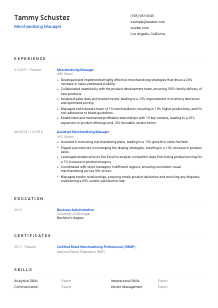
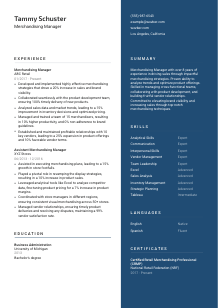
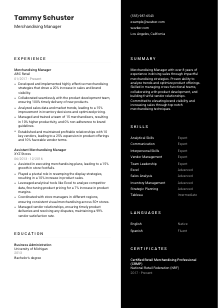
Master of displays, but your resume looks disarrayed? Organize your journey with this Merchandising Manager resume example, created with Wozber free resume builder. Learn how to present your retail storytelling skills in line with job descriptions, keeping your career shelves stocked with opportunities!
Merchandising managers are expected to connect assortment decisions to commercial results. Hiring teams look for proof that you can move sales, protect margin, guide inventory decisions, and keep brand presentation consistent across products, channels, or stores. Your resume should make that commercial judgment visible, not bury it under generic retail duties.
Screening gets easier when your resume mirrors how merchandising work is actually measured. Wozber's free resume builder helps you shape an ATS-compliant resume around the language of the job description, so sales gains, pricing analysis, vendor work, and team leadership are easier to spot early. That matters when employers need to quickly separate hands-on merchandisers from managers who can set strategy and deliver results.
For a Merchandising Manager, the header should do one job well. It should confirm who you are, what role you are targeting, and whether you meet any immediate logistical requirements. Keep it clean, professional, and easy to scan so the hiring team can move straight to your commercial and leadership experience.
Use your full name as the most prominent text on the page. In merchandising, your resume is expected to feel organized and commercially aware, so a clear header already signals good presentation standards. Keep the formatting simple rather than decorative.
Place "Merchandising Manager" directly under your name when that is the role you are pursuing. Matching the posted title helps frame the rest of the resume immediately and supports ATS alignment, especially when the employer is sorting candidates across adjacent titles such as Buyer, Planner, or Assistant Merchandising Manager.
List a reliable phone number and a professional email address. Double-check both. Senior retail and merchandising hiring often moves quickly between recruiter outreach, hiring manager calls, and interview scheduling, so this information needs to be accurate and easy to find.
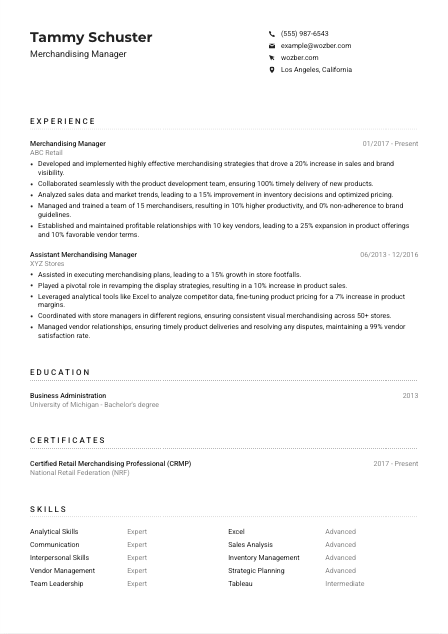
If the posting calls for a specific location, show it in your header. Here, Los Angeles, California is a stated requirement, so including "Los Angeles, California" removes a basic point of uncertainty right away. Tammy Schuster's sample resume does this well by making the location visible at the top without overexplaining it.
Include LinkedIn or a professional website if it supports your candidacy. For merchandising professionals, that can reinforce career progression, retail brand experience, or broader portfolio context. Make sure the profile matches your resume titles, dates, and achievements so the hiring team sees one consistent story.
Your personal details should confirm role alignment and availability in a few seconds. Once that is clear, the rest of the resume can focus on the work that matters most in merchandising: sales impact, inventory judgment, product execution, and team leadership.




This section carries the most weight for a Merchandising Manager. Employers want to see how you have influenced revenue, assortment, pricing, vendor performance, launch execution, and team output. Broad statements about retail responsibility are less persuasive than concrete examples tied to sales, margin, inventory, or store performance.
Read the posting and translate each requirement into proof points from your own work history. In this case, the priorities are clear: building merchandising strategies, analyzing sales and market data, managing merchandisers, collaborating with product teams, and strengthening vendor relationships. Those themes should show up in your bullet points, not just in your skills list.
List your most recent role first, then work backward. Include job title, company, and dates for each position. For merchandising careers, this format helps employers quickly see whether you have moved from execution into ownership, such as progressing from Assistant Merchandising Manager into a role with direct responsibility for sales strategy, team management, and vendor terms.
Quantify achievements with numbers tied to retail performance. Sales growth, margin improvement, inventory accuracy, launch timeliness, productivity, store coverage, and vendor terms all carry weight here. The sample resume gives strong examples, including a 20% increase in sales, 15% better inventory decisions, and management of a 15-person merchandising team. Those are the kinds of specifics that make your contribution credible.
Avoid bullets that only describe tasks such as "worked with vendors" or "supported product launches." Show what changed because of your work. If you used Excel or Tableau to refine pricing, say how that affected margin or sell-through. If you partnered with product development, show whether launches landed on time, assortments improved, or brand visibility increased.
Prioritize experience that supports merchandising leadership. Earlier roles can stay on the resume, but the detail level should match relevance. A hiring manager for this kind of role will care far more about assortment strategy, forecasting, store execution, and cross-functional leadership than unrelated responsibilities that do not connect to commercial performance.
Your experience section should leave little doubt about the scale and quality of your merchandising work. If a hiring manager can quickly see stronger sales, better inventory decisions, reliable launches, and effective team leadership, this section is doing its job.
Education is usually a qualification check for merchandising management roles, but it still helps shape how your background is read. A relevant degree in business, marketing, or a related field supports your understanding of pricing, consumer behavior, forecasting, and retail operations. Present it clearly and let it reinforce the commercial side of your experience.
When the posting asks for a bachelor's degree in Business, Marketing, or a related field, make sure your degree is easy to find. If your background aligns directly, say so plainly. In the sample resume, "Bachelor's degree in Business Administration" meets the requirement cleanly and needs no extra explanation.
List degree, field of study, school, and graduation year. That is usually enough for an experienced Merchandising Manager. Clean structure matters here because recruiters often scan education quickly after confirming your work history and location.
If your degree directly supports merchandising work, do not hide the field of study. Business, marketing, retail management, and related disciplines all strengthen your profile because they connect naturally to assortment planning, pricing strategy, and market analysis.
If your degree title is broad or less obviously related, you can include relevant coursework, projects, or academic distinctions that connect to merchandising. Focus on topics like consumer behavior, marketing analytics, retail operations, or supply chain. For senior candidates with solid experience, keep this brief.
Additional training can strengthen this section if it supports current retail practice. Courses in analytics, forecasting, visual merchandising, or vendor management can be worth mentioning when they sharpen the commercial story you are telling elsewhere on the resume.
This section does not need much space, but it should remove any doubt that you meet the academic requirement. Once that box is checked, your experience and results can carry the heavier argument.
Certifications are not always required for merchandising management roles, but the right ones can strengthen your positioning. They are most useful when they reinforce areas employers already care about, such as retail strategy, analytics, inventory planning, category management, or leadership development.
Start with credentials that sharpen your fit for the specific opening. If the role emphasizes retail merchandising strategy, team leadership, and data-driven decisions, prioritize certificates that support those capabilities rather than unrelated general training.
A short, targeted certification section works better than a long list of low-value courses. The sample resume includes the Certified Retail Merchandising Professional credential, which adds direct relevance because it speaks to recognized knowledge in the retail merchandising field.
Add the certification date or active period so employers can see whether the credential is current. This is especially helpful for certifications tied to evolving retail practices, analytics tools, or professional standards.
If you are strengthening a gap or building toward a more senior merchandising scope, certifications can help round out the picture. For example, training in Tableau, planning, or supply chain analytics can support roles that expect stronger forecasting and inventory decision-making.
The best certifications add weight to the parts of your background the employer already values. Keep this section selective and connected to how merchandising managers drive sales, manage inventory, and lead cross-functional execution.
A Merchandising Manager skills section should read like an operating toolkit for retail performance. It should cover the analytical, commercial, and leadership capabilities that support pricing, assortment, forecasting, vendor coordination, and team management. Generic soft-skill lists will not carry much weight unless the rest of the resume shows where those skills were applied.
Start with the required and implied skills in the job description. Here, that includes data analysis, Excel or Tableau, team management, vendor collaboration, communication, and merchandising strategy. These are not buzzwords to sprinkle in. They should match capabilities you can support in your experience section.
Balance technical and leadership skills. For merchandising roles, that often means including tools such as Excel, Tableau, sales analysis, pricing, forecasting, and inventory management alongside team leadership, vendor management, and cross-functional communication. The sample resume handles this well by combining analytical tools with commercial and people-management strengths.
Put the most relevant skills first instead of listing everything you have ever used. Employers hiring merchandising managers want to see the abilities that influence sales performance, assortment decisions, launch timing, and in-store or brand consistency. If a skill does not support those outcomes, it likely belongs lower on the list or off the resume entirely.
Every skill you list should connect naturally to a merchandising outcome elsewhere on the page. When the tools, business judgment, and leadership skills line up with your accomplishments, the resume feels coherent and credible.
Language skills matter in merchandising when the role involves vendor communication, cross-functional coordination, regional store support, or brand work across different customer groups. Even when only one language is required, listing proficiency clearly helps remove doubt about your ability to communicate in meetings, reporting, and day-to-day execution.
If the posting specifically asks for English, list English first and show your proficiency level clearly. This role requires professional communication in English, so that detail should be easy to find rather than implied elsewhere on the resume.
Place the language most relevant to the role at the top, then add any others that could support the business. For example, bilingual ability may be useful in vendor conversations, regional market work, or collaboration across diverse retail teams, depending on the company and market.
Extra languages are worth listing when they are real working capabilities. In the sample resume, Spanish adds value because it can support broader communication across teams, stores, or vendor relationships, even though the posting only requires English.
Choose direct labels such as Native, Fluent, Advanced, or Conversational. Avoid vague wording. Hiring teams need a realistic sense of how comfortably you can present, negotiate, coordinate, or report in each language.
Do not overstate this section, but do not dismiss it either. In merchandising, clear communication affects vendor management, launch execution, and cross-functional teamwork. If languages strengthen that picture, they deserve a place on the resume.
A concise language section helps confirm communication range without distracting from your merchandising achievements. Accuracy matters more than quantity here.
The summary is your chance to establish commercial scope quickly. For a Merchandising Manager, it should communicate years of experience, the type of retail impact you have delivered, and the blend of strategy, analysis, and team leadership you bring. Keep it brief, but make every line point toward sales growth, product performance, and operational control.
Read the posting closely and decide which themes belong in the first lines of your summary. In this case, those include driving sales through merchandising strategy, improving brand visibility, analyzing demand and pricing, and leading teams. Your summary should reflect that business focus immediately.
Start with your title or professional identity, then add your years of experience and core area of responsibility. A line such as "Merchandising Manager with 8+ years of experience in retail merchandising and sales strategy" gives instant context and sets up the rest of the resume well.
Include the capabilities most relevant to the job, such as assortment strategy, sales and trend analysis, vendor management, product launch coordination, or team leadership. The sample summary works because it brings together sales growth, trend analysis, cross-functional collaboration, and vendor relationships in a compact way.
Aim for a short paragraph that reads clearly in one pass. Skip broad claims about passion or excellence unless they are backed by concrete context. This section works best when it sounds like an experienced operator summarizing how they improve sales performance, inventory decisions, and brand execution.
A focused summary gives the hiring team a fast read on your level, strengths, and merchandising scope. If it clearly points to sales impact, analytical judgment, and leadership, it sets up the rest of the resume well.
A Merchandising Manager resume should show how you make product decisions pay off commercially. When your experience, skills, and summary all point to sales growth, pricing judgment, inventory planning, vendor management, and team leadership, the hiring team can picture you in the role much faster.
Wozber helps you turn that story into a polished, ATS-friendly resume with structure, keyword alignment, and targeted revision support. Use Wozber's AI resume builder and ATS resume scanner to match your resume to the job description with cleaner phrasing and stronger section-level alignment. The finished document should make one thing easy to judge: whether you can lead merchandising decisions that improve both brand presence and business results.




