




Use Wozber and land your dream job
Create Resume
No registration required
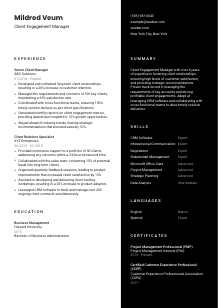
Strengthening bonds, but your resume feels distant? This Client Engagement Manager resume example, created with Wozber free resume builder, shows how to present your relationship-building skills in line with job expectations, ensuring your career story feels as connected as the clients you engage with!
Client engagement work sits at the intersection of relationship management, delivery coordination, and commercial growth. Hiring teams want to see whether you can retain accounts, handle client concerns without losing momentum, and turn day-to-day interactions into longer-term value. Your resume should make that operational range visible quickly, especially through account scope, satisfaction results, retention gains, reporting ownership, and cross-functional collaboration.
A tailored resume changes how your background is interpreted in screening. When titles, metrics, and tools line up with the posting, it becomes much easier to distinguish client engagement experience from broader customer service or sales support work. Wozber's free resume builder helps you shape that alignment in an ATS-compliant resume, so core terms like CRM, client reporting, account management, and strategic recommendations are easy to parse and tied to real outcomes.
This section is brief, but it still does screening work. For a Client Engagement Manager, the header should confirm who you are, how to reach you, and whether basic logistical requirements are already covered.
Place your full name at the top in a clean, readable format. Keep it more prominent than the rest of the header so it anchors the page immediately. This role depends on professional communication and client-facing presence, so even simple presentation choices should feel polished and controlled.
Add "Client Engagement Manager" directly under your name when that is the role you are targeting. Matching the title helps recruiters and ATS systems connect your resume to the opening right away, especially when your recent role used a close variant such as Senior Client Manager or Client Relations Specialist.
Include a reliable phone number, a professional email address, and, if relevant, a LinkedIn profile or personal site. Make sure every link works and every detail is current. In client-facing roles, missed calls, outdated profiles, or informal email addresses create the wrong impression before anyone reaches your experience section.
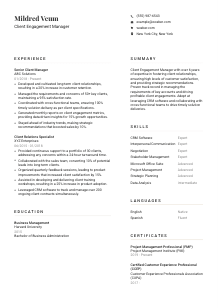
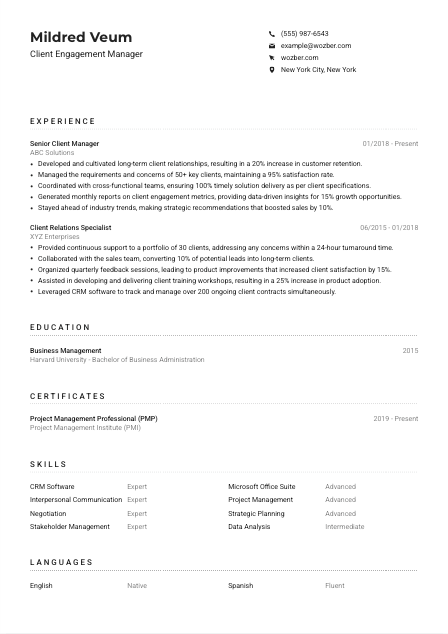
If the posting specifies a location requirement, reflect it clearly in your header. Here, listing New York City, New York directly answers a stated condition and removes questions about relocation or availability. Use this only when location is relevant to the role you are applying for.
A strong LinkedIn profile can reinforce your account portfolio, client-facing achievements, and recommendations from partners or stakeholders. If you include it, make sure the content matches the resume closely, especially job titles, dates, and measurable results like retention, satisfaction, or account growth.
Your header should resolve the basics without distraction. For this kind of role, that means clear contact details, the right target title, and any required location information presented in a way that feels organized and client-ready.




This is the section that carries the most weight for a Client Engagement Manager. Employers are looking for signs that you have managed relationships over time, coordinated internal delivery, handled client concerns well, and used reporting or account insight to grow the business.
Read the posting closely and identify the experience themes that repeat. Here, those include long-term client relationship management, serving as the main point of contact, coordinating with internal teams, reporting on engagement metrics, and offering strategic recommendations. Shape your bullet points around those patterns so your background reads as directly relevant rather than generally customer-facing.
List your positions in reverse chronological order and make the career path easy to follow. Hiring teams want to see whether you moved from support-oriented client work into broader account ownership, escalation handling, or strategic advisory responsibilities. The example resume does this well by moving from Client Relations Specialist to Senior Client Manager, which signals growth in scope and trust.
Generic lines like "managed client relationships" are too thin for this role. Use bullets that connect your actions to retention, satisfaction, renewals, adoption, revenue growth, or delivery performance. For example, "Developed and cultivated long-term client relationships, resulting in a 20% increase in customer retention" shows both the relationship work and the business result.
Client engagement performance is often measured through metrics such as satisfaction scores, retention rates, response time, portfolio size, delivery timeliness, upsell results, or engagement trends. Include those where you can. A 95% satisfaction rate, management of 50+ key clients, or 100% on-time delivery gives hiring teams a concrete read on scale and consistency.
Choose accomplishments that sound native to client engagement work. Strong bullets often show how you handled feedback, coordinated with sales, product, or operations teams, improved adoption, or turned reporting into growth recommendations. Leave out achievements that do not support the story of account stewardship, stakeholder communication, and strategic client management.
Your experience section should make it easy to picture you running accounts, resolving issues, and keeping delivery aligned with client expectations. When the bullets show scope, metrics, and collaboration clearly, your fit for a Client Engagement Manager role becomes much easier to see.
Education is usually a supporting section for mid-career client engagement professionals, but it still matters when the posting specifies a degree. Keep it straightforward and relevant, with enough detail to confirm that you meet the stated academic requirement.
When a role asks for a bachelor's degree in Business, Marketing, or a related field, list that information exactly and prominently. A Bachelor of Business Administration in Business Management, as shown in the example, aligns well because it supports the commercial and relationship-management side of the role.
Include your degree, field of study, school, and graduation year or date. Keep the layout simple so it is easy for recruiters and ATS systems to parse. This section does not need extra design treatment. It needs clarity and accurate qualification details.
If your degree closely matches the posting, let that alignment work for you. Business, marketing, communications, and related fields all make sense for client engagement roles because they support account management, stakeholder communication, and commercial analysis. If your degree is in a less obvious area, the rest of your resume should bridge that gap through relevant experience.
Most experienced candidates do not need coursework, capstones, or student activities here. Include them only if they support the role directly, such as research in customer behavior, marketing analytics, or project coordination, or if you are earlier in your career and need more evidence of relevant preparation.
Honors, scholarships, or leadership in business-related organizations can add value, but they should not crowd out stronger professional material. Use them selectively, especially if they reinforce communication, leadership, or client-centered business work.
For most Client Engagement Manager resumes, education should quickly confirm that you meet the degree requirement and have a relevant academic foundation. Keep it concise, accurate, and easy to scan.
Certifications are often a plus rather than a hard requirement in client engagement hiring, but the right one can strengthen your profile. They are especially useful when they support project coordination, customer experience leadership, or structured account management.
Start with credentials that connect directly to the job description. In this case, a project management certification such as PMP supports a role that involves coordinating internal teams, managing delivery expectations, and keeping client commitments on track. That is why the example resume benefits from placing the PMP visibly.
List the certifications that deepen your case for client-facing leadership. A short list of respected credentials is usually stronger than a long list of unrelated training. PMP, customer experience certifications, account management programs, or industry-specific credentials often add more value than broad online course collections.
Add the issue date or active date range when it helps show that your credential is current. This matters most for certifications connected to active standards, frameworks, or continuing education requirements. It also signals that you stay engaged with professional development rather than treating it as a one-time checkbox.
The best certifications reinforce how you operate on the job. Project management credentials suggest structure, follow-through, and coordination discipline. Customer experience certifications suggest stronger understanding of satisfaction drivers, feedback loops, and service improvement. Choose the ones that support the kind of client work you want to be hired for.
Relevant certifications strengthen your resume when they connect to real client engagement responsibilities such as delivery management, stakeholder communication, and service improvement. Keep the list selective and tied to the work you actually do.
The skills section should mirror how the job is executed, not just repeat generic strengths. For Client Engagement Manager roles, that usually means a mix of relationship management, reporting, coordination, communication, and the systems used to track accounts and engagement activity.
Start with the tools and capabilities named in the job description, then add closely related strengths you genuinely use. Here, CRM software, Microsoft Office Suite, written and verbal communication, and client management are all direct matches. From there, you can add adjacent skills such as stakeholder management, negotiation, strategic planning, or data analysis if your experience supports them.
Place the most role-relevant skills first. For this profession, that often means CRM proficiency, account management, client communication, stakeholder management, reporting, and cross-functional coordination before broader soft skills. The example resume handles this well by leading with CRM software and interpersonal communication rather than burying them lower in the list.
Avoid turning this section into a master inventory. A focused list is more persuasive than a crowded one. Include enough range to show you can manage both the relationship side of the work and the operational side, but keep every item defensible through your experience bullets or summary.
Your skills list should support the picture already established in your experience section: someone who can manage client relationships, use the right systems, communicate clearly, and turn account insight into action.
Language ability matters more in client engagement than it does in many internal-facing roles because communication quality affects trust, issue resolution, and relationship depth. If the posting names a required language, reflect that clearly and honestly.
If the role demands high proficiency in English, place English first and label your level accurately. Native or fluent English can be a direct advantage in roles that involve regular client calls, written follow-up, reporting, and strategic recommendations.
Use familiar labels such as Native, Fluent, Advanced, or Intermediate. Hiring teams need a quick, realistic sense of how comfortably you can speak, write, and present. Avoid vague descriptions that make your actual communication range unclear.
Extra languages can strengthen your profile when the client base is diverse, regional, or international. Spanish, for example, may be valuable in many markets even when it is not listed as a requirement. Treat additional languages as a meaningful asset, not filler.
Do not overstate proficiency. In client-facing work, language ability shows up quickly in meetings, email exchanges, and stakeholder discussions. Accurate labeling protects your credibility and helps employers place you in the right client environment.
For a Client Engagement Manager, language skills matter most when they support relationship building, issue handling, training, and executive communication. If language is part of how you manage accounts effectively, this section helps explain that advantage in a concise way.
A clear language section tells employers whether you can handle the communication demands of the role from day one. Keep it straightforward and aligned with the level of client interaction the job requires.
The summary should give a focused read on your seniority, client-facing scope, and strongest business outcomes. For this role, a good summary usually combines years of experience, account or relationship strengths, and one or two operational capabilities such as CRM use, reporting, cross-functional coordination, or strategic client guidance.
Use the job description to decide what belongs in the summary. Here, the strongest themes are long-term relationship management, client satisfaction, cross-functional delivery, reporting on engagement metrics, and strategic recommendations. Pull from those priorities rather than writing a generic statement about being results-driven.
Start with your title or closest equivalent and your years of relevant experience. A line like "Client Engagement Manager with over 6 years of experience in client relationships and account growth" immediately places you in the right lane and tells the reader your background is established, not entry level.
Use the next sentence to highlight two or three strengths backed by your experience, such as maintaining high client satisfaction, managing key accounts, improving retention, or coordinating timely solution delivery. The example summary works because it mentions client relationships, satisfaction, key account management, and CRM-supported collaboration without drifting into vague personality language.
Aim for a short paragraph that can be read in seconds. Every sentence should carry useful information about your client portfolio, operating style, or measurable outcomes. Skip broad claims that could belong to any business professional and keep the focus on client engagement work.
Your summary should tell the reader, in a few lines, that you can own client relationships, coordinate delivery, and contribute to account growth. When it is specific and well-aligned, the rest of the resume lands with much more force.
A strong Client Engagement Manager resume makes relationship management, delivery coordination, and account insight easy to recognize. Use your experience bullets, skills, and summary to show how you retain clients, manage expectations, work across teams, and turn engagement data into action.
Wozber's free resume builder can help you organize that story in an ATS-friendly resume format, and its ATS resume scanner can highlight missing keywords or requirements from the target posting. With the right tailoring, your resume will show not just that you have worked with clients, but that you can own the relationship and grow it.