



Use Wozber and land your dream job
Create Resume
No registration required
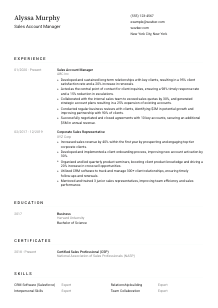
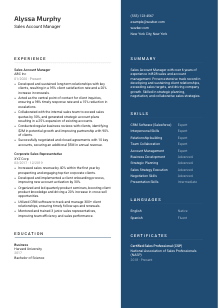
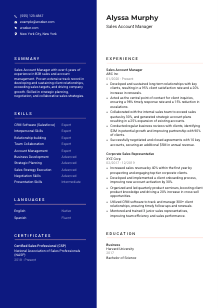
Juggling sales meetings, but your resume isn't closing the deal? Check out this Sales Account Manager resume example, created with Wozber free resume builder. It shows how to spotlight your account management triumphs to match the demands of sales-savvy employers, ensuring your career's ROI hits an all-time high!
Sales Account Manager hiring usually comes down to one practical question fast: can you grow revenue while keeping important clients loyal. A resume for this work has to show more than sales activity. It needs to make your book of business, renewal strength, account growth, client communication, and negotiation results easy to see.
When those details are tailored to the posting, the resume reads less like a generic sales profile and more like a clear account management match. Wozber's free resume builder helps organize that experience into an ATS-compliant resume, so metrics, CRM work, and client-facing results come through cleanly in both screening and human review. That makes it easier to spot whether you can manage relationships that renew, expand, and close.
For a Sales Account Manager, the top of the resume should confirm the basics without slowing down the reader. Hiring teams want to see a professional identity that matches the role, clean contact information, and any location detail that directly affects eligibility.
Place your name at the top in a clear, professional font so it is easy to find in seconds. Keep the styling simple. In sales hiring, polish matters, but so does readability, especially when your resume is being reviewed alongside revenue-focused candidates with similar backgrounds.
Add "Sales Account Manager" directly beneath your name when that is the role you are pursuing. Matching the target title helps frame your background around account growth, renewals, and client ownership instead of leaving the reader to guess whether you are coming from broader sales, business development, or customer success work.
Your contact details should be accurate, current, and professional. This section is basic, but mistakes here create avoidable friction in a process that often moves quickly once a candidate with the right sales numbers is identified.
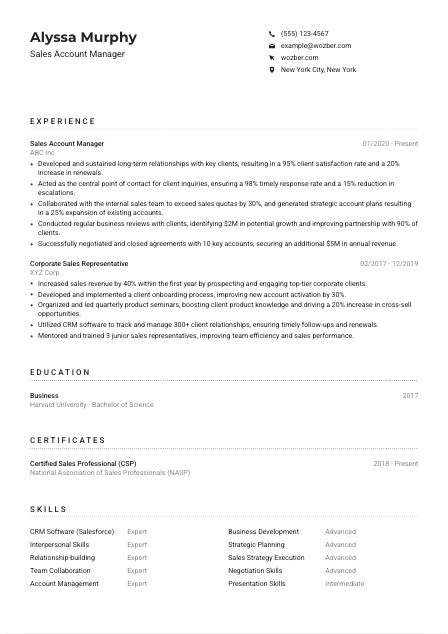
If a posting specifies location, reflect that clearly in your personal details. Here, New York City, New York is a stated requirement, so listing it removes doubt about your availability. Keep in mind that this is a tailoring move for this opening, not a universal rule for every Sales Account Manager resume.
A current LinkedIn profile or professional website can reinforce your resume, especially if it supports your sales scope with consistent titles, account achievements, or industry focus. Make sure the numbers, dates, and client-facing strengths match what appears on the resume so your story stays credible across both channels.
This section should confirm who you are, how to reach you, and whether you meet any immediate requirement such as location. Keep it clean so the reader can move straight to the part that matters most in sales hiring: your account results.




This is the section that carries the most weight for a Sales Account Manager. Hiring teams look for a pattern of revenue ownership, client retention, expansion, quota attainment, and day-to-day account leadership, not just a list of employers.
Start by marking the responsibilities and requirements that define success in the role. For this opening, that includes long-term client relationships, customer satisfaction, renewals, escalations, strategic account plans, business reviews, negotiation, and quota performance. Those themes should guide which achievements you include and how you phrase them.
List each position in reverse chronological order with job title, company, and dates. Clear structure helps the reader quickly trace your move from sales execution into fuller account ownership. For this profession, progression matters because it shows whether you have handled larger books of business, more strategic clients, or higher-stakes renewals over time.
Your bullet points should show how you managed accounts and what changed because of your work. Strong Sales Account Manager bullets often include retention gains, upsell revenue, response time improvements, reduced escalations, or account growth identified through business reviews. The example resume does this well with results such as a 20% increase in renewals, a 30% quota overperformance, and $2M in identified growth opportunities.
Numbers are especially persuasive in sales hiring because they show scale and consistency. Use metrics that belong naturally to account management work, such as renewal rate, client satisfaction, revenue closed, portfolio size, expansion revenue, average deal size, response SLA, or number of strategic accounts managed. Figures like $5M in annual revenue or 300+ client relationships give the reader a much clearer picture than broad claims about success.
Prioritize experience that strengthens your case for B2B sales, account retention, negotiation, CRM discipline, and cross-functional collaboration. If a bullet does not show client ownership, commercial contribution, or account strategy, it is probably taking space from something stronger. Keep the section centered on the work a Sales Account Manager is actually hired to deliver.
A strong experience section should leave no ambiguity about your commercial impact. When your bullets show client retention, account expansion, and closed revenue in concrete terms, the hiring team can picture you handling real accounts, not just supporting them.
Education usually plays a supporting role here, but it still matters when the posting names a degree requirement. Present it clearly so the reader can confirm your academic background and move back to your sales record without interruption.
If the role asks for a Bachelor's Degree in Business, Marketing, or a related field, make sure your degree and field of study are easy to find. In the example, a Bachelor of Science in Business aligns directly with the requirement, which helps remove a basic screening question early.
Use a simple structure: degree, field, school, and graduation year. Sales hiring rarely needs a long education section unless you are early in your career. Clean formatting keeps the focus where it belongs, on quota history, account performance, and client results.
If your education connects neatly to the role, let that relevance speak through the field of study rather than extra explanation. Business, marketing, communications, or similar disciplines naturally support work in account planning, customer communication, and sales strategy.
Recent graduates or candidates shifting into account management can include coursework tied to sales, marketing, negotiation, analytics, or customer behavior. If you already have 5+ years of experience and a strong performance record, this level of detail is usually unnecessary.
Relevant workshops, seminars, or executive education can help if they strengthen your sales profile in areas like strategic selling, key account management, or consultative negotiation. Add them only when they support your target direction and do not distract from your core experience.
This section should confirm that you meet the academic requirement and then get out of the way. For most Sales Account Manager candidates, the real differentiator sits in revenue results, retention numbers, and client management depth.
Certifications are rarely the deciding factor in account management hiring, but they can strengthen your profile when they reflect real selling discipline, client strategy, or ongoing development. Used well, they add professional weight without taking over the resume.
Start with the posting. If certifications are not required, include them only when they support the kind of sales work the job involves. For account-focused roles, credentials tied to consultative selling, negotiation, CRM practice, or strategic account management are the most relevant.
Choose certifications that make sense for a client-facing revenue role. A credential like "Certified Sales Professional (CSP)" works because it reinforces core strengths that matter in account management, including relationship building, sales process discipline, and commercial communication.
Include the issue date and, if applicable, the active period or renewal date. This helps the reader understand whether the certification reflects current practice rather than something completed years ago and never maintained.
Sales methods, buying cycles, and client expectations change. Keeping relevant certifications current can support your case as someone who stays sharp on negotiation, account planning, and customer retention practices. That matters most when the rest of your resume already shows strong execution.
Certifications should reinforce the story your experience already tells. If they connect to revenue growth, client management, or strategic selling, they add substance. If not, leave the space for stronger proof.
A Sales Account Manager skills section should read like the operating toolkit behind your results. It needs to cover both the systems you use and the client-facing strengths that keep accounts healthy, expanding, and on track for renewal.
Pull out the skills the employer actually names, then add closely related capabilities you genuinely use. Here, CRM proficiency, relationship building, negotiation, collaboration, and English communication all stand out. That gives you a skills section grounded in the role instead of a generic sales keyword list.
Lead with the abilities that matter most to account ownership. For many Sales Account Manager resumes, that means account management, CRM software, client relationship management, renewal strategy, negotiation, strategic planning, and cross-functional collaboration. In the example, listing Salesforce, relationship-building, and account management near the top supports the responsibilities described in the experience section.
Do not separate hard and soft skills into artificial buckets if a blended list reads more naturally. Sales Account Managers are expected to use systems and judgment together. A list that pairs Salesforce with negotiation, presentation skills, and team collaboration better reflects how the work actually gets done across reviews, escalations, and deal cycles.
This section works best when it echoes the demands of the target role and matches the language used in your experience bullets. The reader should come away with a clear sense of how you manage accounts, move deals forward, and work across teams.
Language ability matters in sales when it affects client communication, written follow-up, presentations, and relationship management. Even when only one language is required, listing proficiency clearly helps remove doubt about your ability to handle meetings, emails, and negotiations professionally.
If the posting specifies language proficiency, place that language first and label your level clearly. Here, spoken and written English is required, so English should be prominent on the resume.
Additional languages can strengthen your profile when they support the client base, territory, or market segment. They are especially useful in account management roles that involve diverse customer groups, regional coverage, or cross-border communication.
Use labels such as Native, Fluent, Intermediate, or Basic, and be honest. In a role that may involve business reviews, objection handling, and contract conversations, overstating language ability can quickly become a problem in interviews or on the job.
A second language can help you stand out, but it does not replace the core requirements of quota delivery, retention, and account strategy. In the example, Spanish adds breadth, while English remains the essential hiring requirement.
If you are actively improving a language that supports your target market, you can include it. Just keep the phrasing clear. For example, say you are at an intermediate level or currently studying, rather than implying business fluency you do not yet have.
For a client-facing sales role, language skills should help the employer picture how you communicate with customers and internal teams. State them plainly and let them support, not distract from, your sales record.
Your summary should quickly position you as someone who can manage revenue-producing relationships, not just someone who has worked in sales. In three to five lines, connect your experience level, market background, and strongest account management outcomes to the role you want.
Before writing, identify the few ideas that matter most in the posting. For this one, the themes are B2B experience, long-term client relationships, quota attainment, CRM use, renewals, and negotiation. Those should shape the language of your opening lines.
State your title and experience level directly. A line such as "Sales Account Manager with 6+ years in B2B sales and account management" works because it immediately covers seniority and context without wasting space.
Follow with outcomes that reflect the work you want to keep doing. Good summary material includes exceeding sales targets, improving renewals, growing existing accounts, or managing key client relationships. The sample summary points in the right direction, and it would become even stronger with one concrete metric drawn from the experience section.
Limit the summary to a compact paragraph. Avoid broad statements about being driven or passionate unless they are backed by clear business results. The best version sounds like a concise commercial profile, not a personal introduction.
A sharp summary makes the rest of the resume easier to read because it sets the commercial context early. Once it is aligned to the role, the hiring team should know your level, your market, and the kind of account results they can expect to see below.
A tailored Sales Account Manager resume should now show the essentials clearly: relevant B2B experience, account ownership, retention and expansion results, CRM fluency, and the communication skills needed to manage client relationships professionally.
Use Wozber to tighten the language, improve ATS optimization, and organize your content in an ATS-friendly resume format that keeps your sales metrics easy to scan. The finished resume should make one thing obvious quickly: you know how to retain accounts, grow revenue, and represent the business well with key clients.




