



Use Wozber and land your dream job
Create Resume
No registration required
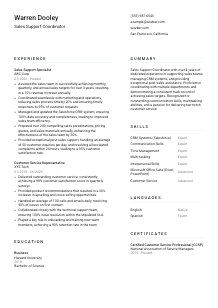
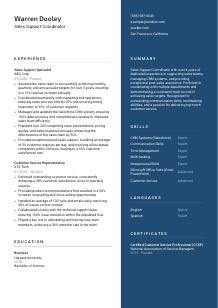
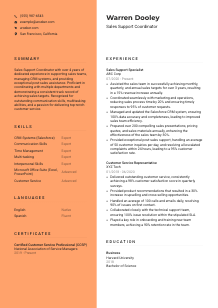
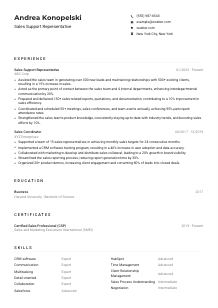
Juggling client calls and emails, but your resume isn't getting any responses? Check out this Sales Support Coordinator resume example, created with Wozber free resume builder. It shows how to connect your operational expertise to job specifics, positioning your career journey as a critical pillar in the sales success story!
Sales support work sits in the middle of constant movement. Reps need quotes and presentation decks on time, CRM records have to stay clean, and customer questions cannot stall the pipeline. A Sales Support Coordinator resume works best when it shows that you keep sales operations moving accurately under deadline, not simply that you have general admin or customer service experience.
Screeners often need to separate candidates who have supported revenue work from those who have only handled broad office coordination. Using Wozber's free resume builder with an ATS-friendly resume format helps you mirror the language of sales support, customer response, CRM upkeep, and cross-functional coordination so hiring teams can quickly see where you have already contributed to target attainment and day-to-day sales execution.
This section is brief, but it still carries practical value. For a Sales Support Coordinator, it should immediately confirm who you are, how to reach you, and whether you meet straightforward application filters such as location.
Use your full name in a clear, readable font so it stands out at the top of the page. In a role built around coordination and responsiveness, a clean header sets the right tone before the hiring team reaches your CRM, quoting, or customer support experience.
Place "Sales Support Coordinator" directly beneath your name when that is the role you are applying for. Matching the posted title helps frame your background around sales operations support, customer requests, and internal coordination from the start.
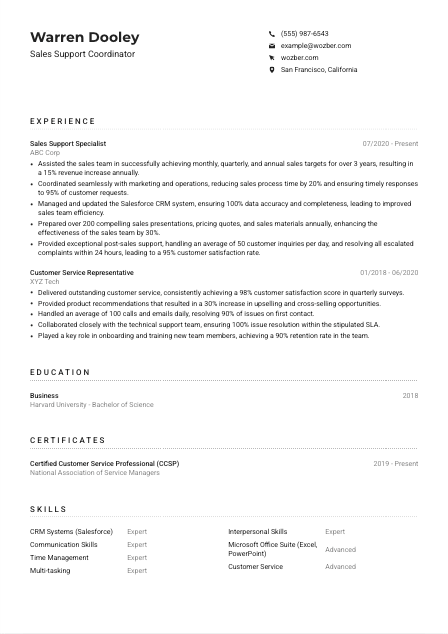
If a job specifically requires local presence, show it clearly. In the example here, listing San Francisco, California directly in the header answers that requirement without forcing the reviewer to search for it. Treat location this way when it is an explicit filter, not as a rule for every application.
Include a professional website or LinkedIn profile if it supports your candidacy with relevant experience, recommendations, or business-facing work. Make sure the information matches your resume, especially job titles, dates, and sales support responsibilities.
Your personal details should remove basic uncertainty in seconds. Once this section is accurate and complete, the reader can move straight to the parts that prove you can support reps, customers, and sales processes without friction.




For this role, experience carries the most weight. Hiring teams want to see how you helped sales move faster, kept records accurate, responded to customers, and worked across departments when deadlines were tight.
Read the job description and mark the work that appears at the center of the role. For Sales Support Coordinator openings, that usually includes CRM accuracy, presentation and quote preparation, post-sales support, and coordination with teams such as marketing or operations. Those are the duties your bullets should echo most clearly.
List your positions in reverse chronological order with job title, company name, and dates. This works especially well in sales support because it lets a reviewer quickly trace how your experience progressed from customer-facing service into broader coordination, reporting, and sales team support.
Do not stop at listing responsibilities. Show what changed because of your work. Strong bullets for this field mention faster response times, cleaner CRM records, higher customer satisfaction, reduced process delays, or stronger sales team output. The sample resume does this well with points such as maintaining Salesforce at 100% data accuracy and preparing more than 200 sales presentations and quotes annually.
Choose numbers that reflect how this work is evaluated. Revenue growth, response rates, customer satisfaction scores, quote volume, SLA performance, issue resolution time, and process speed are all useful when they are true to your experience. A line like "reduced sales process time by 20%" tells much more than "helped improve efficiency."
If a past job included a wide mix of duties, keep the bullets that connect to sales coordination, customer communication, CRM maintenance, reporting, and multi-team follow-through. Even a customer service role can earn space when the bullets show issue resolution volume, first-contact resolution, or support for upselling and account continuity, as the example resume demonstrates.
The best experience section makes it easy to picture you supporting a live sales team. When your bullets show accurate CRM work, fast turnaround, customer follow-up, and measurable contribution to sales goals, the role starts to look familiar to the hiring manager.
Education will not outweigh relevant sales support experience, but it still matters when the posting asks for a specific academic background. Keep this section straightforward and make the connection to the role easy to see.
When the employer asks for a bachelor's degree in Business, Marketing, or a related field, place that qualification clearly in your education section. If your degree aligns directly, as it does in the example with a Bachelor of Science in Business, that match should be obvious at first glance.
Include degree, field of study, school, and graduation year. That is usually enough for a Sales Support Coordinator application, where the main screening value is confirming the required education rather than reviewing extensive academic detail.
Write the subject clearly instead of leaving the relevance implied. "Business," "Marketing," or another related field helps connect your academic background to sales processes, customer communication, reporting, and commercial operations.
If you are early in your career or your work history is still developing, a few relevant courses or projects can help. Focus on topics that support the role, such as business communication, marketing, data analysis, customer relationship management, or sales operations. If you already have several years of directly relevant experience, keep this section lean.
Honors, leadership roles, or projects are worth adding when they show traits that matter in sales support, such as organization, teamwork, presentation preparation, or analytical work in Excel. Leave them out if they do not strengthen your case for the role you are targeting.
Your education section should answer one question quickly: do you meet the academic requirement for the role? Once that is clear, the rest of the resume can focus on the coordination, service, and sales support work that will drive the hiring decision.
Certifications are not always required for Sales Support Coordinator roles, but the right one can reinforce customer support skill, systems knowledge, or commitment to professional development. Relevance matters more than volume.
Choose certificates tied to customer service, CRM platforms, sales operations, communication, or business tools. In this field, a focused certification can support your experience with client handling, issue resolution, and day-to-day sales coordination.
A short list of useful certifications reads better than a crowded section of unrelated courses. If a credential does not connect to sales support, customer communication, quoting, reporting, or system use, it probably does not need space on the page.
Include the year earned and, when relevant, whether the credential is current. This is especially useful for certifications linked to ongoing customer service standards or software knowledge. In the example, the active date range helps show the credential remains current.
Sales support roles often expand into reporting, account coordination, and operations support, so ongoing learning can strengthen your profile. A recent certification can suggest that you are building useful skills in areas such as service quality, CRM workflows, or business communication.
A well-chosen certificate can strengthen your resume, especially when it aligns with customer service or sales support work. Keep the section focused so it reinforces the experience already shown elsewhere.
This section should reflect how the job actually gets done. For Sales Support Coordinator roles, that means mixing system knowledge, document preparation, communication, and the pace-management skills needed to support sales activity without bottlenecks.
Start with the skills named directly in the job ad, such as Excel, PowerPoint, CRM experience, multitasking, and written and verbal communication. Then add the implied ones that show up in the responsibilities, including prioritization, cross-functional coordination, customer issue handling, and data accuracy.
List the capabilities that map closely to the work. For this kind of role, that often includes CRM systems such as Salesforce, Microsoft Office Suite, customer service, time management, communication, and relationship handling. The example resume uses this approach well by balancing technical and interpersonal skills instead of listing only generic strengths.
Do not overload the section with every tool or trait you have ever used. A concise list makes it easier to spot what matters for the opening, especially when the employer is screening for sales support software, customer-facing communication, and the ability to juggle urgent requests in a deadline-driven environment.
A useful skills section should read like the toolkit for the job in front of you. When the list reflects CRM upkeep, Excel work, presentation support, customer communication, and prioritization, it reinforces the experience section instead of repeating it.
Sales support often involves handling customer questions, writing follow-up messages, and coordinating with internal teams. Language skills matter most when they affect service quality, communication speed, or the range of customers you can support.
If the posting specifies English communication, list English clearly with an accurate proficiency level. For this opening, strong spoken and written English is a direct requirement, so it should not be buried.
Lead with the language most important to the role, then add others in descending relevance. If you can support customers or internal stakeholders in an additional language, that can be a practical advantage, especially in diverse markets and service environments.
Additional languages are worth listing when they expand your ability to assist customers, support regional teams, or work across a broader client base. In the example, Spanish adds useful context without distracting from the required English proficiency.
Use clear levels such as Native, Fluent, Conversational, or Basic. Sales support depends on accurate communication, so exaggerated language claims can quickly create problems once interviews move into real-world scenarios like handling complaints or writing customer responses.
If you speak more than one language, think about where that ability matters in practice. It can support smoother customer service, better coordination with regional teams, and stronger communication in multilingual sales environments, though it is usually an added value rather than a core requirement unless the posting says otherwise.
Keep this section honest and practical. For a Sales Support Coordinator, language skills matter when they improve customer interaction, internal coordination, and message clarity.
Your summary sits at the top of the resume, so it needs to define your professional value quickly. For this role, focus on the mix of sales team support, CRM accuracy, customer communication, and coordination across functions that runs through your background.
Start by identifying the few themes that matter most in the target posting. For Sales Support Coordinator positions, those are often supporting sales targets, maintaining CRM data, preparing materials, and handling post-sales requests. Use those themes to decide what belongs in the summary.
Your first line should establish who you are and how much relevant experience you bring. A direct opening such as "Sales Support Coordinator with 4+ years of experience" works because it immediately anchors the reader in your function and level.
Follow your opening with the capabilities that best support the role, such as coordinating with marketing and operations, managing Salesforce records, preparing quotes and presentations, or resolving customer issues efficiently. The sample summary works because it ties broad strengths to recognizable sales support work instead of relying on generic claims.
Aim for three to five sentences. That gives you enough room to mention experience level, key tools or functions, and one or two performance themes without repeating the bullet points from your experience section.
A focused summary helps the hiring team place you quickly. When those first lines show that you can support sales execution, maintain accurate systems, and handle customer follow-through, the rest of the resume lands with more clarity.
Once each section is tailored to the job, your resume should show a clear pattern: you help sales teams stay organized, customers stay informed, and internal processes stay on track. That is the combination employers are trying to find in a Sales Support Coordinator.
Wozber's free resume builder can help you turn that experience into an ATS-compliant resume with structure, wording, and role-specific alignment that are easier to screen. Use it to sharpen the match, then make sure every section points back to the same hiring question: can you keep sales support work accurate, responsive, and dependable under pressure?




