



Use Wozber and land your dream job
Create Resume
No registration required
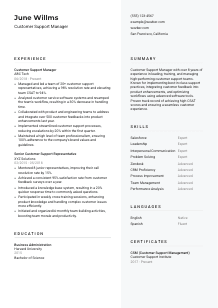
Navigating support tickets, but your resume is on hold? Tune in to this Customer Support Manager resume example, created with Wozber free resume builder. Learn how to match your management skills to job requirements, placing your career at the forefront of customer satisfaction!
Customer Support Manager hiring usually turns on one question fast: can you run a support operation that keeps service levels steady while improving the customer experience behind the scenes. Resumes that stay vague about team leadership, escalation handling, training, workflow design, or metrics like CSAT, resolution rate, and handle time often miss what the job actually demands.
A tailored resume makes your operational scope easier to read from the start, especially when applicant tracking systems are scanning for support leadership, CRM platforms, and process improvement terms. Wozber's free resume builder helps you shape that experience into an ATS-compliant resume that clearly shows where you've led teams, improved support performance, and turned customer feedback into action.
For a Customer Support Manager, the top of the resume should feel organized and dependable. This role is built on clear communication and day-to-day coordination, so your contact details should be easy to scan, accurate, and aligned with any practical requirement named in the posting.
Use your full name as the main heading in a clean, professional format. Keep it larger than the rest of the text so it anchors the page immediately. In customer support leadership roles, where communication and presence matter, a tidy header helps set the tone before the hiring team reaches your metrics or management history.
Place "Customer Support Manager" directly under your name when that is the role you are pursuing. This helps position your background correctly from the first line, especially if your past titles include variations such as Support Lead, Service Supervisor, or Senior Customer Success Manager. A precise title also supports ATS matching when the employer is screening for that exact function.
List a reliable phone number and a professional email address, ideally in a straightforward format such as firstname.lastname. Double-check both. Support leadership hiring can move quickly, and missing a call or interview email because of a typo is an avoidable mistake. If you include a website or LinkedIn profile, make sure it reflects the same career story as the resume.
Some roles include a location filter early in the review process. Here, the employer specifically asks for someone based in San Francisco, California, so showing that location in your personal details helps remove a practical objection right away. Treat that as targeted tailoring, not a rule for every Customer Support Manager application.
If you maintain a LinkedIn profile or a professional portfolio, include it only if it strengthens your application. For this profession, that might mean recommendations that speak to team leadership, examples of support operations work, or a profile that reinforces your experience with service platforms, training, and cross-functional collaboration.
This section does not need flair. It needs accuracy, professionalism, and the right practical details so the hiring team can move straight to your support leadership experience.




This is the section most hiring teams will read first for a Customer Support Manager role. They want to see whether you've led people, improved service performance, handled escalations, and worked across teams to solve recurring customer problems, not just answered tickets yourself.
Start by identifying the experience themes in the posting. Here, the employer is looking for more than 5 years in customer support, at least 2 years in management, experience with customer service software, and responsibility for team performance, customer issue resolution, and process improvement. Those are the points your bullets should address first.
List your most recent role first, then work backward with job title, company name, and employment dates. For support leadership positions, this structure helps reviewers quickly track your progression from frontline work into coaching, supervision, and full team management. It also makes your management timeline easier to confirm against the role's experience requirement.
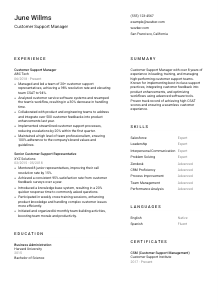
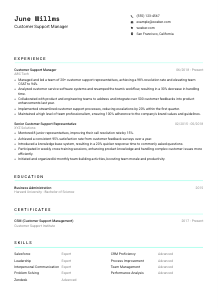
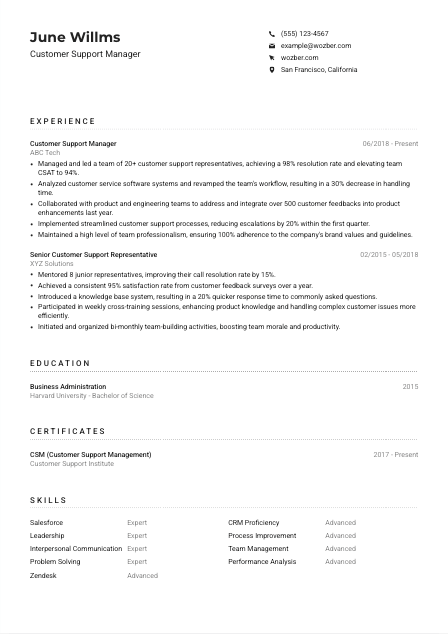
Each role should show what you owned. Include team size, support channel scope, escalation responsibility, and the business results that followed. The example resume does this well by opening with management of 20+ representatives and tying that scope to a 98% resolution rate and 94% CSAT. That kind of bullet tells a hiring manager how large the operation was and how well it performed.
Support management is measured through performance indicators, so use numbers wherever they are real and relevant. Resolution rate, CSAT, first-response time, average handle time, backlog reduction, escalations, QA scores, or training impact all help. A bullet such as reducing handling time by 30% or escalations by 20% is much stronger than saying you "improved workflow" without showing what changed.
Keep the focus on experience that supports the move into, or strength within, Customer Support Manager work. Frontline duties matter less than coaching, staffing, KPI analysis, process redesign, customer feedback loops, and cross-functional work with product or engineering. If an older role is less relevant, shorten it and save the detail for the work that best proves you can lead a support team effectively.
Your experience section should make it easy to see the scale you managed, the service standards you improved, and the customer issues you helped solve across teams. That is the core hiring proof for this role.
Education is rarely the deciding factor for an experienced Customer Support Manager, but it still matters when the posting names a degree requirement. Present it clearly so the reviewer can confirm the credential and move on to the operational and leadership parts of your background.
Look at the posting before you format this section. Here, the employer asks for a bachelor's degree in Business Administration, Communications, or a related field. If you hold one of those degrees, make sure it is easy to spot. If your field is adjacent, list it clearly and let your experience carry the relevance.
Use a clean format that includes degree, field of study, school, and graduation year or date. That is enough for most mid-career support leadership roles. Hiring teams are usually confirming qualification, not looking for a detailed academic profile unless the role or your experience level makes it necessary.
When your degree directly supports the requirement, let that alignment work for you. In the example resume, a Bachelor of Science in Business Administration maps neatly to the posting. That kind of match helps remove friction quickly during screening, especially when the employer has listed education as a clear baseline expectation.
Most experienced candidates can keep this section brief. If you are earlier in your career or your degree is less directly related, a short mention of coursework or projects tied to communication, operations, customer behavior, or team management can add context. Keep it selective and relevant to support leadership work.
Honors, leadership roles, or extracurricular activities can stay if they reinforce themes that matter in customer support management, such as communication, mentoring, process thinking, or service leadership. If they do not add useful context, leave them out and keep the section focused.
For this role, education should confirm that you meet the stated baseline without pulling attention away from your service metrics, leadership record, and systems experience.
Certifications can strengthen a Customer Support Manager resume when they connect to CRM systems, service operations, or team management. They are especially useful when the posting lists them as preferred rather than required, because they show continued development in a field shaped by tools, workflows, and customer expectations.
Review the job description for any preferred credentials. Here, certification in CRM or Customer Support Management is listed as a plus, so those should move to the top if you have them. That kind of alignment can help distinguish you from applicants whose experience is similar on paper.
Prioritize certifications that reinforce the work of managing a support function, such as CRM administration, support management, service operations, or customer experience training. The sample resume's CSM credential works because it directly supports the leadership and process side of the role, not just general professional development.
Add the completion date, and if the credential remains active, show that clearly. This gives the hiring team context on how current your training is, which matters in areas like CRM workflows, service standards, and evolving support practices.
Customer support teams rely on changing tools, reporting habits, and service models, so ongoing certification can add weight to your resume over time. If you are targeting larger or more process-driven organizations, recent training in CRM platforms, analytics, QA, or people management can reinforce that you are keeping your leadership toolkit current.
This section works best when it supports the exact kind of support environment you want to manage. Lead with credentials that connect to customer operations, CRM use, and team leadership.
For a Customer Support Manager, the skills section should reflect the real mix of platform knowledge, people leadership, and service improvement work behind the title. It is one of the fastest places for a reviewer or ATS to confirm whether your background matches the support environment they are hiring for.
Start with the posting's language. This one points to customer service software, preferably Salesforce or Zendesk, plus leadership, interpersonal communication, problem-solving, and the ability to improve team performance. Those are strong anchors for your skills list because they reflect both the systems side and the management side of the role.
Do not list only soft skills and do not list only software. Customer Support Managers are often hired on a combination of CRM fluency, reporting awareness, coaching ability, escalation judgment, and process improvement. A list that combines Salesforce, Zendesk, team management, performance analysis, communication, and problem solving paints a much more credible picture of daily work.
Trim anything that does not contribute to this role. A shorter list of support-specific tools and leadership capabilities is more effective than a broad collection of generic strengths. If the posting emphasizes support operations, include the systems and management skills that actually drive service quality, agent performance, and customer outcomes.
Choose skills that reflect how customer support is actually managed: through systems, coaching, issue resolution, reporting, and process improvement. That mix helps both ATS screening and human review.
Language ability matters differently depending on the support team, customer base, and service channels involved. For a Customer Support Manager, the first priority is showing that you can communicate clearly in the language required for coaching, escalations, documentation, and stakeholder coordination.
If the job description specifies a language, list it at the top with an honest proficiency level. Here, English is required, so it should appear first. For a management role, that signals readiness for customer escalations, internal reporting, training delivery, and cross-functional communication.
Additional languages can be valuable when the customer base is diverse or the company supports multiple regions. They are not mandatory in every Customer Support Manager role, but they can strengthen your profile by showing broader service capability. In the example resume, Spanish adds practical range without distracting from the core English requirement.
Use clear levels such as Native, Fluent, Intermediate, or Basic. Overstating proficiency is risky in customer support, where managers may need to step into sensitive conversations, review written communication, or support multilingual team members.
If the employer serves international markets, multilingual ability may matter more for escalation handling, support coverage planning, or communication with distributed teams. If the role is primarily domestic, extra languages are still a plus, but they should remain secondary to leadership results and service operations experience.
If you are improving a language that is relevant to your customer base, you can mention it once your proficiency is usable in a professional setting. For support leadership roles, stronger language capability can improve empathy, reduce friction in difficult interactions, and widen the range of customers or teams you can support effectively.
For this role, language skills matter when they strengthen customer communication, team leadership, or service coverage. Keep the section honest, relevant, and easy to understand.
Your summary should read like the opening case for your candidacy. For a Customer Support Manager, that means combining leadership tenure, service results, and operational strengths in a few lines that quickly establish the scale and style of work you bring.
Start with your current professional identity and years of relevant experience. A line such as "Customer Support Manager with 8+ years in customer service and support leadership" gives immediate context and helps distinguish you from frontline applicants or adjacent customer success profiles.
Use the summary to mention the outcomes and systems that define your value. That can include leading high-performing teams, improving CSAT, reducing handling time, implementing support best practices, or using platforms like Salesforce and Zendesk. The example summary works because it connects leadership, workflow improvement, product feedback integration, and customer experience results in a compact way.
Aim for 3 to 5 sentences with no filler. Avoid generic claims about being passionate or hardworking unless they are backed by support-specific substance. Every line should help the reader understand your management scope, your operational strengths, or the customer outcomes you consistently improve.
A useful summary gives the hiring team a quick read on your support leadership style, the results you deliver, and the systems or workflows you know how to improve. Keep it concise and grounded in actual performance.
A Customer Support Manager resume should make three things easy to see: the team environments you have led, the service metrics you have improved, and the systems or processes you have used to raise customer experience standards. When those details are clear, your application reads like someone who can manage support, not just participate in it.
Wozber's free resume builder can help you organize that experience into an ATS-friendly resume template, refine wording with AI support, and strengthen ATS optimization around the requirements that matter most. The final result should give hiring teams a clear view of your ability to lead service operations, coach teams, and improve customer outcomes from day one.