



Use Wozber and land your dream job
Create Resume
No registration required
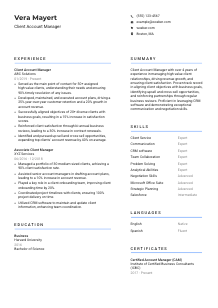
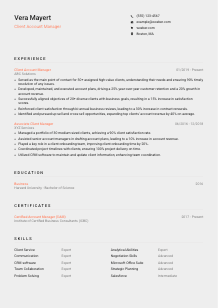
Juggling clients, but your resume feels lost? Navigate this Client Account Manager resume example, created with Wozber free resume builder. Learn how to reflect your relationship-building skills and strategic insights to meet job expectations, ensuring your career climbs alongside your client list!
Client Account Managers sit at the point where revenue, service quality, and long-term trust meet. Hiring teams want to see more than friendly client handling. They look for proof that you can run a book of business, keep issues moving, strengthen renewals, and grow accounts through steady relationship management. Your resume should make that commercial ownership visible from the start.
When the resume is tailored well, the difference is immediate. Instead of reading like general customer service, it reads like account stewardship with retention targets, business reviews, cross-functional coordination, and expansion opportunities. Wozber's free resume builder helps shape that into an ATS-compliant resume by aligning your wording with the posting, so employers can quickly recognize client-facing experience that translates into revenue and renewal performance.
Client Account Management is built on trust, responsiveness, and clean communication. Your contact section should reflect that same standard. Keep it direct, professional, and aligned with any practical requirements the employer has already stated.
Use your full name in a larger, clean font so it is easy to spot at the top of the page. For a client-facing role, a polished header matters because it sets the tone before the reader reaches your account portfolio, retention results, or business review experience.
Place "Client Account Manager" directly below your name when that matches the role you are pursuing. It immediately frames your background around account ownership, client communication, and growth responsibility rather than broader labels like customer success or sales support.
Include a reliable phone number and a professional email address, then check them carefully. If a hiring manager wants to discuss your client portfolio, renewal impact, or CRM experience, there should be no friction in reaching you.
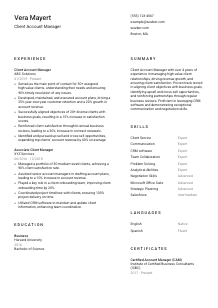
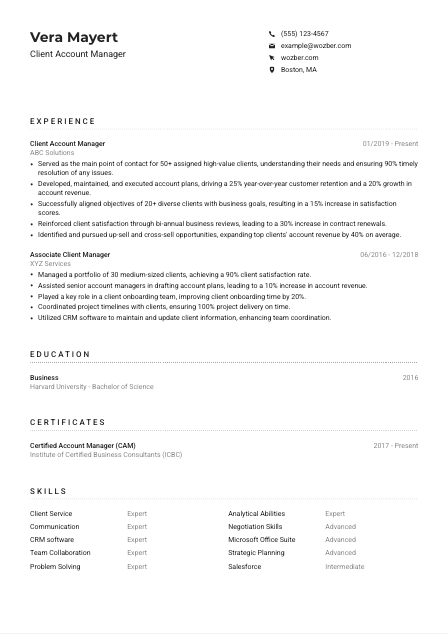
If the employer specifies a location, reflect it clearly in this section. Here, listing "Boston, MA" directly addresses a stated requirement and removes doubt about local eligibility. Use this approach whenever geography is part of the screening process, but only when it is actually relevant to the job.
A LinkedIn profile or personal website can reinforce your background if it is current and consistent with the resume. For Client Account Managers, that profile should support the same story your resume tells: account growth, client retention, cross-functional coordination, and strong communication with decision-makers.
This section should answer basic screening questions fast: who you are, how to reach you, whether you match the role title, and whether any location requirement is covered. Clean details help the reader move straight to your client results.




This is where Client Account Manager resumes usually separate themselves. Hiring teams want to see how you handled client relationships in practice: the size of the portfolio, the pace of issue resolution, the quality of account planning, and the commercial results tied to renewals, expansion, or satisfaction.
Read the posting closely and mark the responsibilities that define success in the role. For this one, the priorities are clear: serve as the main client contact, maintain account plans, run reviews, coordinate with internal teams, and identify up-sell and cross-sell opportunities. Those themes should guide which achievements you surface first.
List roles in reverse chronological order with job title, company name, and dates. That structure matters because account management careers often progress from coordination and support work into full portfolio ownership, and the reader should be able to track that progression quickly.
Focus your bullet points on the work that matters in account management: managing relationships, resolving issues, leading reviews, aligning deliverables with client goals, and growing revenue within accounts. The example resume does this well by showing ownership of 50+ high-value clients and direct responsibility for account plans and business reviews.
Metrics make your scope and impact easier to judge. Use figures tied to retention, contract renewals, satisfaction scores, account growth, response or resolution rates, portfolio size, or onboarding speed. Results like 25% year-over-year retention growth, 30% higher renewals, or 40% average revenue expansion in top accounts tell a much stronger story than generic claims about relationship building.
Each bullet should strengthen your case for handling assigned accounts and improving business results. Remove accomplishments that do not connect to client service, revenue growth, coordination, planning, or issue resolution. A focused experience section helps hiring teams see that your background fits account management rather than drifting into unrelated operations or administrative work.
By the end of this section, the reader should understand the size of the accounts you managed, the kind of clients you supported, how you worked across teams, and what happened to retention, satisfaction, and revenue under your ownership.
For many Client Account Manager openings, education is a qualification check rather than the main selling point. Still, when a degree in business, marketing, or a related field is listed, this section should make that match easy to confirm without slowing down the reader.
If the job asks for a bachelor's degree in Business, Marketing, or a related field, present that information clearly and without extra clutter. In the example, a Bachelor of Science in Business is a straightforward match and helps clear an early screening step.
List the degree, field of study, school name, and graduation year. Client Account Manager hiring rarely depends on elaborate education detail, so keep the format concise and let your account results carry the heavier weight elsewhere on the resume.
If your education supports client-facing commercial work, let that connection show through the field of study. Business, marketing, communications, and related disciplines often align well because they support relationship management, negotiation, and customer growth responsibilities.
Relevant coursework can help if you are early in your career or moving into account management from a nearby field. Classes in marketing, sales, business communication, customer analytics, or negotiation may strengthen the section when your work history is still developing.
Honors, leadership roles, or major projects are worth adding only if they support your client-facing or business background. If you are an experienced account manager, keep the emphasis on your portfolio results and include extra academic details only when they add something specific.
Education should quickly confirm that you meet the stated baseline and have a relevant academic foundation. Once that is established, your resume can return focus to client ownership, account growth, and retention performance.
Certifications are rarely the deciding factor for Client Account Manager roles, but they can strengthen your positioning when they relate to account management, client success, sales process, or the systems you use to manage relationships. Include them when they add professional relevance, not just extra lines.
Check whether the posting asks for a certification or signals a preference through responsibilities and tools. This role does not require one, yet a credential such as Certified Account Manager can still reinforce your background in client retention, account planning, and relationship management.
Choose certifications that connect to how Client Account Managers actually operate. Account management, customer success, negotiation, CRM platforms, or sales enablement training all make more sense here than unrelated general business courses.
If a certification is current, renewable, or recently completed, include the date range. That helps show that your knowledge is active, especially for platform-based training or credentials tied to modern account workflows and client communication practices.
Client expectations, CRM workflows, and retention strategies change over time. Ongoing learning in areas like account growth, customer journey management, or advanced CRM usage can sharpen your resume and give you stronger language for future applications.
A well-chosen certification adds depth when it connects to account planning, client communication, or growth strategy. Keep only the credentials that strengthen your case for managing relationships and expanding business.
The best skills sections for Client Account Managers read like the tools and strengths behind real account work. That usually means a mix of relationship management, commercial judgment, communication, and the systems used to track client activity and follow-through.
Start with the skills the employer actually names. Here that includes communication, negotiation, CRM software, and Microsoft Office Suite, along with the broader need to manage client relationships and support account growth. Those should appear in your skills section when they reflect your real experience.
Lead with the capabilities most tied to success in the role: client service, account planning, relationship management, problem solving, business reviews, cross-functional collaboration, and revenue expansion. The example resume supports this well with skills such as Client Service, Communication, CRM software, Team Collaboration, Negotiation Skills, and Strategic Planning.
Put the most role-specific strengths first, then list supporting tools and secondary capabilities after that. For a Client Account Manager, CRM proficiency and communication usually matter more than generic office software, so the order should reflect how the work is actually done and measured.
Your skills list should sound like someone who can manage a client portfolio, keep teams aligned, and turn account knowledge into retention and growth. If a hiring manager can picture you running the account from this section, it is doing its job.
Language ability matters differently depending on the client base. For Client Account Managers, the first priority is usually clear communication with assigned accounts, internal teams, and stakeholders during reviews, issue resolution, and ongoing relationship management.
If the posting requires English mastery, state your level clearly. In the example, listing English as "Native" directly addresses that requirement and removes any doubt about written and verbal communication in a client-facing setting.
Extra languages are most useful when they connect to the customer base, territory coverage, or company growth plans. A fluent second language such as Spanish can be valuable if you support multilingual clients or work with diverse account portfolios, even when it is not listed as a formal requirement.
Choose clear levels such as Native, Fluent, Intermediate, or Basic. In account management, overstatements create risk because language ability can directly affect client calls, business reviews, negotiations, and written follow-up.
If the role covers regional or international clients, language skills deserve more visibility. If it is a domestic account book with one required language, keep the section brief and accurate rather than trying to overstate its importance.
When additional language ability genuinely helps you build relationships, resolve issues faster, or support expansion into new markets, include it. Otherwise, keep the section lean and let your account management results stay in the foreground.
This section should clarify whether you can handle the communication demands of the role. For client-facing work, that means accuracy first, with extra languages included when they support the accounts you are likely to manage.
A Client Account Manager summary should quickly establish the kind of accounts you handle and the business results you influence. It is most effective when it combines relationship ownership with outcomes such as retention, satisfaction, renewals, and account growth.
Review the posting and identify what the employer needs the hire to improve or protect. Here, the message is clear: manage client relationships well, keep issues moving, support satisfaction, and grow revenue through account planning and expansion opportunities. Your summary should reflect that mix of service and business impact.
Begin with a direct line that states your title or specialty and your years of experience. The sample summary does this effectively with "Client Account Manager with over 4 years of experience," which gives immediate context before moving into client relationship and revenue results.
Mention two or three role-specific strengths backed by business relevance, such as managing high-value client relationships, aligning client goals with business objectives, improving satisfaction, or identifying up-sell and cross-sell opportunities. This keeps the summary tied to how account managers are evaluated in practice.
Aim for a short paragraph that can be read in seconds. Avoid generic personality claims and use the space for concrete positioning instead. A concise summary with account scope, client focus, and growth or retention language gives the hiring team a clear reason to keep reading your experience section.
Your summary should introduce you as someone who can own client relationships and produce measurable account results. When it is tailored properly, the rest of the resume reads as proof of that claim.
A polished Client Account Manager resume should show that you can protect revenue, manage relationships, coordinate internal delivery, and grow accounts over time. With that structure in place, your experience reads as business impact rather than generic customer support.
Use Wozber's AI resume builder and ATS resume scanner to tighten the language, surface missing requirements, and shape an ATS-friendly resume format around the role you want. The finished resume should make it easy to judge your readiness to manage clients, renew business, and expand account value.