



Use Wozber and land your dream job
Create Resume
No registration required
Juggling client requests, but your resume feels like it's on hold? Check out this Client Service Manager resume example, created with Wozber free resume builder. Learn how to present your relationship-building skills to fit job requirements, paving the way for your career in client-centered excellence!

Client Service Manager hiring usually turns on one practical question: can you keep important accounts steady while service issues, internal handoffs, and revenue targets all move at once? A resume for this role needs to make that operating range visible. Hiring teams want to see how you manage client relationships, lead service staff, run account reviews, and turn client feedback into retention, profitability, or stronger account growth.
The first scan often separates candidates with general customer-facing experience from those who have actually managed portfolios, service performance, and executive reporting. Using Wozber's free resume builder helps you shape an ATS-compliant resume around that distinction by matching the language of the job description, organizing measurable results clearly, and making it easier to show where you have owned client outcomes, team results, and account strategy.
For a Client Service Manager, the top of the resume should read like a polished business introduction. Keep it clean, credible, and easy to scan so the hiring team can move quickly to your account management and leadership experience without getting stuck on missing basics.
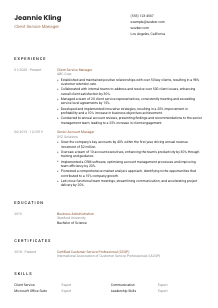
Use your full name in a slightly larger font than the rest of the resume so it is immediately identifiable. This section does not need design flourishes. In client-facing leadership roles, a polished presentation matters, and a clean header already sets the right tone.
Place "Client Service Manager" directly under your name when that matches the role you are pursuing. This helps frame your background around client retention, service delivery, and team oversight right away. If your recent title was slightly different, such as Senior Account Manager, you can still position yourself for the target role through the rest of the resume.
List a current phone number and a professional email address that uses your real name. Client service roles depend on responsiveness and clear communication, so even basic contact details should feel business-ready. Double-check for typos before sending.
If the employer specifies a location requirement, reflect it in your header. In this example, Los Angeles, California belongs here because the job calls for a locally based candidate. That kind of detail removes an avoidable question before the hiring manager reaches your experience section.
Include your LinkedIn profile or personal professional website if it supports your candidacy with consistent job titles, recommendations, or account-facing achievements. For a Client Service Manager, this can reinforce credibility, especially when your online profile shows leadership scope, client portfolio work, or progression from account management into service leadership.
Your personal details should do one job well: confirm that you are easy to contact, professionally presented, and aligned with any stated location requirement. Once that is clear, the hiring team can focus on the parts that matter most for this role, your client portfolio, team leadership, and service results.




This section carries the most weight for a Client Service Manager. Employers look for signs that you have managed key accounts, resolved escalations with internal teams, improved service performance, and translated client needs into business results. Generic customer service bullets will not carry enough weight here.
Read the job description closely and mark the phrases tied to actual work, such as client satisfaction, retention, service level agreements, account reviews, profitability, CRM use, and senior management presentations. Then reflect those ideas in your bullets using your own experience. This keeps the resume aligned with both ATS screening and the way hiring teams compare candidates in client service leadership.
Start with your most recent role and work backward. For each position, include job title, company name, and employment dates in a format that is easy to scan. That structure helps show progression from hands-on account work into broader responsibility for client portfolios, service teams, and cross-functional coordination.
A Client Service Manager is expected to own results, not just activity. Instead of saying you "handled client relationships," show what changed because of your work. The sample resume does this well with bullets like maintaining relationships with more than 50 key clients and reaching a 98% retention rate, or resolving more than 500 client issues while lifting satisfaction by 30%.
Use numbers that fit the role naturally. Retention rate, SLA performance, client satisfaction, issue resolution volume, team size, revenue growth, profitability improvement, and account expansion are all strong measures here. A bullet such as exceeding service level agreements by 15% tells a hiring manager far more than a vague claim about excellent service.
Every bullet should reinforce your value in account stewardship, service operations, leadership, or client strategy. If an achievement does not connect to client retention, internal coordination, reporting, process improvement, or commercial results, it probably does not belong. Relevance matters more than trying to capture your entire work history in one section.
After reading your experience section, a hiring manager should be able to tell how many clients or accounts you handled, what teams you led, what service metrics you improved, and how your work affected retention or profitability. That is the level of clarity this role calls for.
Education is usually not the deciding section for an experienced Client Service Manager, but it still needs to confirm that you meet the baseline requirement quickly. Keep it clear and aligned with the posting so no one has to search for the qualification.
When the job asks for a Bachelor's degree in Business Administration or a related field, make sure that information is easy to find. If your degree matches exactly, say so clearly. In the example, a Bachelor of Science in Business Administration aligns cleanly with the requirement.
List degree, field of study, school name, and graduation year in a consistent order. This format is easy for recruiters to scan and works well in ATS-friendly resume format. Education does not need extra wording unless there is a strong reason to explain something.
If your degree is not titled Business Administration but is closely connected, such as Marketing, Management, Communications, or a similar business field, present it in a way that makes the connection obvious. The aim is to remove doubt, not to overexplain.
Relevant coursework can help if you are earlier in your career, changing direction, or applying to a role with a stronger analytical or operational focus. Courses in market analysis, business communication, customer strategy, or operations can support your profile, but most experienced candidates can keep this section brief.
Honors, leadership positions, or major academic projects are worth adding only if they support your story as a client-facing business professional. For example, leading a business club or completing a client strategy project may help, but only if it adds useful context rather than crowding the page.
Your education section should confirm the required academic background in seconds. For this kind of role, that is usually enough. The deeper proof of your candidacy will come from account results, leadership scope, and service performance in the sections around it.
Certifications are not always required for Client Service Manager roles, but the right one can strengthen your credibility, especially when it reflects service quality, account management, or customer experience leadership. Use this section to show ongoing professional development, not to fill space.
Start with the posting. If no certification is required, treat this section as supporting material. Add credentials that reinforce client service fundamentals, customer success, service operations, or leadership development rather than unrelated certifications with no link to account-facing work.
Choose certifications that make sense for the responsibilities you are targeting. The example's Certified Customer Service Professional credential works because it supports a role centered on client satisfaction, retention, and service quality. Similar credentials in customer experience or account leadership can also strengthen the profile.
If a certification is current, renewable, or recently completed, include the date range. That helps employers understand whether the credential is active and relevant. In service leadership roles, up-to-date training can matter when your work involves changing customer expectations, service processes, or CRM workflows.
A well-chosen certification can show that you keep developing beyond your degree and day-to-day responsibilities. That matters when the role includes coaching teams, improving service strategy, or presenting account insights to senior management. It suggests you take your craft seriously and stay current with the discipline.
Certifications should add another layer to your profile by supporting the kind of client service leadership the job requires. When they connect clearly to customer retention, service quality, or account management, they help round out the resume without distracting from your core experience.
The skills section should mirror how the role actually works. For a Client Service Manager, that usually means a mix of client-facing judgment, service operations, reporting tools, and people leadership. A long list of generic strengths is less useful than a focused set of skills tied to the job's real demands.
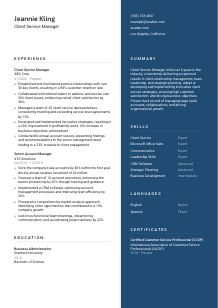
Look for both explicit and implied skills in the posting. Here, that includes CRM software, Microsoft Office Suite, communication, interpersonal ability, leadership, market analysis, client service fundamentals, and strategy development. Those are the capabilities the resume should surface first.
List the skills you genuinely use in your work and phrase them in language close to the posting. If you manage accounts through CRM platforms, lead service teams, run client reviews, or build service strategies, say so directly. The sample resume handles this well by pairing technical tools like CRM software and Microsoft Office Suite with leadership and strategic planning.
Do not overload this section with every tool or soft skill you have ever used. Prioritize the capabilities most likely to matter in a Client Service Manager search: account management, client retention, SLA management, escalation handling, team leadership, reporting, market analysis, and cross-functional collaboration. A tighter list gives a clearer picture of your operating range.
A hiring team should be able to glance at your skills and immediately see that you can manage clients, lead people, use the core systems, and support business goals. Keep the list compact, accurate, and grounded in how client service work gets done.
Language ability matters more in client service than it does in many internal roles because communication affects trust, escalation handling, and account continuity. If a posting names a required language, treat that as a practical requirement, not a minor detail.
Review the posting for required or preferred languages. In this case, comfort communicating in English is explicitly requested, so English should appear clearly on the resume. For client-facing roles, language requirements often connect directly to meetings, account reviews, email communication, and issue resolution.
List the language the employer requires before any others and include your proficiency level. If English is essential to the role, do not bury it beneath secondary languages. A clear entry such as "English - Native" or "English - Fluent" removes uncertainty quickly.
Additional languages can strengthen a Client Service Manager resume when they support the customer base or market served. In the example, Spanish is a useful addition because bilingual communication can help with relationship building and service continuity in many client environments. It is an advantage, though not automatically a requirement everywhere.
Use honest levels such as Native, Fluent, Intermediate, or Basic. Inflated language claims can create problems quickly in client calls, presentations, or written communication. Accuracy matters because these roles often depend on clear expectation-setting and professional communication.
If the role supports regional, multilingual, or international clients, language capability can become a stronger differentiator. If it is primarily domestic and English-speaking, keep the section concise and practical. Match the level of emphasis to the likely client environment rather than treating every language as equally important.
For a Client Service Manager, languages can support relationship quality, smoother issue resolution, and broader account coverage. Include them when they clarify how you communicate with clients and internal teams, especially when the posting names a language requirement outright.
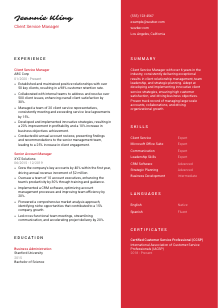
The summary needs to do more than say you are experienced. It should quickly establish the scale of your client work, the kind of teams you have led, and the business results you influence. In a Client Service Manager resume, those first lines often decide whether the reader expects strategic account ownership or only general customer support experience.
Open with your current professional identity and your years of relevant experience. For this role, that usually means naming your background in client services, account management, or customer success leadership. A clear opener immediately positions you in the right lane.
Follow the opener with two or three core areas that define your value, such as client retention, team leadership, escalation management, account reviews, service strategy, or profitability improvement. The sample summary works because it centers on relationship management, team leadership, and strategic planning instead of broad claims with no operating context.
Use the summary to echo the role's main themes in natural language. If the employer needs someone who can maintain key client relationships, lead representatives, work across internal teams, and present findings to senior management, those are the points to foreground. Keep the wording grounded in your actual experience rather than copying phrases mechanically.
Aim for three to five lines with enough specificity to feel credible. Mentioning outcomes such as retention, client satisfaction, account growth, or operational improvement can strengthen the section, but keep the details brief. The summary should set direction for the rest of the resume, not try to repeat the experience section.
A strong summary should make it clear that you can manage client relationships at a strategic level, lead service teams, and connect service performance to business objectives. If that comes through in the first few lines, the rest of the resume has a much stronger foundation.
A Client Service Manager resume should leave no doubt about three things: the accounts you have managed, the teams you have led, and the business outcomes you have improved. When each section is tailored around those points, the resume reads like a leadership profile rather than a general customer service document.
Wozber's free resume builder can help you turn that experience into a sharper, ATS-friendly resume template, while the ATS resume scanner helps you align wording, required skills, and missing details with the job description. The result should make it easy to judge your readiness to manage client relationships, service delivery, and account performance from day one.




