



Use Wozber and land your dream job
Create Resume
No registration required
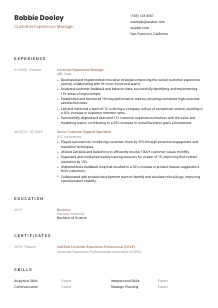
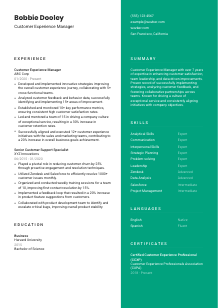
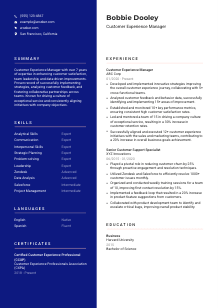
Crafting delightful encounters, but your resume lacks that special touch? Check out this Customer Experience Manager resume example, created with Wozber free resume builder. It shows how to bring together your service finesse and leadership savvy to match job insights, making your career journey as unforgettable as a 5-star review!
Customer experience managers are brought in when customer friction is hurting retention, loyalty, or revenue. Hiring teams want to see whether you can turn feedback, service patterns, and cross-functional coordination into a better end-to-end customer journey. Your resume should make that operational impact visible early, especially through retention gains, satisfaction metrics, process improvements, and team leadership.
When the resume is tailored to the role, it becomes much easier to connect your background to the work at hand, from CX strategy and KPI ownership to tools like Zendesk or Salesforce. Wozber's free resume builder helps organize that experience into an ATS-compliant resume that reflects the employer's language without sounding forced, so the hiring team can quickly see how you improve customer outcomes at scale.
For a Customer Experience Manager, even the top of the resume should feel clear and intentional. This section needs to confirm who you are, how to reach you, and whether you meet any practical screening filters before the reader moves on to retention metrics, feedback analysis, or leadership scope.
Use your full name as the most visible text on the page. Keep it clean and professional so the reader can identify your application immediately, just as clear communication matters in customer-facing leadership roles.
Place "Customer Experience Manager" directly under your name if that is the role you are pursuing. This helps position your background around customer journey strategy, team leadership, and satisfaction metrics from the first glance, instead of making the recruiter infer your direction from previous titles.
List a current phone number and a professional email address. Customer experience work depends on trust, responsiveness, and polished communication, so even basic contact details should reflect that standard.
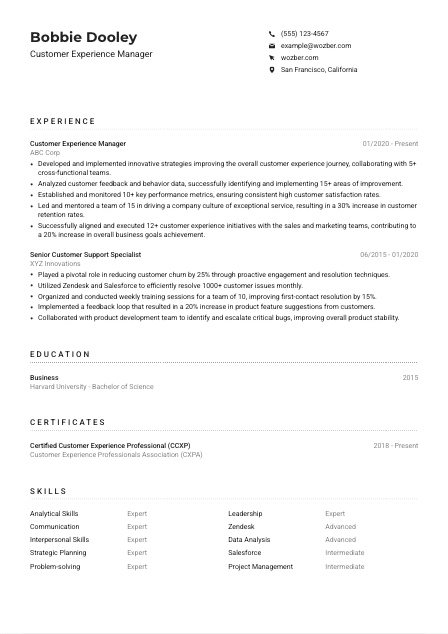
If the job requires a specific location, show it clearly. In the example here, listing "San Francisco, California" answers a stated requirement upfront and avoids questions about relocation or local availability. If a posting does not require location, city and state are usually enough.
Include LinkedIn or a relevant professional website if it strengthens your application. Make sure the content matches your resume, especially around job titles, dates, leadership scope, and customer-focused achievements.
These details are straightforward, but they do real screening work. Handle them cleanly so the reader can move quickly to the parts of your resume that show how you improve customer satisfaction, retention, and service performance.




This is the section where a Customer Experience Manager resume usually wins or loses attention. Hiring teams are looking for more than customer service history. They want to see strategy, analysis, measurable improvement, and the ability to work across support, sales, marketing, and product teams to change how customers actually experience the business.
Start by identifying the work that matters most in the role you want. For this job, that includes improving the customer journey, analyzing feedback and behavior, tracking KPIs, leading a team, and aligning initiatives with business goals. Your experience bullets should speak directly to those areas rather than staying broad or purely service-oriented.
List your most recent role first, then work backward. For each position, include job title, company, and dates before the accomplishment bullets. This structure helps the reader quickly trace how you moved from execution-heavy customer work into broader ownership of strategy, reporting, and team leadership.
A Customer Experience Manager is hired to improve results, so your bullets should show what changed because of your work. The sample resume does this well with lines about improving the customer experience journey, identifying more than 15 areas for improvement, and aligning 12+ initiatives with sales and marketing. That framing is much stronger than simply stating that you were responsible for customer feedback or service quality.
Quantify your work where the numbers reflect real performance. Retention rate, customer satisfaction, churn reduction, first-contact resolution, issue volume, improvement initiatives, team size, and cross-functional project count are all useful indicators. For example, leading a team of 15 and increasing customer retention by 30% gives the employer a clear sense of scope and business impact.
Cut achievements that do not support the story of CX management. If a past role included work in support operations, product feedback, training, or account coordination, keep the parts that show escalation handling, process improvement, customer insight, or service performance. The strongest resumes show progression from solving customer problems to designing systems that prevent them.
Your experience section should make one thing obvious: you do more than manage interactions. You improve customer outcomes, lead teams, and translate feedback into changes the business can measure.
Education is usually a qualifying section for Customer Experience Manager roles rather than the main decision point, but it still matters. It should quickly confirm that you meet the academic requirement and, when relevant, reinforce your grounding in business, marketing, operations, or customer behavior.
Review the posting and match the credential it asks for. Here, the employer wants a bachelor's degree in Business, Marketing, or a related field, so a Bachelor of Science in Business directly supports the application. If your degree is in a related area, keep the wording clear enough for the connection to be obvious.
List degree, field of study, school, and graduation year or date. Keep it easy to scan. This section should answer the qualification question quickly so attention stays on your customer experience achievements and leadership record.
If your education matches the role closely, make that visible. The example candidate's Business degree works well because it supports work involving customer strategy, KPI tracking, and cross-functional alignment with sales and marketing.
Early-career candidates can include coursework, honors, capstone projects, or activities tied to customer research, marketing analytics, service operations, or business communication. For experienced candidates, keep extras only if they strengthen the story instead of distracting from professional results.
If you completed research or projects involving customer insights, segmentation, service design, or market analysis, those can help show early interest in customer-centered work. This is especially useful when your formal job history is still growing.
Education does not need a lot of space here. It needs to confirm that you meet the requirement and, where possible, support the business and analytical side of your customer experience background.
Certifications are not always required for Customer Experience Manager positions, but the right one can strengthen your profile. They are most helpful when they show current knowledge of customer experience frameworks, service quality, analytics, or leadership methods that connect directly to the role.
This posting does not require a certification, so only include ones that reinforce your value. A credential such as "Certified Customer Experience Professional (CCXP)" is relevant because it speaks directly to customer journey thinking, governance, and service improvement.
List certificates that support the actual work of the role, such as customer experience management, CRM platforms, analytics, service operations, or leadership development. A shorter, focused list is stronger than a long inventory of unrelated courses.
If the certificate is active, renewed, or tied to a time period, include that information. It helps the employer see that your knowledge is current, especially in an area where tools, customer expectations, and reporting practices continue to evolve.
Customer experience work now overlaps with analytics, automation, voice-of-customer programs, and cross-channel service design. Continued learning in these areas can strengthen future applications, particularly for roles with broader strategic ownership.
A well-chosen certificate can sharpen your positioning, especially when it supports customer journey design, service performance, or CX leadership. Keep this section selective and directly connected to the work you want to do.
A Customer Experience Manager needs a mix of analytical, operational, and people skills. This section should reflect how the role is actually performed, with a balance of customer insight, communication, leadership, and platform knowledge rather than a generic list of strengths.
Read the posting closely and note both stated and implied requirements. In this example, analytical skills, communication, interpersonal strength, and familiarity with Zendesk or Salesforce are explicit. Just as important are implied capabilities such as KPI tracking, strategic planning, cross-functional collaboration, and team leadership.
Only include skills that are supported elsewhere in your resume. If you list data analysis, your experience section should show how you used customer feedback, behavioral data, or service metrics to identify improvements. If you list leadership, the resume should show team size, coaching, or process ownership.
A balanced skills section works well for this role. Pair hard skills such as Zendesk, Salesforce, data analysis, or project management with role-critical strengths like communication, problem-solving, strategic planning, and leadership. The sample resume does this effectively by mixing platform knowledge with management and analytical capability.
This section should reinforce the story already told in your experience. When the listed skills match your metrics, tools, and leadership examples, the whole resume reads as more credible and better aligned.
Language matters in customer experience because tone, clarity, and trust shape every interaction. If a role calls for strong written and verbal communication, the languages section can help confirm that you can operate effectively with customers, stakeholders, and internal teams.
If the posting specifies a language, list it clearly with an accurate proficiency level. Here, fluent English communication is essential, so English should appear first and be described honestly, whether native, fluent, or professional proficiency.
Additional languages can be valuable, especially for companies serving multilingual customer bases or global markets. In the example, Spanish adds useful range and suggests broader communication ability across customer segments.
Use realistic labels such as Native, Fluent, Advanced, or Conversational. Overstating proficiency can create problems later, particularly in customer-facing roles where clear communication is central to performance.
If the company operates across regions or has diverse customer communities, language skills can support escalations, relationship management, and better understanding of customer expectations. Include them when they help explain your range, not just to fill space.
If you are still learning a language, mention it only if it adds useful context and label the proficiency accurately. For most Customer Experience Manager applications, depth and honesty matter more than a long list.
For this role, language skills should support your ability to communicate with clarity and credibility. Lead with the required language, then add others that genuinely strengthen your customer-facing profile.
The summary should quickly tell the reader what kind of Customer Experience Manager you are. In a few lines, show your level of experience, your core strengths, and the kind of customer and business outcomes you have delivered. This is where strategic focus and measurable impact should come through immediately.
Start with a clear statement of who you are professionally. Mention your title and years of experience in customer experience, service operations, or a closely related field. That gives the reader immediate context for the rest of the resume.
Focus on the themes the employer cares about most. For this job, that means customer journey improvement, data-driven analysis, KPI ownership, team leadership, and collaboration with sales and marketing. Build the summary around those points rather than using vague claims about being passionate or results-driven.
Use one or two concise achievements or performance indicators if they fit naturally. The sample summary works because it points to customer satisfaction, collaborative execution, and strategy implementation without becoming a list of buzzwords. If you have stronger metrics such as retention growth, churn reduction, or service improvement, those can sharpen the message even more.
Aim for 3 to 5 lines with enough specificity to distinguish you from support managers, account managers, or general operations candidates. A strong summary gives the reader a quick view of your scope and the customer outcomes you are used to owning.
A well-written summary should prepare the reader for the evidence that follows. By the time they reach your experience section, they should already understand your level, your strengths, and the customer outcomes your work tends to improve.
Once each section is aligned, your resume should show a clear pattern: you improve the customer journey, lead teams effectively, work well across functions, and track the metrics that matter. That is the combination employers look for when hiring someone to own customer experience at a strategic level.
Use Wozber's free resume builder to shape your content into an ATS-friendly resume format, then refine it with the ATS resume scanner so the language, structure, and keywords match the target role cleanly. The final result should make it easy to judge your ability to improve satisfaction, retention, and service performance.




