



Use Wozber and land your dream job
Create Resume
No registration required
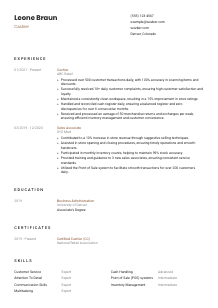
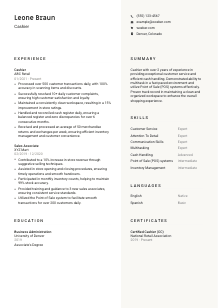
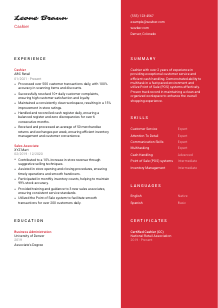
Handling greenbacks, but your resume doesn't have that cash flow? Check out this Cashier resume example, created with Wozber free resume builder. Learn how to present your transactional talents to catch the attention of hiring managers, taking your career to the top of the receipt stack!
Cashier work looks simple from a distance, but employers know the front lane sets the pace for the whole store. A resume for this role needs to show accurate cash handling, steady customer interaction, and the ability to keep transactions moving when lines build, returns pile up, and pricing issues need a quick fix.
When those details are tailored to the posting, hiring teams can quickly see whether you have the right mix of POS experience, customer-facing judgment, and pace for the floor. Wozber's free resume builder helps you shape that experience into an ATS-compliant resume, so the key points, such as transaction volume, payment handling, and service quality, are easy to read and hard to miss.
Retail hiring often moves fast, and your header should answer the practical basics immediately. For a cashier position, that means clear identity, direct contact details, and any location detail the employer specifically asked for.
Use your full name at the top in a clean, readable font. Keep it more prominent than any other text so the hiring manager can immediately place your application, especially when reviewing a stack of retail resumes in one sitting.
Place "Cashier" directly under your name if that is the role you are applying for. This keeps the resume aligned with the opening and helps both the recruiter and ATS connect your background to front-end retail work without guesswork.
List a current phone number and a professional email address that you check regularly. Cashier hiring can move quickly, particularly for stores filling shift coverage, so make it easy for managers to reach you for interviews or schedule discussions.
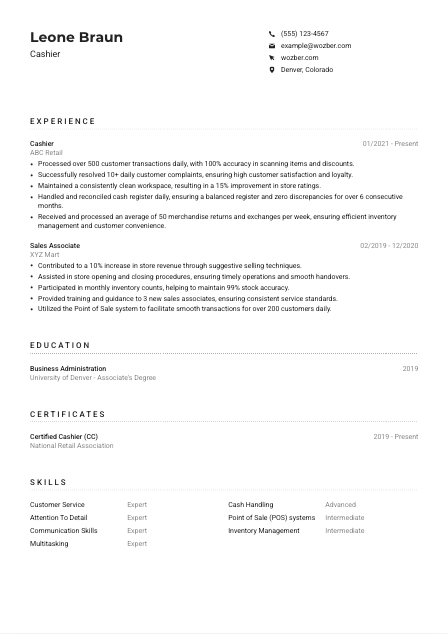
If the employer requests a local candidate, add your city and state. In the provided example, listing Denver, Colorado directly supports the requirement to be located there. For other cashier roles, include location when it helps confirm commute practicality or local availability.
A LinkedIn profile can be useful if it matches your resume and reinforces retail experience, customer service work, or steady employment history. If you do not have a profile that adds anything meaningful, leave it out rather than linking to a sparse page.
This section should confirm that you are reachable, local when required, and clearly applying for cashier work. That is all a hiring manager needs here.




For cashier hiring, experience is where managers look for proof that you can handle volume, payment accuracy, customer questions, and the rhythm of the sales floor. Generic duty lists do not help much. Specific numbers, store tasks, and customer-facing examples do.
Read the posting closely and note the day-to-day work it emphasizes. Here, that includes scanning items, applying discounts, taking different payment types, handling returns, resolving complaints, stocking shelves, and balancing the register at close. Those points should shape which experience bullets you lead with.
Start with your most recent position and include job title, employer, and dates. If your background includes closely related roles such as Sales Associate or Customer Service Associate, keep them in because they still show register use, product knowledge, floor support, and customer interaction in a retail setting.
Cashier resumes get stronger when they show pace and accuracy. The sample resume does this well with details like processing over 500 transactions daily, resolving 10+ customer complaints per day, and keeping a balanced register with zero discrepancies for six straight months. Metrics like transaction volume, error rate, return volume, or store-rating improvements tell a manager how you actually perform under pressure.
Keep the focus on store operations, customer service, and money-handling responsibility. A cashier resume should spend its space on checkout flow, payment accuracy, upselling, returns, merchandising support, and opening or closing duties, not unrelated achievements that do not help a store manager picture you on the front end.
Employers notice when a cashier contributes to smoother operations. That could mean training new hires on the POS, helping with inventory counts, reducing checkout delays, or stepping into opening and closing procedures. In the example, assisting with store opening and closing and helping maintain 99% stock accuracy adds depth beyond ringing up purchases.
A hiring manager should be able to see you handling the register, supporting customers, and keeping the front of store organized from this section alone.
Education is rarely the deciding factor for cashier roles, but it still adds context. It can show reliability, basic business knowledge, and any coursework that supports customer service, retail operations, or money handling.
Even when a degree is not required, list your school, credential, and graduation year or expected completion date. An associate degree, high school diploma, or GED is enough for many cashier openings, and it helps complete the picture of your background.
Use a simple format with school name, degree or diploma, field of study if applicable, and date. The example's Associate's Degree in Business Administration works well because it is concise and easy to scan.
If you are early in your career or have limited retail experience, relevant classes can help. Courses in business basics, accounting, communication, retail management, or customer relations can support a cashier application by showing comfort with transactions and customer-facing work.
Include academic honors, leadership, or club activity only if they add something useful, such as responsibility, teamwork, or service orientation. For an entry-level cashier resume, this can help fill out your profile. For an experienced cashier, keep it brief unless it clearly strengthens the application.
Short workshops or training in customer service, retail systems, workplace safety, or handling difficult customers can belong here or in certificates, depending on how formal they are. Use them when they support the actual store work the employer needs covered.
For cashier roles, education works best as clean supporting information that rounds out your retail experience without competing with it.
Certifications are optional for many cashier jobs, but the right one can strengthen your resume, especially when it relates to retail service, payment handling, or store operations. Keep this section focused on credentials that actually support cashier work.
Some cashier postings do not mention certifications at all, while others may value training in customer service, loss prevention, food handling, or retail operations depending on the store environment. Start with the ad, then decide whether a certificate meaningfully adds to your application.
Choose credentials that connect to the register, the sales floor, or customer interaction. The example's Certified Cashier credential is a strong fit because it reinforces commitment to the role rather than adding a generic course with no link to checkout work.
If a certificate is active, renewed regularly, or recently completed, include the date. That helps show current knowledge, especially for credentials tied to store procedures, compliance, or customer-facing standards.
A short certificate list can quietly show that you keep improving how you work. For cashier candidates, that might include training in POS systems, retail customer service, conflict handling, or store safety. Keep it relevant and current.
If a credential makes you look more prepared to handle transactions, customers, or store procedures, include it. If it does not, leave the space for stronger retail evidence.
A cashier skills section should read like the work you actually do during a shift. Employers are looking for practical checkout abilities, accurate payment handling, and customer-facing skills that hold up during busy hours.
Pull both technical and interpersonal skills from the posting. In this case, core matches include cash handling, basic math, POS system use, communication, multitasking, attention to detail, and handling multiple payment methods. Those are the skills that deserve top placement.
Lead with the abilities that affect checkout accuracy and customer experience most directly. Customer service, cash handling, POS systems, and attention to detail usually belong near the top because they connect directly to daily register performance and end-of-day balancing.
Do not overload the section with broad traits. A shorter list with real cashier value works better. The example keeps a useful balance by combining service skills with operational ones like inventory management and POS systems. Rate or describe your skill level only if it helps clarify your actual proficiency.
This section should sound like someone who can step onto the register, work accurately, and handle customer traffic without a long learning curve.
Language ability matters in cashier roles because the work is constant communication. You are answering questions, explaining prices, handling complaints, and confirming payments in real time, often with a line forming in front of you.
If the posting requires strong English fluency, list English clearly and give an accurate proficiency level. That directly addresses a stated requirement and reassures the employer that you can handle customer conversations, returns, and payment issues smoothly.
Extra languages can be valuable in busy retail environments, especially in customer-facing stores serving a broad community. Even a basic second language can help with simple greetings, directions, or common purchase questions when presented honestly.
Terms such as Native, Fluent, Conversational, or Basic are easy to understand and set realistic expectations. The example does this well by listing English as Native and Spanish as Basic.
Do not treat languages as decorative. For a cashier, they support service, problem resolution, and smoother communication at checkout. If another language has helped you assist customers, mention that in experience rather than trying to overstate it here.
Retail teams rely on clear communication at the register, so honesty matters. If you are still learning a language, say so plainly. A realistic label is more useful than an inflated one that creates the wrong expectation on the floor.
For cashier applications, language skills matter when they help you communicate clearly with customers and support the pace of the store.
Your summary should give a quick, concrete picture of how you perform in a cashier role. In a few lines, show your experience level, the kind of retail environment you have handled, and the customer and transaction skills you bring to the register.
Start by naming yourself as a Cashier or retail customer service professional and include your years of experience. This immediately frames your background and tells the reader whether you are coming in with proven register experience or adjacent retail support.
Mention the abilities that define solid cashier performance, such as fast and accurate transaction processing, POS use, payment handling, customer service, and working well in busy store conditions. Keep the wording grounded in real tasks rather than vague claims.
A summary becomes more convincing when it includes a concrete result. The example works because it points to efficient cash handling, strong customer service, and an organized workspace. You can also mention high transaction volume, low discrepancy rates, or success handling returns and complaints if those are part of your background.
Aim for 3 to 5 lines. That is enough room to show your cashier experience, strongest skills, and one clear performance point without repeating the rest of the resume. Save details for the experience section and keep the summary focused on the role you want now.
A good cashier summary gives the employer a fast read on your transaction accuracy, service style, and ability to handle a busy retail shift.
A cashier resume works when it shows the practical details a store manager cares about: transaction accuracy, dependable customer service, comfort with POS systems, and the ability to stay organized during a busy shift. If those points are clear across your header, experience, skills, and summary, your application already reads stronger.
Use Wozber's AI resume builder and ATS resume scanner to tailor your wording to each posting, strengthen ATS optimization, and present your experience in an ATS-friendly resume format. The finished resume should make one thing easy to judge right away: you can step in, handle the register, and keep the customer experience running smoothly.




