



Use Wozber and land your dream job
Create Resume
No registration required
Closing deals, but your resume isn't selling it? Check out this Retail Sales Executive resume example, created with Wozber free resume builder. Learn how to highlight your sales leadership and retail acumen to match job criteria, crafting a career narrative as compelling as your top-selling pitch!
Retail Sales Executive hiring usually turns on a simple question: can you grow revenue without losing the customer experience that keeps people coming back? Your resume needs to show both sides of the job. That means visible sales results, strong product knowledge, and examples of how you built repeat business, coached store teams, or responded to shifts in customer demand.
When those details are tailored to the posting, the resume is easier to sort in both human review and ATS screening. Wozber's free resume builder helps you match the employer's language around sales targets, CRM use, forecasting, and customer relationships while keeping the document in an ATS-friendly resume format. The result is a clearer picture of how you perform in a retail environment where service quality and sales performance move together.
Retail is a customer-facing business, and your contact section should feel as polished and direct as an in-store introduction. Keep this area clean, professional, and aligned with any practical requirements named in the posting.
Put your name at the top in a readable format that stands out without looking styled for style's sake. In a role tied to presentation, customer interaction, and credibility on the sales floor, even this first line should feel orderly and confident.
Place "Retail Sales Executive" directly under your name when that matches the role you are applying for. It helps position you immediately for sales leadership, customer relationship management, and revenue accountability rather than a more general retail profile.
List a current phone number and a professional email address that you actually monitor. Hiring teams filling retail leadership roles often move quickly when they find candidates with the right sales background, so missed calls or an outdated email can cost you an interview.
If the employer asks for local candidates, include your city and state. In this example, listing "Los Angeles, California" addresses a specific requirement right away and removes a practical question before it slows down your application.
Include LinkedIn or a personal professional site only if it supports your candidacy with consistent job history, awards, sales accomplishments, or recommendations. For a Retail Sales Executive, an online profile is most useful when it reinforces customer-facing leadership and measurable sales performance, not when it adds unrelated content.
This section should confirm who you are, how to reach you, and whether you meet any location requirement. Keep it neat and practical so the focus stays on your sales record and retail leadership.




This is the section hiring managers read most closely for retail sales roles. They want to see where you sold, what you were responsible for, how you influenced customer behavior, and whether your work translated into higher revenue, stronger retention, or better team performance.
Read the posting for its operating priorities, then bring those themes into your bullets using language you can support. For this role, that means sales growth, customer service, relationship building, market awareness, forecasting, and mentoring sales associates. If you have done that work, say it directly instead of relying on generic retail wording.
Start with your most recent role and include job title, employer, and dates for each position. That format makes it easy to follow your progression from customer-facing selling into broader responsibility such as coaching staff, owning targets, or influencing sales strategy.
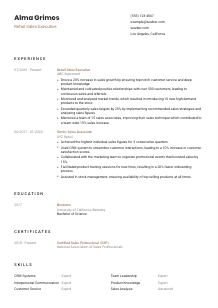
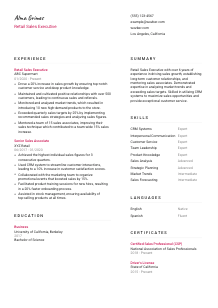
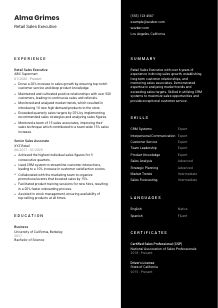
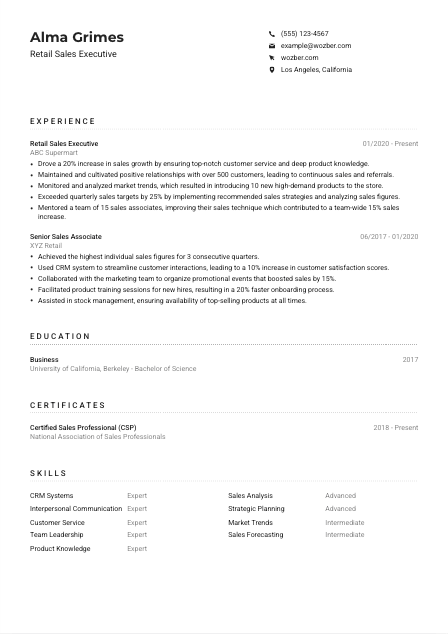
Retail employers already know a sales executive works with customers and products. What they need to learn is how well you did it. Replace routine task language with outcome-driven bullets such as increasing store sales, improving customer satisfaction, expanding repeat business, or training associates to lift conversion. The sample resume handles this well with bullets like a 20% sales increase and relationships maintained with more than 500 customers.
Metrics carry real weight in retail because performance is often tracked closely by revenue, target attainment, conversion, basket size, customer retention, and team results. Use percentages, volume, team size, or account counts where they are accurate. Examples like exceeding quarterly sales targets by 25% or helping a team of 15 associates improve sales by 15% tell a hiring manager far more than "responsible for sales growth."
You do not need to include every retail task or every early-career role. Prioritize experience that shows customer-facing selling, account development, product expertise, vendor or partner interaction, CRM use, and commercial judgment. A selective experience section makes your core strengths easier to spot, especially when the employer wants at least 4+ years in retail sales or a similar environment.
Your experience should make it easy to see a pattern of sales delivery, customer relationship strength, and retail leadership. If a hiring manager can picture you owning targets, guiding associates, and responding to market trends, this section is doing its job.
Retail Sales Executive roles do not treat education as decoration. When a posting asks for a bachelor's degree in Business, Marketing, or a related field, this section should confirm that you bring the commercial foundation to handle sales analysis, budgeting, and strategy discussions.
If you hold a bachelor's degree in Business, Marketing, or a related discipline, list it clearly so the requirement is easy to confirm. In the example resume, a Bachelor of Science in Business lines up directly with the posting and supports the analytical side of the role.
Include degree, field of study, school name, and graduation year or date. Retail hiring rarely needs a complicated education layout. A simple format works best because it lets reviewers confirm qualifications quickly and move back to your sales results.
If your coursework connects naturally to retail sales, marketing, consumer behavior, pricing, or business performance, the degree becomes more than a checkbox. It reinforces your ability to read market conditions, interpret sales figures, and support store-level or regional growth decisions.
Relevant courses, academic projects, or honors can help if they point toward sales, merchandising, analytics, or customer strategy. This matters most for newer candidates or career changers. If you already have a strong track record in stores, keep these additions brief so your experience remains the center of gravity.
Short programs in CRM, retail analytics, sales management, or customer experience can sit here or in certifications, depending on format. They show you keep developing the practical skills tied to modern retail operations rather than relying only on past tenure.
Keep this section concise, relevant, and easy to verify. For this kind of opening, your education should support the business side of retail sales without competing with your performance history.
Certifications are optional in many retail sales openings, but the right ones can sharpen your profile. They are most useful when they strengthen your case in areas such as sales process, customer relationship management, service standards, or commercial analysis.
Pick credentials that connect to sales execution, customer engagement, or retail leadership. A certification such as "Certified Sales Professional (CSP)" fits naturally because it supports the kind of target-driven selling and client relationship work expected from a Retail Sales Executive.
This section works best when it stays focused. Include certificates that improve your case for revenue ownership, team mentoring, CRM use, or strategic selling. If a credential does not add anything to those areas, it does not need space on the page.
Show the issue date and, if relevant, the renewal period or active status. That tells employers your knowledge is current, especially for certifications tied to sales methods, software, compliance, or customer service standards.
Retail changes quickly with shifts in product demand, loyalty strategies, digital customer journeys, and store analytics. Recent learning in CRM platforms, sales forecasting, merchandising, or frontline coaching can strengthen your resume, especially if the posting leans toward data use and team development.
A short, relevant certifications section can reinforce your professionalism and your commitment to better sales execution. Keep it tied to the commercial and customer-facing demands of the job.
For a Retail Sales Executive, the skills section should read like a summary of how you operate on the floor and behind the numbers. It needs to cover customer interaction, sales discipline, team influence, and the systems or analysis skills that support smarter decisions.
Start with the requirements named by the employer, then match them to skills you have already used in practice. Here, that includes interpersonal communication, written and verbal communication, CRM systems, sales data analysis, customer service, product knowledge, and mentoring. Use the wording naturally so the connection is clear in both ATS review and human screening.
Do not crowd this section with every ability you have picked up over time. Put the strongest role-related skills first, especially those tied to revenue growth, customer retention, team guidance, and market awareness. The example resume does this well by foregrounding CRM Systems, Customer Service, Team Leadership, Product Knowledge, and Sales Analysis.
Group skills in a way that makes sense for the role. You might separate sales and service skills from analytical or systems skills, or simply order them by importance. However you format it, make sure a reader can quickly find the capabilities most relevant to a Retail Sales Executive, such as CRM proficiency, communication, forecasting, and strategic planning.
Your skills list should support the story told in your experience bullets. When the same themes appear across both sections, your resume feels more credible and better aligned with the demands of retail sales leadership.
Language ability matters in retail because sales often depend on trust, clarity, and quick rapport. If the employer names English proficiency as essential, your resume should state that plainly, then add any additional languages that strengthen your ability to serve the customer base.
When the posting specifically asks for effective English communication, list English at the top with an accurate proficiency level such as "Native" or "Fluent." That immediately answers a stated requirement and supports the communication-heavy nature of the role.
Extra languages can be a real asset in retail, especially in diverse markets or stores with broad community traffic. In the example resume, Spanish adds practical value because it suggests wider customer accessibility, not just an extra line on the page.
Use clear labels such as Native, Fluent, Intermediate, or Basic. Retail employers may rely on these skills in live customer interactions, team communication, or vendor conversations, so accuracy matters more than trying to sound impressive.
If you are applying to a store, territory, or brand that serves multilingual customers, language skills deserve more prominence. They can support better service, faster issue resolution, and stronger relationship building at the point of sale.
Additional language skills can support upselling, repeat business, and customer loyalty when they help you communicate more naturally with shoppers. In retail, that is not a side detail. It can directly influence service quality and conversion.
Handled well, languages show more than communication ability. They can strengthen your case as someone who can connect with customers, represent the brand well, and sell effectively across a broader audience.
Your summary sits at the top of the resume, so it should quickly establish what kind of retail sales professional you are. Focus on scope, strengths, and the kinds of outcomes you deliver, then mirror the employer's priorities without turning the section into a keyword dump.
Before writing, identify the two or three themes at the center of the posting. For this opening, those themes include sales growth, customer relationships, sales analysis, and team mentoring. Build the summary around that mix instead of writing a broad statement that could fit any retail candidate.
A direct opening like "Retail Sales Executive with over 6 years of experience" works because it immediately establishes seniority and relevance. It is especially useful when the employer asks for a minimum of 4 years in retail sales or a similar customer-facing role.
Mention the abilities that carry the most weight for the target role, such as driving revenue, building long-term customer relationships, analyzing market trends, or using CRM systems to capture opportunities. The example summary works because it combines experience, results orientation, and practical tools in a compact way.
Aim for 3 to 5 lines that a hiring manager can absorb quickly. Skip vague descriptors and focus on concrete value. A sharp summary should sound like the top line of your sales profile, with enough detail to support the rest of the resume rather than repeating it.
This section should make your direction clear within seconds: you know how to sell, build customer loyalty, and contribute to store performance. Once that is established, the rest of the resume can prove it with metrics and examples.
A Retail Sales Executive resume works best when every section points to the same core strengths: revenue growth, strong customer relationships, sound commercial judgment, and the ability to raise team performance. When your title, experience, skills, and summary all reinforce those outcomes, hiring managers can quickly understand where you add value.
Use Wozber's free resume builder to shape that story into an ATS-compliant resume, and use its ATS resume scanner and AI resume builder features to tighten wording around the exact sales, CRM, and customer-service language in the posting. The final version should make one thing easy to judge: you can step into the retail floor, own targets, and deliver results.




