



Use Wozber and land your dream job
Create Resume
No registration required
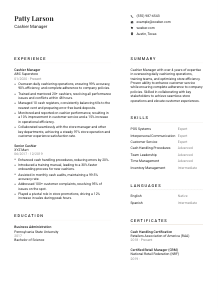
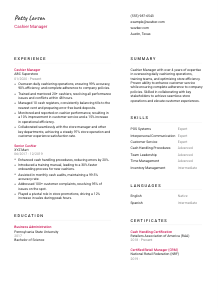
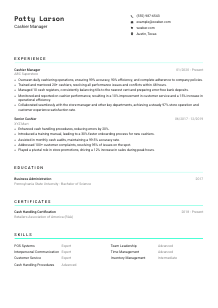
Ringing up sales, but your resume just keeps getting returned? Handle it as smoothly as cash transactions with this Cashier Manager resume example, created with Wozber free resume builder. Learn how to match your managerial acumen with transactional expertise, ensuring your career rises to the top of the receipt stack!
Cashier Manager hiring usually turns on operational control. Stores need someone who can keep front-end checkout running accurately during rush periods, handle till balancing and deposits without errors, coach cashiers through service issues, and keep policies consistently applied across every shift. Your resume should make that front-end leadership visible, not read like a general retail profile.
When the resume is tailored well, hiring teams can quickly see whether your background matches the real pressure points of the job: POS oversight, cash accountability, team supervision, and customer-facing problem solving. Wozber's free resume builder helps you shape that experience into an ATS-compliant resume using the same retail language the posting uses, so the document surfaces your readiness to manage cashier operations from the first scan.
Front-end retail roles move fast, so your contact details need to be clean and practical. For a Cashier Manager, this section should immediately confirm who you are, what role you are targeting, and whether you meet any location or communication requirements named in the posting.
Use your full name at the top in a clear, readable format. Keep it slightly larger than the rest of the text so the resume feels organized from the first line. In store leadership hiring, clarity matters, and that starts with a header that is easy to read at a glance.
Place the job title directly under your name when you are applying for a specific opening. If the target job is Cashier Manager, use that exact title rather than a broader label like Retail Associate or Front-End Staff. This helps the reader immediately place your experience in the right lane.
Include a working phone number and a professional email address. Double-check both. Cashier Manager interviews are often scheduled quickly, especially for active retail operations, so one typo can cost you a callback. A straightforward format such as firstname.lastname@email.com works well.
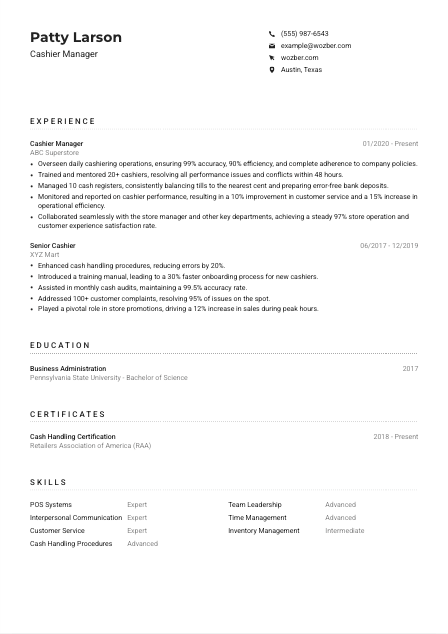
If the employer specifies a location requirement, include your city and state. Here, listing Austin, Texas directly supports a stated requirement in the job ad. Treat this as tailoring to the opening, not a rule for every Cashier Manager resume.
A LinkedIn profile or professional website is worth adding when it reinforces your store leadership background, customer service record, or retail progression. Keep titles, dates, and certifications aligned with the resume so there is no mismatch when someone checks your details.
This section does a practical job. It should confirm your identity, target role, and any required logistics without distracting from your store operations experience. Clean details make the rest of the resume easier to trust.




For a Cashier Manager, experience carries the most weight because the work is measured in control, consistency, and results on the sales floor. Your bullets should show how you handled registers, people, reporting, and customer flow, with numbers that reflect accuracy, efficiency, and team performance.
Start by pulling out the core duties from the posting, then match them to your own work. In this case, that includes overseeing cashier operations, balancing tills, preparing deposits, training cashiers, and reporting on performance. Build bullets around those responsibilities so the reader does not have to guess whether you have managed a retail front end before.
List your jobs in reverse chronological order. For each one, include your title, employer, and dates. That format makes promotion paths easy to spot, such as moving from Senior Cashier into Cashier Manager. In retail hiring, that progression often matters because it shows you earned trust with cash control and team oversight over time.
Do not stop at responsibility statements like "managed cash registers" or "trained staff." Show what changed because of your work. The sample resume does this well by tying front-end oversight to 99% transaction accuracy, 15% higher operational efficiency, and faster conflict resolution. Those are the kinds of outcomes that make experience believable and useful.
Choose metrics that reflect how cashier teams are actually evaluated. Good examples include register accuracy, till balancing, deposit errors, onboarding speed, complaint resolution rate, customer service scores, queue efficiency, or the number of cashiers supervised. Metrics such as balancing tills to the nearest cent or improving onboarding by 30% tell a hiring manager you understand the operational side of the role.
Keep the section focused on front-end supervision, customer service improvement, cash accountability, and collaboration with store leadership. If an older bullet does not help prove you can run cashier operations, trim it or rewrite it. Every line should support the case that you can manage checkout performance, enforce procedures, and keep the customer experience steady during busy store hours.
This section should leave no doubt that you can supervise cashiers, manage registers accurately, and improve store operations. When your bullets combine scope, action, and retail outcomes, hiring teams can picture you stepping into the floor lead role quickly.
Education is usually a supporting section for Cashier Manager roles, but it still adds useful context. It can reinforce business knowledge, retail readiness, or formal training that supports store operations, team supervision, and day-to-day decision making at the register level.
Some Cashier Manager jobs do not require a specific degree, while others prefer business or retail-related education. If the job ad stays flexible, include your strongest relevant credential without overexplaining it. A degree in Business Administration, for example, naturally supports skills in operations, team management, and customer service.
List your degree, field of study, school, and graduation year in a simple order. Hiring managers usually spend only a few seconds here, so give them exactly what they need. Straightforward formatting also supports ATS readability.
If your education connects to retail management, finance basics, operations, or business administration, make sure that connection is visible. You do not need a long explanation. The degree title itself often carries enough weight when it aligns with store leadership responsibilities.
Relevant coursework can help if you are early in your career or if your classes directly support the role. Retail operations, accounting fundamentals, customer behavior, or business communication are all more useful here than a generic list of classes.
Honors, leadership roles, or practical projects are worth noting when they strengthen your management profile. If you are already experienced in cashier supervision, keep this brief. If you are moving up from cashier to manager, these details can help round out your leadership story.
Your education section does not need to carry the resume, but it should reinforce the kind of judgment and business grounding the role requires. Keep it concise and connected to retail operations.
Certifications matter most when they reinforce trust. In a Cashier Manager role, they can support your credibility in cash handling, retail procedures, team supervision, or store operations, especially when the posting mentions them as a plus.
Check whether certifications are required, preferred, or simply helpful. Here, cash handling certification or related retail management coursework is listed as a plus. That means relevant certificates can strengthen your application, even if they are not mandatory.
Prioritize credentials that support the actual work of the role. A Cash Handling Certification or Certified Retail Manager credential is much more persuasive than a generic course because it directly relates to register accountability, customer-facing supervision, and store procedure.
Include issue dates and, if relevant, renewal periods. This is especially useful for certifications tied to current retail practices or ongoing membership. Clear dating shows the credential is active and not something you completed so long ago that it no longer reflects your working knowledge.
Retail environments change with new POS workflows, fraud-prevention procedures, and service expectations. Current certificates tell employers that you take operations seriously and continue building skills beyond day-to-day shift management.
Certificates work best here as proof of practical retail knowledge. If they support cash accuracy, leadership, or store operations, they add useful weight to your application without needing much space.
The skills section should read like the operating toolkit of someone who can run a checkout area well. For a Cashier Manager, that means a balanced mix of technical retail skills and people-management strengths, chosen to match the language of the job ad and the realities of front-end supervision.
Review the posting for both explicit and implied skills. In this example, POS systems, cash handling procedures, interpersonal communication, team leadership, and English proficiency are all directly relevant. Using that language helps connect your resume to the role in a way both hiring teams and ATS systems can recognize.
Put the most important front-end capabilities first. For this role, that usually means POS systems, till balancing, deposit handling, customer service, cashier training, conflict resolution, and shift coordination. The sample resume also includes team leadership and time management, which support the day-to-day realities of supervising busy checkout lanes.
Do not overload this section with every retail skill you have ever used. Choose the skills that best support store efficiency, cash accuracy, and staff supervision. A shorter list of relevant skills is more convincing than a long list filled with low-priority items.
The right skills list should make it obvious that you understand both the systems and the people side of cashier management. Focus on the abilities that keep checkout accurate, fast, and customer-friendly.
Language skills can be useful in cashier management because the role sits at the intersection of customer service and team coordination. They are most valuable when they support a stated job requirement or reflect the communication needs of the store's staff and customers.
Look for any stated language requirement before deciding how much space this section needs. In this job description, high English proficiency is explicitly required, so English should be listed clearly with an accurate level.
Put the required language first and state your proficiency honestly, such as Native, Fluent, or Professional. For a Cashier Manager, strong English matters because the role includes training, policy communication, performance feedback, and customer issue resolution.
If you speak additional languages, include them when they could improve customer interactions or support a multilingual cashier team. In many retail settings, even intermediate ability can help with customer questions, line management, and smoother service during peak periods.
Use clear labels and avoid overstating your ability. If you can handle everyday customer conversations but not detailed policy discussions, mark that level appropriately. Accuracy matters because language skill in retail is often tested in live interaction, not just on paper.
If language is central to the posting, make it visible. If it is only a secondary advantage, keep the section short. For this opening, English deserves explicit emphasis because it appears in the requirements, while any second language works as added value rather than a core qualification.
Use this section to support how you communicate on the floor, with both customers and staff. For this role, clear English proficiency should be unmistakable, and any added language skill should strengthen your customer service profile.
Your summary should quickly position you as someone who can run cashier operations without losing control of service, accuracy, or staff performance. In a few lines, show your level of experience, your front-end management strengths, and the kinds of retail results you have delivered.
Start with the priorities named in the job description, then reflect the parts you genuinely cover. For a Cashier Manager, that often means years in retail cashier leadership, POS and cash handling knowledge, team supervision, and strong communication on the floor.
Your first line should establish who you are professionally. A phrase like "Cashier Manager with 4+ years of experience leading front-end retail operations" works because it combines title, tenure, and scope immediately.
Bring in details that match the role and reflect your track record. The sample summary points to overseeing cashier operations, training teams, and improving store efficiency. You can make yours even sharper by mentioning customer service gains, transaction accuracy, or the scale of registers or staff supervised.
Aim for a short paragraph, not a biography. Focus on what matters for this job now: front-end control, cashier coaching, policy compliance, and operational efficiency. If the summary could apply equally well to a general retail associate, it needs to be more specific.
A well-written summary should immediately place you in a cashier leadership context. When it highlights retail supervision, cash accuracy, and customer-facing team management, the rest of the resume lands with more force.
A Cashier Manager resume works when it shows control over the details that matter in retail: register accuracy, deposit procedures, cashier coaching, service recovery, and steady coordination with store leadership. If those points are clear across your experience, skills, and summary, the application reads as operationally credible from top to bottom.
Wozber's free resume builder helps turn that experience into a polished ATS-friendly resume, and its ATS resume scanner can help you align your wording with the posting's requirements before you apply. The final result should make one thing easy to judge: you can keep cashier operations accurate, efficient, and well-led on a live retail floor.




