



Use Wozber and land your dream job
Create Resume
No registration required
Brewing perfection, but your resume feels half-caffeinated? Check out this Coffee Shop Manager resume example, created with Wozber free resume builder. Learn how to blend your java genius with job grounds, creating a career profile as rich and enticing as your prized espresso shots!
Running a coffee shop means balancing two things at once all day: a consistently strong customer experience and disciplined store operations behind the counter. Hiring teams want to see that you can keep service moving during rushes, coach staff, protect product quality, manage inventory, and still grow sales without losing control of labor or costs.
That balance needs to be obvious fast. When a coffee shop manager resume is tailored to the posting, the reader can quickly connect your past work to store performance, staffing, and specialty coffee knowledge instead of guessing where your strengths sit. Wozber's free resume builder helps turn that experience into an ATS-compliant resume that surfaces the right language and makes your management range easier to spot.
Personal details are simple, but they still shape the first read of your resume. For a Coffee Shop Manager role, this section should confirm who you are, how to reach you, and whether you meet practical requirements such as location without adding clutter.
Use your full name in a larger, clean font so it stands out immediately. Coffee shop hiring often moves quickly, especially for management openings, so a clear header helps the reader orient themselves before they get into your staffing, sales, and operations experience.
Place "Coffee Shop Manager" directly below your name if that is the role you are pursuing. This small choice matters because it frames your background around store leadership, floor operations, team supervision, and business growth from the first line.
List a reliable phone number and a professional email address. Double-check both. If a hiring manager wants to reach you after seeing relevant experience with scheduling, performance reviews, or sales growth, you do not want a typo to interrupt that process.
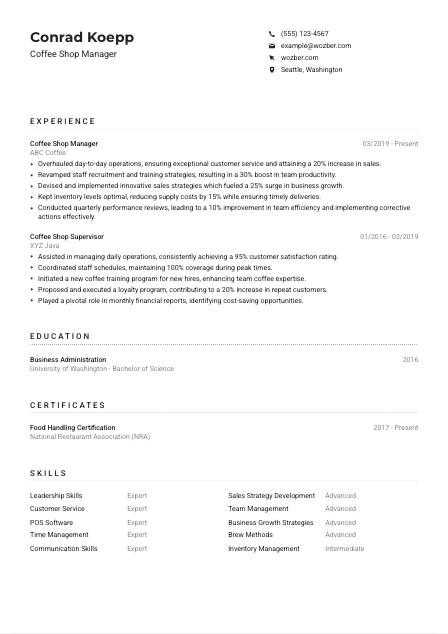
When a posting asks for local candidates, add your city and state clearly. In the example, listing Seattle, Washington directly supports the stated location requirement. If you are relocating, note that elsewhere only if it strengthens your application and matches the employer's expectations.
A LinkedIn profile or professional website can support your application when it reinforces management experience, hospitality leadership, coffee training, or business results. Only include it if the content is current and consistent with the resume you are submitting.
This section does not need personality flourishes. It should confirm the basics quickly and remove any doubt about how to contact you and whether you meet practical requirements for the role.




For a Coffee Shop Manager, experience carries most of the hiring weight. This is where you show how you ran the floor, led a team, protected service quality, handled inventory, and improved store performance through better execution.
Prioritize positions where you owned daily operations, staff supervision, scheduling, training, sales performance, inventory, or budget awareness. If you moved up from barista or supervisor roles, show that progression clearly so the reader can see how you grew into managing both people and business results.
Start with your most recent position and work backward. That format helps employers quickly find your current level of responsibility, whether that includes overseeing a full shop, running shifts, managing labor coverage, or coaching staff through high-volume service periods.
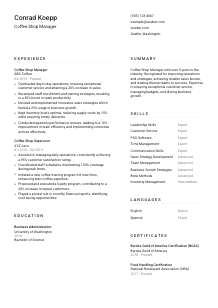
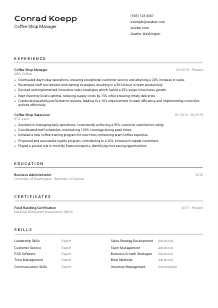
Do not stop at "managed staff" or "oversaw operations." Show what changed because of your work. The example bullet, "Overhauled day-to-day operations, ensuring exceptional customer service and attaining a 20% increase in sales," works because it connects operations to a business result. Aim for that same cause-and-effect structure throughout your section.
Coffee shop management is often judged through sales growth, repeat business, labor coverage, customer satisfaction, waste reduction, supply cost control, and team productivity. The sample resume uses metrics well, including a 25% surge in business growth, a 15% reduction in supply costs, and 100% peak-time coverage. Even one or two grounded numbers per role can make your management impact much more believable.
Keep the section focused on experience that proves you can run a shop successfully. Hospitality, restaurant, café, and specialty coffee experience all belong here when they show transferable strengths such as staff leadership, service standards, ordering, cash handling, or local marketing. Leave out older or unrelated work that does not strengthen that case.
Your experience section should leave a clear picture of the operation you managed, the team you led, and the results you produced. When those three pieces are visible, the resume reads like a manager's resume, not a barista resume with a new title.
Education is rarely the deciding factor for a Coffee Shop Manager, but it still adds useful context. It can support your business judgment, hospitality background, or commitment to learning, especially when the rest of your resume already shows strong operational experience.
Start with your most recent or most relevant academic credential. Many coffee shop management jobs do not require a specific degree, but education in business, hospitality, food service, or retail operations can reinforce your ability to handle budgets, teams, and day-to-day store performance.
Include the degree, field of study, school, and graduation year. The example's "Bachelor of Science in Business Administration" is a good illustration of concise formatting that still adds value, especially for a role involving sales targets and budget management.
If your coursework, training, or academic projects relate to management, customer experience, small business operations, or food service, make that connection visible when space allows. This is especially useful if your hands-on management experience is still growing.
Leadership roles, hospitality clubs, business competitions, or campus work in food service can be worth including if they strengthen your profile. Skip extras that do not connect to team leadership, customer service, or commercial performance.
For experienced managers, education should complement your store results rather than compete with them. If you also hold role-relevant certifications, such as food safety or specialty coffee training, those often carry more direct weight for this profession and should be listed in their own section.
A clear education section rounds out your profile and can reinforce your business or hospitality foundation. Keep it clean, relevant, and proportionate to your level of hands-on management experience.
Certifications matter in coffee shop management when they connect directly to safety, product knowledge, or leadership credibility on the floor. They can also help separate candidates who know café operations from those who have only handled general retail supervision.
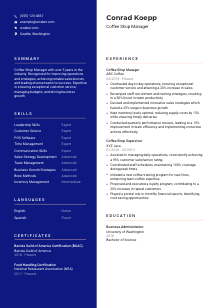
Start with credentials that support daily shop operations, compliance, and specialty coffee knowledge. In the example, Food Handling Certification aligns directly with the posting's "Food Handling or ServSafe" preference, while Barista Guild training reinforces depth in brew methods and coffee craft. Use your own equivalent credentials when they are relevant.
Add the year earned or active date range for each certification. That helps the employer see whether your food safety training is current and whether your coffee education reflects recent industry standards, equipment, and preparation methods.
If a certification needs renewal, make sure the status on your resume is accurate. Current food safety credentials are especially useful for management roles that include handling products, training staff on procedures, and maintaining shop compliance.
A short list of well-matched credentials does more for a coffee shop manager than a long list of unrelated certificates. Focus on training that speaks to safe operations, specialty coffee, equipment knowledge, service standards, or staff development.
The right certificates show that you can lead a coffee shop with attention to safety, product quality, and technical understanding. Keep the list focused on qualifications that strengthen day-to-day management trust.
Coffee Shop Manager skills should reflect how the business actually runs. That means a mix of people leadership, service execution, shop operations, commercial awareness, and enough coffee knowledge to train staff and protect product quality.
Read the posting closely and mirror the language where it matches your real experience. For this role, that includes leadership, sales strategy, budget management, staff scheduling, inventory control, customer service, and knowledge of coffee equipment and brew methods. This keeps the section useful for both human readers and ATS optimization.
Do not make this section read like a generic retail manager profile. A strong Coffee Shop Manager resume should include operational and hospitality skills alongside café-specific knowledge such as specialty coffee, espresso equipment, brew methods, or POS systems used in food service environments.
Keep the list tidy and relevant. The example works because it combines leadership and customer service with practical shop skills like POS software, sales strategy development, brew methods, and inventory management. Grouping your strongest, most job-aligned skills first makes the section easier to read during a quick resume screen.
Your skills section should show that you can lead people, maintain service standards, and understand the operational side of a busy coffee business. That balance is what makes the role distinct.
Language skills can matter in café management because customer service happens in real time, often in a fast, public setting with a diverse team and customer base. Even when English is the only stated requirement, additional languages can strengthen how you lead staff and connect with guests.
When the posting calls out English proficiency, put English at the top of the section and state your level clearly. That immediately addresses a stated hiring requirement and removes uncertainty about your ability to handle customer interactions, team communication, and operational instructions.
Use plain labels such as Native, Fluent, Advanced, or Conversational. Clear proficiency levels help employers judge how well you can manage customer issues, coach staff, or support a multilingual team during busy service hours.
Additional languages can be valuable in coffee shops, especially in neighborhoods with varied customer traffic or diverse staff teams. In the example, Spanish adds useful service and team communication value without distracting from the core management profile.
Only claim the level you can actually use at work. If you may need to explain menu items, train a new hire, or handle a customer complaint in that language, your listed proficiency should match reality.
Language skills should support the job, not fill space. Include them when they improve your ability to lead a team, serve customers smoothly, or operate effectively in the local market.
For a Coffee Shop Manager, language ability matters most when it helps the shop run better. Present it clearly and let it support the customer and team side of your management profile.
The summary sits at the top of the resume, so it needs to establish your management level quickly. For a Coffee Shop Manager, that usually means years of experience, store leadership scope, coffee knowledge, and a few business results that show you can run an operation well.
Start with your title and years of relevant experience in coffee shops, cafés, restaurants, or hospitality operations. This quickly tells the reader whether you meet a requirement such as 3+ years in coffee shop or restaurant management.
Add a brief line about your strengths in daily operations, staff management, customer service standards, budgeting, sales growth, or specialty coffee oversight. Choose the points that best match the target posting rather than trying to cover every part of the job at once.
Specific results make the summary more credible. The sample summary is strengthened by experience that supports it elsewhere, including sales increases and operational improvements. A short mention of growth, cost control, customer satisfaction, or team productivity can work well here if the metrics are backed up in your experience section.
Aim for 3 to 5 lines. That is enough space to introduce your management experience, your coffee or hospitality expertise, and the main value you bring. Every phrase should help the employer picture you running a shop, leading a team, and improving performance.
A useful summary makes your level, your operating strengths, and your results clear within seconds. When it is tailored well, the rest of the resume reads with more focus.
A Coffee Shop Manager resume should make three things easy to find: how you lead people, how you keep operations under control, and how your decisions improve sales, service, or costs. When those points come through clearly, your application feels grounded in real store performance rather than generic hospitality language.
Use Wozber's AI resume builder to sharpen that alignment, strengthen ATS optimization, and present your experience in an ATS-friendly resume format that matches the job description naturally. The final result should show that you are ready to step into the shop, lead the team, and keep the business moving.




