



Use Wozber and land your dream job
Create Resume
No registration required
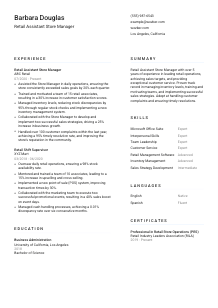
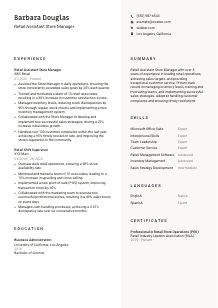
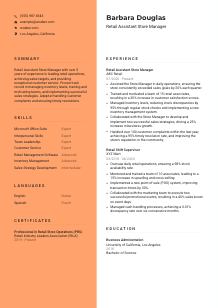
Managing store aisles, but your resume feels misplaced? Check out this Retail Assistant Store Manager resume example, created with Wozber free resume builder. Learn how to present your leadership skills clearly to match the job blueprint, ensuring your career shelves are stocked with success!
Retail Assistant Store Managers sit at the point where sales performance, floor execution, and team coaching meet. Hiring teams look for people who can keep the store running smoothly during busy shifts, maintain presentation standards, resolve customer issues without escalation, and help move weekly targets in the right direction. Your resume should make that operating range visible through concrete results, not broad retail language.
A tailored resume also helps separate assistant managers from strong senior associates or shift leads who have partial leadership exposure but not the full store-facing scope. Using Wozber's free resume builder to align your wording with the posting and create an ATS-compliant resume makes it easier to surface the right mix of sales KPIs, staff supervision, inventory control, and customer service ownership. That gives hiring teams a clearer read on whether you can step into day-to-day store leadership quickly.
For a Retail Assistant Store Manager, the top of the resume should confirm basic fit fast. Contact details, title, and location are simple items, but they also tell the employer whether you are aligned with the role's level, easy to reach for interview scheduling, and available to work where the store operates.
Use your full name in a slightly larger font than the rest of the header so it stands out right away. Store hiring often moves quickly, especially when managers are reviewing several candidates between operational tasks, so clean visibility matters.
Add "Retail Assistant Store Manager" directly below your name when that is the role you are pursuing. This helps frame the rest of the resume around supervisory retail work, sales ownership, and floor leadership instead of general store support.
List a working phone number and a professional email address that you check regularly. Retail interviews can be scheduled on short notice, and missed calls from a district manager or store manager are an avoidable setback.
If the employer specifies a city or region, show your location clearly in the header. Here, listing Los Angeles, California immediately answers a stated requirement and removes doubt about local availability.
A LinkedIn profile can help if it matches your resume and includes retail leadership details such as store volume, team size, promotions, or merchandising work. Skip personal links that do not add to your management credibility.
This section should answer the basic operational questions quickly: who you are, what role you are targeting, how to contact you, and whether you meet location requirements. Once that is clear, the reader can focus on your store leadership experience.




This is the section that carries the most weight for a Retail Assistant Store Manager. Employers want to see that you have already handled the mix of sales execution, associate supervision, customer issue resolution, inventory control, and daily store routines that come with supporting a Store Manager.
Before editing bullets, mark the duties that define success in the role. In this job description, that means assisting with daily operations, hitting sales goals, coaching associates, managing inventory, supporting sales strategy, and resolving customer complaints. Those are the experiences your bullets should answer directly.
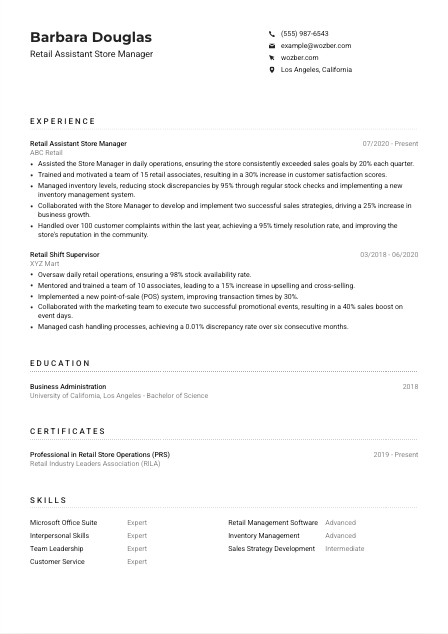
Start with your most recent role and list job title, employer, and dates consistently. For retail leadership roles, progression matters. A move from Shift Supervisor to Retail Assistant Store Manager, like in the example, shows increasing ownership over staff, sales, and operations.
Retail management resumes are stronger when bullets point to real store measures such as sales growth, customer satisfaction scores, stock accuracy, shrink reduction, upselling performance, transaction speed, or complaint resolution rates. The example bullet about exceeding sales goals by 20% each quarter works because it ties assistant management work to a business result the store cares about.
If you supervised associates, explain what that looked like. Mention training new hires, assigning floor coverage, coaching service behaviors, improving conversion or upselling, or managing performance during peak periods. "Led a team" is weaker than "trained 15 associates and raised customer satisfaction scores by 30%."
Prioritize achievements that reflect store leadership and operational control. Routine cashier duties, basic stocking, or generic customer service points belong only if they connect to a bigger result such as faster checkout flow, stronger stock availability, or improved complaint handling. Every bullet should move you closer to the assistant manager standard.
Your experience section should show that you already understand how a retail floor performs day to day. When your bullets connect team supervision, inventory discipline, customer service recovery, and sales KPIs, the employer can picture you stepping in beside the Store Manager and contributing from the start.
Education usually sits behind experience for this role, but it still matters when the posting asks for a bachelor's degree in business, retail management, or a related field. Present it clearly so the employer can confirm the requirement without searching for it.
Read the education line in the posting and make sure your entry answers it as closely as possible. In this case, a Bachelor of Science in Business Administration aligns well with the stated preference for Business, Retail Management, or a related field.
List your degree, school, field of study, and graduation year in a clean format. Retail hiring managers and recruiters usually want a quick confirmation here, not a long academic profile.
If your degree is directly connected to store operations, management, merchandising, or business performance, make that field clear. Relevant study in business, finance, supply chain, or retail management supports your readiness for KPI-driven store work.
If you are newer to supervisory retail roles, selected coursework in consumer behavior, inventory systems, marketing, or operations management can help connect your education to the job. For experienced candidates, this is usually unnecessary unless it fills a gap.
Academic achievements can support your profile if they relate to leadership, business analysis, or retail operations. For example, a merchandising project, sales case competition, or business club leadership role may be worth noting if your professional record is still developing.
Education should confirm that you meet the stated academic requirement and reinforce the business side of your retail background. Keep it direct, relevant, and easy to verify.
Certifications are rarely the deciding factor for an assistant store manager opening, but they can strengthen your profile when they show current knowledge of store operations, customer service standards, inventory practices, or leadership development. They are especially useful when you want to show continued growth beyond your day-to-day role.
Some retail roles do not require certifications, but the posting may still hint at useful areas such as store operations, inventory systems, customer experience, or leadership training. That tells you which certificates deserve space on the resume.
Choose credentials that connect to retail execution rather than unrelated coursework. A certification such as Professional in Retail Store Operations fits because it reinforces knowledge of store procedures, sales support, and operational consistency.
Include the issue date or active date range, especially for certifications tied to current practices or systems. That helps the employer see whether the knowledge is recent and still relevant to modern retail operations.
Retail changes through new POS systems, omnichannel fulfillment, customer service expectations, and inventory tools. Recent training in these areas can strengthen your case, particularly if the posting asks for retail management software proficiency or supervisory readiness.
Used well, certifications show that your retail knowledge is current and intentional. They add depth to your experience, especially when they support the same operational areas the job description emphasizes.
For a Retail Assistant Store Manager, the skills section should reflect how you run a store environment, not just how you work in one. The best lists combine operational tools with people leadership and customer-facing judgment.
Look beyond the explicit skills line and gather what the posting actually asks you to do. Here, that includes leadership, communication, customer complaint resolution, inventory management, sales strategy support, Microsoft Office, and retail management software.
If the posting names Microsoft Office Suite or retail management software, use those terms when they accurately reflect your background. This helps with ATS optimization and also makes your resume read as directly relevant to the opening.
Prioritize skills tied to running shifts, coaching staff, tracking KPIs, maintaining stock accuracy, handling escalated customer issues, and supporting promotional execution. The example skill list works because it balances team leadership, customer service, inventory management, and software use instead of listing generic retail traits.
Your skills section should tell the employer that you can manage people, protect store standards, and work with the systems behind sales and inventory performance. Keep the list focused on the capabilities that matter on the floor and in reporting.
Language skills can be useful in retail because they affect customer interactions, team communication, and service recovery on the floor. They are most valuable when they are relevant to the store's customer base or specifically mentioned in the posting.
If the employer calls out a language requirement or preference, list it clearly with your proficiency level. In this case, English should appear prominently because the posting identifies it as a significant asset.
After the required or preferred language, list other languages you can use in customer interactions or team communication. In many retail markets, additional fluency can support service quality, upselling, and smoother issue resolution.
Choose simple levels such as Native, Fluent, Intermediate, or Basic. These are easy to understand and help employers judge whether you can use the language confidently in a sales floor setting.
If you serve a multilingual customer base or work with diverse teams, language ability becomes more than a bonus. It can improve customer satisfaction, reduce friction during complaints, and make training more effective.
Only include languages you can actually use at work. A short, accurate list is more valuable than an inflated one, especially in customer-facing retail where communication gaps show up quickly.
Language skills can strengthen a retail management resume when they support better service, clearer coaching, and smoother customer interactions. List them honestly and in the order that best reflects their practical value.
Your summary should quickly establish your level, your retail management scope, and the results you are known for. For an assistant store manager role, that usually means a mix of sales performance, team supervision, customer experience, and operational control.
Start from your real scope. Are you leading shifts, coaching associates, helping run daily operations, managing stock accuracy, or partnering with a Store Manager on promotions and targets? Build the summary around those responsibilities so it reflects assistant manager work, not generic retail support.
Lead with your time in retail and the level at which you have operated. A line like the example's "over 5 years of experience" works because it gives immediate context before moving into sales, operations, and customer service strengths.
Reference the results that matter most for the target role, such as achieving sales targets, improving customer satisfaction, training teams, reducing stock discrepancies, or resolving customer complaints efficiently. This ties your opening pitch to the store's actual priorities.
Aim for a short paragraph that reads cleanly in six seconds. Use direct language, role-relevant metrics where possible, and terms that match the posting. Wozber's AI resume builder can help tighten this section so it aligns with the job description and stays readable in an ATS-friendly resume format.
A good summary gives the employer a quick picture of the kind of retail leader you are. When it combines years of experience with store results, team leadership, and operational strengths, it sets up the rest of the resume effectively.
A Retail Assistant Store Manager resume should make one thing easy to judge: can you help run a store, lead associates, and improve commercial results without losing control of customer service or inventory standards. If those points are clear across your experience, skills, and summary, your application is already doing the work it needs to do.
Use Wozber to sharpen that alignment from top to bottom. Its free resume builder, ATS resume scanner, and ATS-friendly resume templates help you match the language of the job description, strengthen ATS optimization, and present your retail leadership experience in a format hiring teams can review quickly. The finished resume should show that you are ready to support store performance from day one.




