




Use Wozber and land your dream job
Create Resume
No registration required
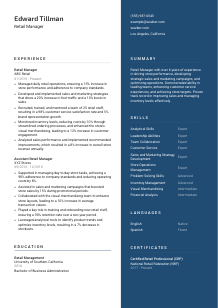
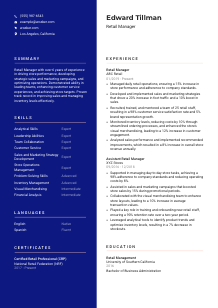
Calling the shots, but your resume feels off the shelf? Check out this Retail Manager resume example, created with Wozber free resume builder. Learn how to stock your management prowess to match job criteria, making your career journey as successful as those clearance sales!
Retail management sits at the point where sales targets, staffing, customer experience, and day-to-day execution all collide. Hiring teams want to see whether you can keep a store running cleanly while improving performance, whether that means lifting foot traffic, protecting margin, reducing stock issues, or coaching a floor team to stronger service standards.
When the resume is tailored well, that operational range becomes much easier to read in both ATS screening and human review. Wozber's free resume builder helps you align your wording with the posting, keep the document in an ATS-friendly resume format, and surface the parts of your background that show you can lead a store, hit targets, and manage retail complexity with confidence.
Retail hiring moves quickly, and the top of your resume should answer the practical questions first. For a Retail Manager, that means showing clear contact details, the exact target title, and any location match that removes friction before the hiring team gets into your sales and operations experience.
Your name should be the clearest line on the page, using a clean, professional format. Store leadership roles rely on presence and accountability, and your resume header should reflect that same straightforward professionalism.
Place "Retail Manager" under your name if that is the role you are pursuing. It immediately frames the rest of the resume around store leadership, team supervision, sales ownership, and operational accountability instead of leaving the reader to infer your direction.
List a phone number you answer, a professional email address, and check every character carefully. In retail hiring, interview scheduling often moves fast, especially for store-level leadership roles, so accuracy matters more than embellishment.
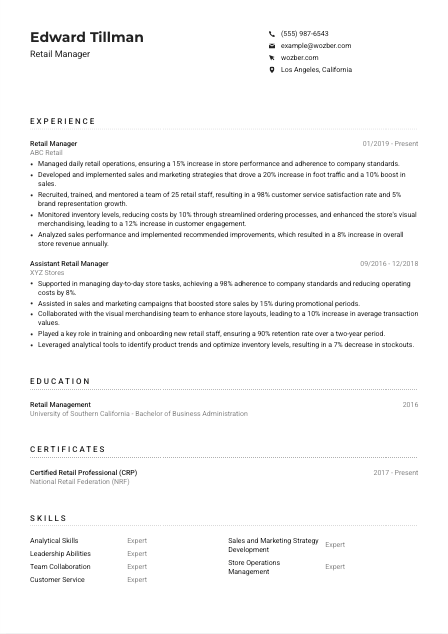
If a role requires local presence, include your city and state clearly. In the example, listing "Los Angeles, California" directly supports a stated requirement and saves the employer from guessing about relocation, commute, or start-date logistics.
Include LinkedIn or a relevant professional website only if it reinforces your management background. For retail leaders, that could mean a profile that supports your promotion history, multi-store exposure, merchandising work, or staff development record and matches the resume exactly.
This section should remove basic questions immediately and support the role you are targeting. Once your contact details, title, and location are clear, the hiring team can focus on whether your store leadership record matches the business need.




This is the section most retail employers read first. They want to know what kind of store environment you have led, how you influenced sales, how you handled staffing and inventory, and whether your decisions improved performance in ways that show up in revenue, service scores, shrink control, or operating efficiency.
Before editing your bullets, identify the business priorities in the opening. For a Retail Manager, those often include daily operations, sales growth, staff coaching, customer service, merchandising, inventory control, and trend analysis. Use those priorities to decide which achievements deserve space and which older bullets can be cut.
Start with your current or most recent position and make each entry easy to scan. Include job title, employer, and dates, then follow with accomplishment bullets that show progression from supporting store operations to owning results, budgets, team performance, or broader operational scope.
Retail management resumes stand out when they connect actions to business results. The example does this well with metrics such as a 15% increase in store performance, a 20% rise in foot traffic, and a 10% sales boost. Numbers like these show that your decisions affected traffic, conversion, revenue, customer satisfaction, or cost control rather than simply keeping the store running.
Focus on bullets that show ownership of store performance. Strong examples include hiring and mentoring associates, improving customer service scores, reducing stockouts, refining ordering processes, supporting visual merchandising, or making recommendations from sales trend analysis. Save less relevant accomplishments for another version of the resume.
Whenever possible, quantify the scale and impact of your work with measures a retail employer understands. That can include sales growth, average transaction value, customer satisfaction, retention, headcount trained, inventory accuracy, stockout reduction, labor efficiency, or annual revenue improvement. In the sample, even assistant-level work gains credibility because the bullets tie actions to operating cost reduction and promotional sales performance.
Your experience section should make it easy to picture you running the floor, leading the team, and improving store results. If the reader can quickly see sales impact, operational control, and people leadership, this section is doing its job.
Retail management hiring is usually led by performance history, but education still matters when the employer asks for a degree or values formal business training. Present it clearly so the hiring team can confirm the academic requirement and move on to your operating results.
If the posting calls for a bachelor's degree in Business, Retail Management, or a related field, make that easy to find. A degree such as a Bachelor of Business Administration in Retail Management directly supports the role because it reflects training in merchandising, operations, finance, and customer-facing business strategy.
List the institution, degree, field of study, and graduation year in a simple structure. Retail employers usually want to confirm qualifications quickly, not decode a heavily styled education section.
If your coursework or degree title clearly relates to retail, business operations, management, or marketing, do not hide that detail. In the example, the Retail Management field strengthens alignment with the employer's stated preference without needing extra explanation.
Early-career candidates may benefit from including coursework, honors, student leadership, or retail-related projects. Once you have several years of store leadership experience, those details usually matter less unless they connect directly to merchandising, analytics, or business performance.
This section does not need to tell your full academic story. It needs to confirm that your education supports the level of commercial judgment, leadership foundation, and business understanding expected from a Retail Manager.
Use education to confirm your formal background and support the business side of your management experience. In most cases, a clear and relevant entry is enough.
Certifications are rarely the deciding factor for a Retail Manager, but the right one can strengthen your profile, especially when it points to retail operations, leadership development, customer experience, or inventory and sales management. They work best as supporting proof of continued professional growth.
Start with certifications that reinforce the actual demands of store leadership. Programs tied to retail operations, customer service, sales management, loss prevention, merchandising, or team leadership will add more value than general certificates with no clear connection to the role.
Do not crowd this section with every course you have completed. A focused credential such as "Certified Retail Professional (CRP)" carries more weight because it maps directly to the retail environment and shows ongoing commitment to the field.
Certification dates help the employer understand whether your training is current. In retail, where systems, customer expectations, and merchandising practices shift over time, recent or actively maintained credentials are more persuasive than old, unsupported listings.
As you move into larger stores, district-level responsibilities, or more analytical retail environments, your certifications should evolve too. Add credentials that support the next level of responsibility, whether that is advanced leadership, financial analysis, or specialized retail operations training.
Relevant certifications can add depth to your management profile and show that your retail knowledge keeps moving forward. Keep the list selective and closely tied to store performance, team leadership, or operational excellence.
A Retail Manager skill list should read like the toolset behind real store results. The most useful mix combines commercial judgment, floor leadership, operational control, and customer-facing execution, all expressed in terms that match the job posting naturally.
Pull out the skills the employer names directly, then add closely related retail terms you genuinely use. In this posting, that includes analytical skills, problem-solving, leadership, team collaboration, sales performance, inventory oversight, and customer service. Matching that language helps ATS optimization while keeping the content relevant to the work.
Lead with the capabilities that drive store performance. For a Retail Manager, that usually means store operations management, sales strategy, staff leadership, customer service, inventory management, visual merchandising, and performance analysis before broader or less central abilities.
A shorter skills section is usually stronger if every item connects to daily retail management. The sample works because it balances leadership and operations skills with business-facing capabilities like financial analysis and sales strategy development. That gives the reader a clear view of how you run a store, coach a team, and respond to trends.
This section should confirm that your experience is backed by the right operating and leadership capabilities. When the skills line up with the posting and your bullet points support them, your resume feels much more credible.
Language skills matter in retail because managers communicate constantly, on the floor, in coaching conversations, during hiring, and with customers. If a posting specifies language ability, list it clearly. If you speak additional languages used in your market, that can strengthen your value in customer service and team leadership.
Look for explicit language expectations before you finalize this section. Here, English fluency is required, so it should appear clearly and without ambiguity.
Put English at the top when the role calls for it, and state your level accurately. A label such as "Native" or "Fluent" gives the employer quick confirmation that you can handle team communication, customer issues, reporting, and day-to-day store leadership in the required language.
Additional languages can be valuable in retail settings with diverse customer bases or multilingual teams. For example, Spanish can be useful in many store environments because it supports stronger service interactions and clearer staff communication, but it should remain an added advantage rather than a forced inclusion if it is not relevant to your market.
Choose clear levels such as "Native," "Fluent," "Intermediate," or "Basic." Retail employers may rely on these skills in real customer and staffing situations, so accuracy matters.
Languages are most useful when they support the work itself. On a Retail Manager resume, that means smoother customer service, clearer team coaching, stronger conflict resolution, and better communication in a diverse store environment.
If language skills support the market, customer base, or team environment, they deserve space on the resume. Keep the list accurate and relevant to how you lead and communicate in the store.
Your summary should give the employer a quick read on the level of store leadership you bring. In a few lines, it should establish your years of experience, the kinds of results you deliver, and the retail functions you handle well enough that the reader expects to see those claims backed up in the experience section.
Start with a direct statement of who you are professionally. For example, "Retail Manager with 6+ years of experience" immediately establishes your level, while the next phrase can define your strengths in store performance, sales growth, or operations management.
Use the summary to reflect the themes that dominate the job posting. In this case, those include driving sales, leading teams, improving store operations, mentoring staff, and analyzing performance trends. When those phrases reflect your actual background, they help the resume feel aligned from the first lines.
Aim for 3 to 5 lines with concrete retail language instead of broad personality claims. The sample summary works because it mentions store performance, strategic sales campaigns, team leadership, customer service, and inventory management without drifting into generic statements.
Retail Manager openings vary. One employer may care most about high-volume store operations, another about merchandising and customer experience, another about sales recovery and staff development. Adjust your summary so it reflects the business priorities of the role you are applying for, not just your default profile.
A well-written summary should tell the reader, within seconds, what kind of retail operation you can lead and what results tend to follow your management. Keep it concise, specific, and fully supported by the sections that follow.
Your Retail Manager resume should leave no doubt about three things: you can lead people, run store operations, and improve commercial performance. When your bullets show outcomes such as sales growth, stronger customer satisfaction, cleaner inventory control, or better team retention, hiring teams can quickly connect your background to the demands of the role.
Use Wozber's free resume builder to shape that experience into an ATS-compliant resume with clear structure, role-matched language, and stronger ATS optimization. Wozber's AI resume builder and ATS resume scanner can help you surface missing requirements, align your wording with the posting, and present your results in an ATS-friendly resume template that makes your store leadership easy to judge.
That is the standard your resume should meet before you apply.




