



Use Wozber and land your dream job
Create Resume
No registration required
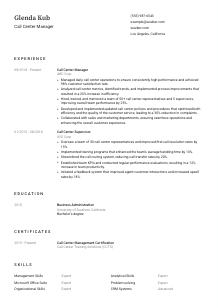
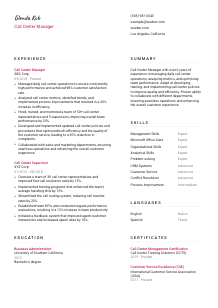
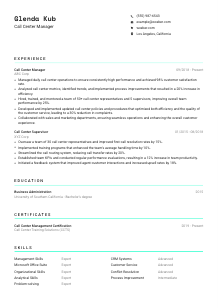
Ringing with managerial skills, but your resume gets put on hold? Dial in to this Call Center Manager resume example, built with Wozber free resume builder. Learn how to showcase your leadership in sync with job expectations, ensuring your career connection stays clear and responsive!
Call Center Managers are trusted with two things that show up quickly in results: team performance and customer experience. A hiring team scanning your resume wants to see whether you have led daily operations, improved service quality, and kept core metrics such as customer satisfaction, first-call resolution, efficiency, or complaint volume moving in the right direction.
When that track record is tailored to the job description, your background reads much faster in both human review and ATS screening. Wozber's free resume builder helps you align titles, keywords, and measurable outcomes into an ATS-friendly resume format, so the resume makes your operational scope and leadership results easy to recognize.
For a Call Center Manager, the header should do one practical job well: confirm who you are, what role you are targeting, and whether you meet any immediate screening requirements. Keep this section simple, accurate, and professional so nothing slows down the review.
Place your name at the top in a clean, readable format. Avoid decorative styling. For management roles in customer operations, a straightforward presentation helps the document feel professional and business-ready from the first line.
Add "Call Center Manager" directly under your name when that is the role you are applying for. This creates instant alignment with the posting and helps position your background around call center leadership rather than general customer service or support management.
List a reliable phone number and a professional email address you check regularly. Since call center leadership roles often move quickly once interviews begin, accuracy matters here. One typo in your phone number or email can cost you a follow-up.
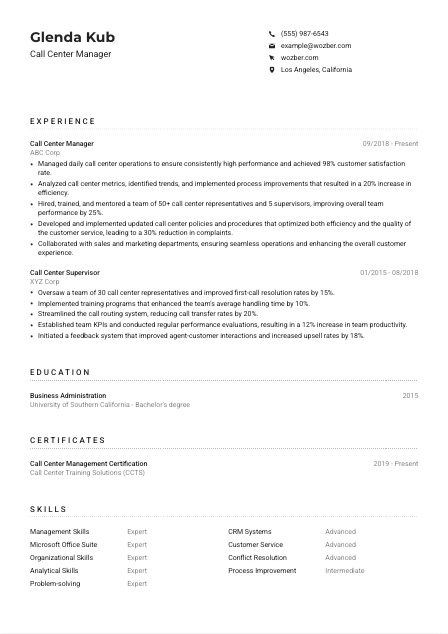
If the employer requires candidates to be based in a specific city or region, show that clearly in your header. In the example, listing Los Angeles, California immediately addresses a stated requirement. Use that approach when location is part of the screening process, but do not overemphasize it when it is not.
Include your LinkedIn URL or another professional profile if it supports your resume. Make sure it reflects your current title, team size, performance results, and operational scope, especially if you manage multi-shift teams, training programs, or service metrics.
This section does not need personality tricks. It needs precision. When your header confirms the target role, contact details, and any location requirement right away, the reader can move straight to your call center management experience.




This is the section that carries the most weight for a Call Center Manager. Hiring teams want to see how you led operations, coached supervisors or agents, managed service levels, and improved outcomes across the center. Duties matter, but results matter more.
Read the posting and pull out the work that defines success in the job. For this opening, that includes daily call center operations, KPI and SLA performance, process improvement, hiring and mentoring, policy development, and cross-functional coordination. Shape your bullets around those same areas so your experience lines up with how the role is actually run.
List each position in reverse chronological order with job title, company, and dates. That format helps the reader quickly understand your progression from team supervision into full call center management. For this field, title progression often tells an important story about growing responsibility for staffing, quality, and performance management.
Replace generic responsibility statements with outcomes tied to service delivery and team performance. The sample does this well with bullets such as achieving a 98% customer satisfaction rate and reducing complaints by 30% after updating policies and procedures. Those are the kinds of results that show you can manage both the people side and the process side of a call center.
Call center hiring is heavily metrics-driven, so quantify wherever you can. Useful measures include customer satisfaction, first-call resolution, average handling time, complaint reduction, efficiency gains, transfer rates, productivity, upsell performance, and team size. The example's 20% efficiency gain and supervision of 50+ representatives give immediate scale and business impact.
Prioritize experience that shows staffing oversight, quality management, coaching, reporting, workflow improvement, and collaboration with departments such as sales, marketing, or operations. If an older bullet does not strengthen your case for leading a service team or improving performance, trim it and use the space for stronger management evidence.
A Call Center Manager resume should make it easy to see the scope you handled and the outcomes you delivered. When your experience section shows team leadership, KPI ownership, and process improvement with real metrics, your qualification becomes much easier to judge.
Education is usually a quick checkpoint in this kind of hiring process, especially when the posting names a degree requirement. Present it clearly so the reviewer can confirm the academic baseline without hunting for it.
If the posting asks for a Bachelor's degree in Business or a related field, list that qualification clearly. In the example, "Bachelor's degree, Business Administration" aligns directly with the requirement. Use the official degree and field name so there is no ambiguity in ATS or human review.
Include the school name, degree, field of study, and graduation year or dates. A clean format is enough here. Unless you are early in your career, this section does not need extra detail to do its job.
If your degree is closely tied to operations, business, management, customer service, or analytics, that connection strengthens your resume. You usually do not need to list courses unless they add real value, but they can help if your background needs a clearer link to leadership or service operations.
Call Center Managers often balance staffing, reporting, efficiency, and customer experience. A degree in business, management, communications, or a related field can support that profile, especially when your experience also shows KPI ownership and team development.
If you have completed additional management, service excellence, workforce planning, or operations training, mention it when it strengthens the picture. For an experienced candidate, this can show that your learning has kept pace with changing service standards and leadership expectations.
This section should confirm that you meet the academic requirement and support the management story your experience already tells. Clear degree details are usually enough, especially when the rest of the resume shows strong call center results.
Certifications are rarely the main hiring factor for Call Center Managers, but the right ones can strengthen your profile. They work best when they reinforce areas employers already care about, such as service quality, leadership, coaching, process improvement, or customer experience.
Review the job posting first. If it does not require a certification, choose ones that still support the role's real demands. For call center leadership, useful topics include management, customer service excellence, quality assurance, performance coaching, or operational improvement.
Lead with certifications that connect directly to running a call center. In the example, "Call Center Management Certification" and "Customer Service Excellence" both reinforce the candidate's fit. A certificate should help explain how you lead service teams or improve customer outcomes, not simply fill space.
Add the issue date or active period, especially if the credential reflects current practices in service operations or management. Fresh dates can help show that your approach to coaching, quality, or customer experience is current rather than outdated.
A short list of relevant certifications reads better than a long list of loosely related training. Focus on the credentials that support your work as a people leader, operations manager, or customer service strategist, and remove anything that no longer adds value.
Certifications should back up the management and service strengths already visible elsewhere in your resume. Chosen well, they add another layer of credibility around coaching, operations, and customer experience.
The skills section should reflect how call center managers are hired and measured. That means a mix of leadership, operational control, reporting ability, and tool familiarity. Generic soft skills on their own will not carry this section.
Look for both explicit requirements and implied day-to-day demands. In this job description, that includes leadership, organization, time management, call center software, CRM systems, Microsoft Office Suite, and KPI or SLA performance. Those terms belong in your skills section if they match your real background.
List the skills that matter most to running a center before broader strengths. Team leadership, workforce oversight, coaching, performance management, process improvement, customer service operations, and conflict resolution should usually appear before more general business skills.
Grouping skills can make this section easier to read. For example, place CRM systems, call center platforms, reporting tools, and Microsoft Office Suite together, then group leadership, training, KPI management, and process improvement separately. That organization reflects the practical mix of systems knowledge and people management the role requires.
A useful Call Center Manager skills section should quickly show two things: you can run the systems and you can lead the team. Keep the mix focused on the tools, workflows, and management capabilities that drive service performance.
Language ability can be a real advantage in call center leadership, especially in teams serving diverse customer bases. Still, this section should stay factual and tied to communication needs, not padded with broad claims.
If the role requires working in English, list English clearly with the appropriate level. In this posting, operating in an English-speaking work environment is a stated requirement, so that should be obvious in your resume.
Extra languages can strengthen your profile when they relate to the customer population, team communication, or business market. In some call centers, Spanish or other high-volume customer languages may be especially useful, but only include languages you can genuinely use in a professional setting.
Choose clear labels such as "Native," "Fluent," "Intermediate," or "Basic." For management roles, overstating language ability can become a problem quickly if the job involves coaching staff, handling escalations, or coordinating across teams in that language.
Additional languages are most valuable when they improve communication with customers, agents, or partner teams. They can support coaching, de-escalation, and service consistency, especially in high-volume or regionally diverse operations.
You do not need to turn this into a major selling point unless languages are central to the role. A short, accurate list is enough. The main benefit is showing communication range where it supports customer experience and team leadership.
For a Call Center Manager, language skills matter when they improve communication on the floor or with customers. Present them clearly, rate them honestly, and let them support the broader operations story in your resume.
Your summary should quickly establish your level, your operating scope, and the kind of results you deliver. For a Call Center Manager, that usually means years of experience, leadership responsibility, and a few metrics or outcomes that show control over performance.
Start with a direct introduction such as "Call Center Manager with 6+ years of experience" or a version that reflects your real background. That immediately frames your seniority and tells the reader they are looking at a candidate with management-level exposure.
Build the next line around the strengths the employer cares about most, such as leading daily operations, analyzing call center metrics, mentoring supervisors and agents, improving service quality, or managing customer satisfaction. Keep this focused on the role rather than broad leadership language.
A summary becomes much stronger when it includes proof. The example uses outcomes such as improving efficiency and strengthening customer experience. If you have metrics like customer satisfaction scores, complaint reduction, first-call resolution gains, or team productivity improvements, include one or two that reflect your best management work.
Aim for a short paragraph that reads cleanly in a few seconds. Avoid repeating every skill from the rest of the resume. The summary should give a hiring manager a fast picture of your call center leadership profile and make them expect strong detail in the experience section.
The best summary for this role reads like someone who has already owned performance, coached teams, and improved customer outcomes. Keep it concise, measurable, and anchored in actual call center operations.
A Call Center Manager resume should leave little guesswork about your leadership scope, metric ownership, and impact on customer service operations. When each section reflects the posting's real priorities, from degree requirements to KPIs and CRM familiarity, the document reads as a focused management application rather than a general customer service resume.
Use Wozber's free resume builder to shape that content into an ATS-compliant resume, refine role-specific wording with AI support, and check alignment with an ATS resume scanner. The result should make one thing clear fast: you can lead a call center team, improve performance, and keep service standards on track.




