



Use Wozber and land your dream job
Create Resume
No registration required
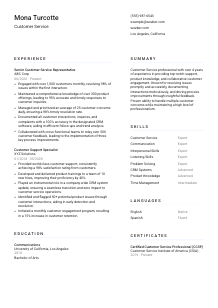
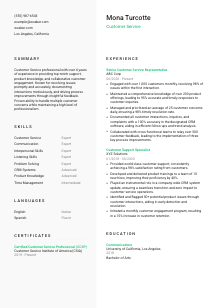
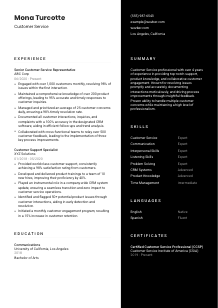
Resolving queries, but your resume has a busy tone? Check out this Customer Service resume example, created with Wozber free resume builder. Learn how to channel your service savvy to match job expectations, ensuring your career calls are always answered!
Customer service hiring moves quickly, but the work itself is not simple. Teams need people who can stay calm with frustrated customers, keep product details straight, document every interaction correctly, and move issues toward resolution without dropping speed or empathy. Your resume should make that operating standard visible from the first few lines.
When customer service resumes are tailored well, employers can immediately tell whether your background lines up with their support environment, whether that means high call volume, retail traffic, or ticket-based workflows. Wozber's free resume builder helps shape that experience into an ATS-compliant resume by aligning your wording with the job description and keeping the structure clean. That makes it easier for a hiring team to see how you handle customer volume, service quality, and follow-through.
Customer service roles depend on fast contact, clear communication, and practical availability. Your personal details section should confirm those basics right away, with no clutter and no missing information that could slow down a hiring decision.
Use your full name in a slightly larger, clean font so it anchors the page immediately. Customer service resumes are often reviewed in batches, and clear identification helps your application read as organized before anyone reaches your experience section.
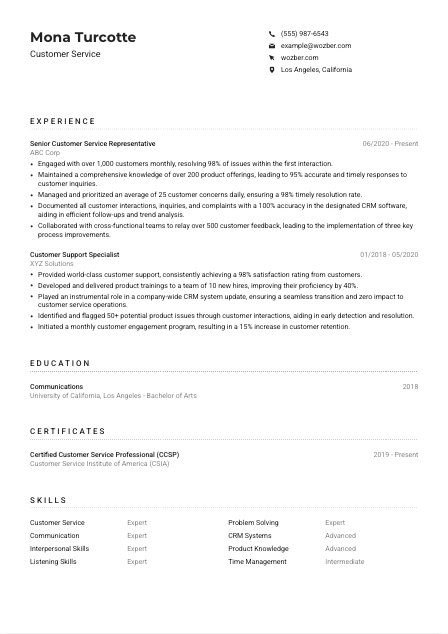
Place the exact or closely matched title beneath your name, such as "Customer Service" or "Customer Service Representative" if that better matches your background. This helps frame your resume around support work rather than a broader admin or retail profile. In the example, the simple title keeps the focus on customer-facing experience from the start.
List a phone number you answer reliably and a professional email address based on your name. In customer service hiring, responsiveness matters, so even this section should reflect reliability. If you include a website or LinkedIn profile, make sure the information there matches your resume and supports your service background.
If an employer requires candidates to be based in a specific city or state, include that clearly. Here, "Los Angeles, California" directly addresses a stated requirement. For other customer service roles, city and state are usually enough unless the employer asks for something more specific.
A LinkedIn profile, portfolio, or professional site can strengthen your application if it adds context, such as endorsements, service awards, training, or bilingual communication strengths. Skip links that do not support your customer-facing work. Every item here should reinforce professionalism and accessibility.
This section does not need personality flourishes. It needs accuracy, professionalism, and any logistical details the employer has already flagged, including location when required.




Experience is where customer service resumes either become credible or stay generic. Employers want to see what kind of customer volume you handled, how you resolved issues, how well you documented work in CRM or help desk systems, and whether your support improved response quality, satisfaction, or retention.
Before you rewrite anything, mark the duties and requirements that define the role. In this posting, the priority areas are customer issue resolution, product knowledge, CRM documentation, multitasking, and professional communication in English. Those themes should shape which accomplishments you surface first and how you phrase them.
List each job in reverse chronological order with employer name, title, and dates. That format lets hiring teams quickly see whether you meet the requested 2+ years of customer service experience and whether your background comes from settings such as call centers, retail, or support teams with similar pace.
Do not stop at saying you answered questions or handled complaints. Show what happened because of your work. Strong customer service bullets mention issue resolution, response quality, escalation handling, documentation accuracy, or customer satisfaction. The sample resume does this well by tying day-to-day support to outcomes like first-contact resolution and process improvements.
Metrics carry real weight in customer service hiring. Include figures such as customers handled per day or month, resolution rates, satisfaction scores, response time, retention impact, training results, or documentation accuracy. In the example, numbers like 1,000 customers monthly, 98% issue resolution, and 100% CRM documentation accuracy give the reader a concrete picture of pace and consistency.
Prioritize experience that shows communication under pressure, product or service knowledge, CRM use, and coordination with other teams. If you have older or less relevant work, trim it down unless it shows transferable strengths like complaint handling, sales-floor support, or high-volume communication. Each bullet should help an employer picture you handling real customer demand in their environment.
Well-written experience bullets make your customer service style tangible. They show how you manage volume, resolve issues, document accurately, and contribute beyond the individual interaction.
Education usually plays a supporting role in customer service hiring, but it still adds context. It can show communication training, business awareness, or early preparation for customer-facing work, especially when your degree or coursework connects to service delivery, conflict handling, or team communication.
List your highest completed education first. If your degree relates to communication, business, psychology, or another field that supports customer interaction, that connection is worth making visible. The example's BA in Communications works well because customer service depends on clear explanation, listening, and tone control.
Include the school name, degree, field of study, and graduation year or completion date. Keep it straightforward. Hiring teams reviewing customer service resumes do not need a long academic narrative here. They need quick confirmation of your educational background.
If your studies helped build communication, conflict resolution, writing, or interpersonal skills, let that relevance come through naturally through the field of study or degree name. You do not need to over-explain it, but you should not hide useful alignment either.
Relevant coursework can help if you are early in your career or moving into customer service from another field. Classes in communications, consumer behavior, business operations, or technology systems can add context when your professional experience is still growing.
Student leadership, peer support roles, volunteer help desks, or service-oriented campus work can add value when they show communication, reliability, or problem-solving. Skip generic activities that do not connect to customer interaction or teamwork.
Education should support the rest of the resume, not compete with it. Include the details that strengthen your customer-facing profile and leave out the rest.
Certificates matter most when they sharpen your service toolkit. They can show formal training in customer support, communication, CRM platforms, conflict resolution, or product knowledge, all of which can help when an employer wants someone who can contribute quickly.
List certifications that connect to customer service delivery, support systems, or communication quality. A customer service credential, CRM training, or help desk platform certification is much more useful here than a broad unrelated course.
Focus on certificates that help explain why you can handle the environment you are applying to. In the example, the Certified Customer Service Professional credential supports the candidate's focus on service excellence and gives extra weight to an already customer-centered background.
Certification dates help employers understand whether your training is current. That matters when the certificate relates to active tools, service standards, or support workflows that change over time. If a certification is ongoing or renewable, note that clearly.
Customer service work evolves with new products, support platforms, and customer expectations. Short courses in de-escalation, customer retention, CRM systems, or written support can strengthen future applications, especially if you are aiming for a more specialized support team.
A certificate section works best when it backs up the kind of customer service work you want next. Keep it focused on training that improves support quality, system fluency, or customer communication.
Customer service skills should read like tools you use on the job, not a grab bag of soft traits. Hiring teams look for a mix of communication ability, issue resolution, product understanding, time management, and system fluency, especially with CRM or help desk software.
Start with the language the employer already uses. Here, that includes communication, interpersonal skills, active listening, CRM systems, help desk platforms, product knowledge, and the ability to manage multiple customer concerns at once. These are the first skills a hiring team will look for on the page.
Choose skills that reflect how you actually worked. If you handled a ticket queue, mention CRM systems or help desk platforms. If you worked in retail or a call center, add customer service, problem solving, de-escalation, and time management if those are genuine strengths. The example skill list stays close to the posting, which helps the resume feel aligned without overcomplicating the section.
Do not overload this section with every trait you have ever used. Prioritize the skills that support the target role and that also show up in your experience bullets. A shorter list with real backing is far more convincing than a long list of unsupported claims.
The best skills section mirrors the job description and is supported by your work history. If a skill matters for customer service, your experience should show how you used it under real customer demand.
Language ability can matter a great deal in customer service because every shift depends on clear explanation, accurate listening, and tone. When a posting names a required language, treat it as a core qualification rather than a small extra detail.
If the job description specifies English, list it clearly with an honest proficiency level. In this case, English is required, so it should be easy to find in your languages section and consistent with the communication level reflected across the resume.
Additional languages can be a real advantage in customer service, particularly in diverse markets, retail settings, or teams serving broad customer bases. The example includes Spanish, which can strengthen a candidate's profile in many customer-facing environments, though it is not a universal requirement.
Use clear levels such as native, fluent, professional, or conversational. Overstating language ability creates problems quickly in customer service roles, where misunderstandings can affect resolution quality and customer trust.
If the employer serves multilingual customers, language skills can support faster issue handling and a better customer experience. Mention them when they are relevant, but keep the focus on languages you can use confidently in live interactions, calls, chats, or in-person service.
Language ability improves with use. If bilingual service is part of the roles you are targeting, keep practicing the vocabulary and tone needed for customer conversations, product explanations, and complaint resolution so the claim remains practical, not just decorative.
For customer service work, languages are valuable when they improve communication quality and customer access. List them clearly and honestly so employers can judge where they add real support value.
Your summary sets the tone for the rest of the resume. In customer service, it should quickly establish your years of experience, the type of support environment you know, and the results you deliver, whether that means high satisfaction, fast resolution, accurate documentation, or strong product guidance.
Review the posting and identify the few themes that matter most. For this one, that includes customer communication, issue resolution, CRM documentation, product knowledge, and the ability to manage multiple concerns at once. Those priorities should shape the language of your summary.
Your first line should identify you as a customer service professional and state your relevant experience clearly, such as "Customer Service professional with 4+ years of experience in call center and retail support environments." This immediately gives the employer context for the rest of the resume.
Follow with two or three specifics that show how you work. Mention customer volume, satisfaction scores, first-contact resolution, CRM accuracy, product expertise, or collaboration with operations teams if those reflect your background. The example summary works because it highlights prompt resolution, accurate documentation, and process improvement rather than relying on generic claims about being people-focused.
Finish by reinforcing the strengths most relevant to the opening, such as handling multiple concerns, maintaining professionalism, or giving accurate product information. The summary should read like a compressed version of your best-fit experience, not a personal mission statement.
A sharp customer service summary gives the hiring team a fast read on your support style, operating range, and reliability. Keep it specific enough that they can already picture you on the front line.
A customer service resume works when it shows how you communicate, how you resolve issues, how you handle volume, and how accurately you document the work. Tailor each section to the job description so those strengths show up in the same language the employer uses.
With Wozber's free resume builder, ATS-friendly resume templates, and ATS resume scanner, you can align your content with the role, tighten your wording, and build an ATS-friendly resume format that keeps key qualifications visible. The finished resume should make one thing clear fast: you can step into customer conversations and handle them well.




