



Use Wozber and land your dream job
Create Resume
No registration required
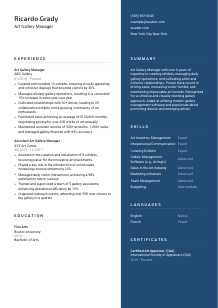
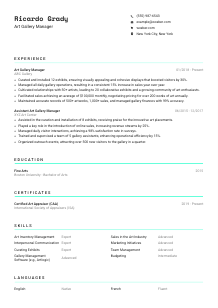
Curating creativity, but your resume feels like a blank canvas? Check out this Art Gallery Manager resume example, created with Wozber free resume builder. Learn how to blend your artistic vision with job demands, making sure your career hangs in the perfect frame!
Gallery management sits at the intersection of curatorial judgment and commercial execution. Hiring teams want to see that you can build exhibitions that feel cohesive in the room, keep daily operations running smoothly, and turn artist and collector relationships into repeat visits, sales, and a stronger reputation for the gallery.
A tailored resume helps separate gallery managers who have only supported events from those who have owned programming, sales conversations, and records management. Using Wozber's free resume builder to shape an ATS-compliant resume makes it easier to match your experience to the posting's language, from exhibit installation to inventory accuracy, so your application reads like someone ready to run the space.
This section should confirm the basics quickly. For an Art Gallery Manager, that means clear contact information, the target title, and any location detail that directly answers the employer's stated requirement.
Use your full name as the most visible text at the top of the resume. Keep the formatting clean and professional so it reads easily in an ATS-friendly resume format and looks polished when a director, owner, or hiring manager opens the file.
Place "Art Gallery Manager" directly under your name if that is the role you are targeting. This immediately aligns your resume with the posting and avoids any confusion if your recent title was broader, such as gallery coordinator, assistant manager, or museum operations lead.
Include a phone number and professional email address that are easy to scan and error-free. Gallery hiring often moves through quick follow-ups around interviews, exhibition schedules, or event coverage, so your contact details should never slow that down.
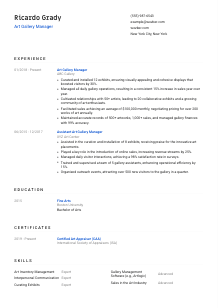
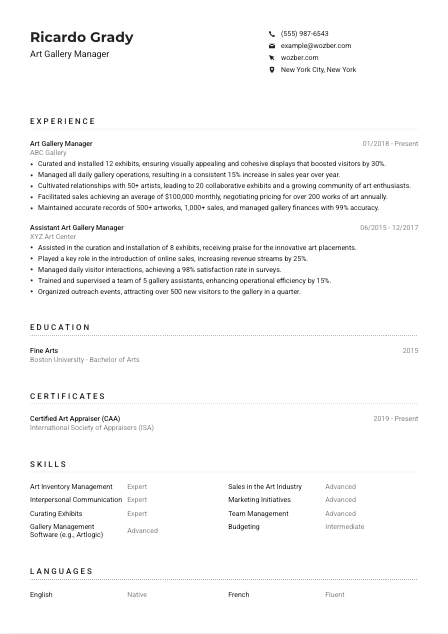
If a role requires local availability, list your city and state clearly. In the example, "New York City, New York" directly answers the employer's location requirement, which matters more here than in roles where relocation is open.
A LinkedIn profile, portfolio site, or gallery project page can strengthen this section if it shows exhibitions, programming, press mentions, or artist collaborations. For gallery management, a link is useful when it supports your record of curation, sales activity, or community engagement rather than acting as a generic placeholder.
Personal details do not need flair. They need to confirm that you are reachable, locally viable when required, and applying for the exact gallery leadership role in front of you.




This is where hiring teams look for proof that you can manage both the public-facing and behind-the-scenes work of a gallery. Your bullets should show exhibitions delivered, sales closed, artists supported, visitors engaged, and records kept under control.
Before rewriting your experience, pull out the responsibilities that define the job. For this kind of role, that usually includes exhibition curation and installation, sales, artist and collector relationships, staffing, marketing support, budgeting, and inventory control. Those priorities should shape which achievements you feature first.
Start with your most recent gallery, museum, or art center role and work backward. This structure helps hiring teams see your current level of ownership quickly, especially if you progressed from assistant gallery management into full operational leadership.
Describe what changed because of your work. Instead of saying you "handled exhibits" or "managed sales," show the result through visitor growth, revenue, number of works sold, exhibition count, artist partnerships, or finance accuracy. The example does this well by tying exhibit curation to a 30% increase in visitors and sales activity to average monthly revenue.
Quantify the scope of your work with metrics that matter in this field: exhibits installed, artists represented, visitors attracted, works sold, monthly sales volume, outreach event attendance, shipment volume, or record accuracy. Figures like "500+ artworks tracked" or "99% accuracy" give hiring teams a much clearer view of operational control than general claims about being organized.
Prioritize experience that reflects gallery operations, commercial performance, and relationship management. If you have broader arts experience, keep the bullets that show exhibition delivery, sales support, donor or collector interaction, marketing initiatives, or staff supervision, and trim unrelated detail that does not strengthen your case for managing a gallery space.
The best experience sections make two things obvious: you can create an engaging exhibition environment, and you can keep the business side of the gallery performing. That balance is what this role is hired for. Wozber's ATS-friendly resume templates help present that track record clearly while keeping the structure easy to scan.
Gallery employers usually expect formal grounding in art, whether through art history, fine arts, or a related discipline. Your education section should confirm that foundation quickly and without extra clutter.
When the posting asks for a bachelor's degree in Art History, Fine Arts, or a related field, make sure that credential is easy to find. If your degree is closely aligned, list it clearly so the requirement is satisfied without the reader having to interpret it.
List your degree, field of study, school, and graduation year in a consistent format. For most Art Gallery Manager roles, this section is a qualification check rather than a storytelling section, so clarity matters more than detail.
If your degree is in Fine Arts, Art History, Museum Studies, or a comparable field, that alignment is worth stating plainly. In the example, a Bachelor of Arts in Fine Arts maps directly to the employer's request and reinforces subject-matter credibility.
You do not need to list coursework unless it adds something useful, such as curatorial studies, arts administration, exhibition design, or collection management. This is especially helpful if your degree title is broad or your experience is still developing.
Honors, scholarships, curated student exhibitions, or museum internships can add value when they connect to gallery work. Keep them if they support your professional direction and remove them if your experience section already carries the stronger evidence.
Education should reassure the reader that you understand the artistic and professional context of the work. Once that is clear, let your exhibitions, sales results, and operational experience do the heavier lifting.
Certifications are not mandatory for every gallery management role, but the right ones can sharpen your profile. They are most useful when they reinforce expertise tied to valuation, collections, appraisals, arts administration, or relevant systems.
Choose credentials that connect to gallery responsibilities, not just general professional development. For this field, that might include art appraisal, collection care, museum studies, art business, or software training tied to inventory and gallery management workflows.
If a certification strengthens your authority in pricing, authenticity, artwork handling, or collection oversight, place it here. The example's Certified Art Appraiser credential is a good illustration because it supports commercial judgment and credibility in sales conversations.
Include the year earned and, if relevant, the active date range. That helps employers understand whether the credential reflects current professional knowledge, especially in areas tied to valuation standards or evolving gallery systems.
The gallery world changes through new sales channels, digital inventory practices, collector behavior, and exhibition formats. Ongoing certification can support your resume when it reflects real developments in the work, such as online sales operations or collection software proficiency.
A certificate should add something your experience and education do not show on their own. When it deepens your authority in sales, appraisal, collections, or gallery operations, it earns the space.
Art Gallery Manager roles require a mix of aesthetic judgment, commercial ability, and operational control. Your skills section should reflect that full picture instead of leaning only on creative or only on administrative strengths.
Start with the language used in the posting. Here, that includes exhibit curation and installation, gallery operations, staffing, budgeting, marketing initiatives, sales, negotiation, recordkeeping, and familiarity with gallery management software. Build your list from skills you genuinely use in those areas.
A gallery manager needs more than taste. Include hard skills such as art inventory management, budgeting, shipping coordination, and software use, alongside interpersonal strengths like artist relations, collector communication, and negotiation. The example strikes this balance with inventory management, curating exhibits, software proficiency, sales, and team management.
Group or order your skills so the most relevant ones appear first. You might lead with exhibition and sales capabilities, then operational tools, then team and communication strengths. This makes it easier for both ATS screening and human review to connect your skill set to the gallery's day-to-day needs.
This section should show that you can shape the visitor experience, support artists, and manage the business mechanics behind the walls. Wozber's ATS resume scanner can help you tune the wording to the posting and strengthen ATS optimization without turning the list into keyword clutter.
Communication matters in galleries because the role often involves artist conversations, collector outreach, event hosting, and written material tied to exhibitions or sales. Language skills are worth listing when they improve how you can serve the audience around the gallery.
If the posting specifies English proficiency, list English first and indicate your level clearly. In this job description, superior English is a stated requirement, so it should be unmistakable on the resume.
Terms such as Native, Fluent, Intermediate, and Basic work well because they are widely understood. Clear language levels matter in roles that rely on tours, artist communication, client correspondence, and sales discussions.
Additional languages can be valuable in galleries that work with international artists, collectors, tourists, or multilingual communities. They are not a substitute for gallery experience, but they can strengthen a profile when relationship-building is central to the role.
Only claim a level you can use in practice. If you might need to discuss artwork, negotiate pricing, explain an exhibition concept, or coordinate logistics in that language, your stated proficiency should hold up in conversation.
Language skills become more relevant when the gallery participates in international fairs, works with overseas artists, or serves a diverse local collector base. In the example, French adds a useful secondary strength because it can support communication within parts of the global art market.
This section works best when it reflects how you actually engage with artists, buyers, and visitors. Keep it honest, clear, and tied to the audience your target gallery serves.
Your summary should read like a concise professional introduction, not a string of generic strengths. For an Art Gallery Manager, it should quickly connect your years of experience to exhibitions, sales performance, operational leadership, and relationship-building in the art sector.
Review the posting and decide which parts of your background most directly match it. For gallery management, that usually means a blend of curatorial work, sales results, artist and collector engagement, and operational oversight. Those are the points your summary should foreground first.
Open with your title or professional identity, followed by your years of experience and the environment you have worked in, such as galleries, art centers, museums, or commercial art spaces. This gives immediate context for the rest of the resume.
Mention the capabilities that define your value in this field, such as increasing footfall, driving artwork sales, managing exhibition programs, maintaining accurate records, or building strong artist networks. The example summary works because it combines experience, measurable commercial impact, and software fluency in a few lines.
Aim for a short paragraph that can be read quickly. Avoid broad claims about passion or creativity unless they are backed by something specific, such as curating successful exhibitions, promoting emerging artists, or improving gallery performance through programming and outreach.
A well-written summary gives the reader an immediate sense of your scope, from exhibition leadership to sales and records management. Once that framing is in place, the experience section can supply the detail and numbers behind it.
An Art Gallery Manager resume needs to show more than taste. It should connect curatorial work to sales performance, daily operations, artist relationships, and accurate inventory or finance records. When those pieces are clear, hiring teams can quickly see whether you can manage both the gallery experience and the business behind it.
Use Wozber's free resume builder to structure that story in an ATS-friendly resume template, then refine the wording with its ATS resume scanner so your exhibitions, revenue results, software knowledge, and community-building work match the role you are targeting. The finished resume should make your gallery leadership easy to recognize.