



Use Wozber and land your dream job
Create Resume
No registration required
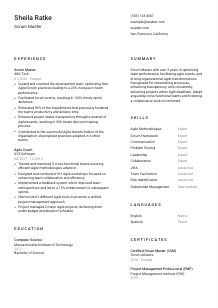
Mastering sprints, but your resume hits roadblocks? Check out this Scrum Master resume example, created with Wozber free resume builder. It shows how to showcase your agile leadership in a way that clicks with job calls, paving the way for your career to sprint ahead!
Scrum Master resumes are often too vague about the work that actually matters. Hiring teams want to see how you improved sprint flow, coached teams through Agile adoption, cleared blockers, and made delivery progress visible through ceremonies, boards, and team habits that held up over time.
The difference a tailored resume makes here is simple. It helps reviewers quickly tell whether your experience is rooted in active facilitation and team enablement or in broader project coordination. Wozber's free resume builder helps you shape that distinction into an ATS-compliant resume by aligning your wording with the job description and surfacing the Scrum practices, tools, and delivery outcomes that matter first.
For a Scrum Master, the header should feel organized, current, and easy to act on. This role depends on clear communication and low-friction coordination, so even your contact section should reflect that same discipline.
Use your full name as the most visible text at the top of the page. Keep the styling professional and readable. For a Scrum Master resume, that clean presentation sets the tone before the hiring team even reaches your sprint metrics, facilitation work, or Agile coaching experience.
Place "Scrum Master" directly under your name when that is the role you are pursuing. Matching the target title helps recruiters and ATS systems categorize your resume quickly, especially when they are sorting between Scrum Masters, Agile Coaches, Delivery Leads, and Project Managers.
Include a reliable phone number and a professional email address, then check both for errors. If you add a website or LinkedIn profile, make sure it supports your resume with the same role focus, such as Agile transformation work, team coaching, certifications, or delivery results.
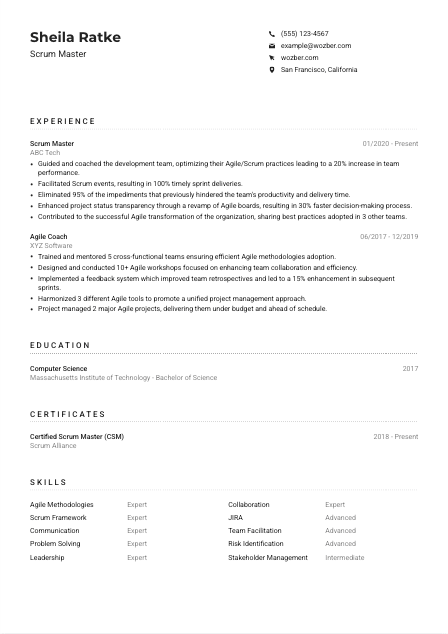
If a posting includes a location requirement, reflect it plainly in your header. Here, listing "San Francisco, California" directly addresses the employer's stated requirement and removes uncertainty about whether you are local or available to work from that market.
A LinkedIn profile or personal site can strengthen your application when it shows consistent Agile and Scrum experience. Keep the content aligned with your resume, including titles, dates, certifications, and major outcomes like team performance gains or cross-team Agile rollout work.
This section should answer the basics immediately and remove avoidable questions. Clear contact details, the right title, and a location match when required let the reader move straight to your Scrum leadership and delivery record.




This is the section where a Scrum Master resume usually stands or falls. Titles alone do not tell much. Hiring teams need to see how you facilitated ceremonies, improved delivery rhythm, handled impediments, and supported teams through real execution challenges.
Before rewriting bullets, pull out the operating priorities from the job description. For this role, those include coaching on Agile and Scrum practices, facilitating stand-ups and sprint ceremonies, removing impediments, maintaining transparency through boards and documentation, and contributing to Agile transformation. Use those priorities to decide which accomplishments belong near the top of each role.
List your experience in reverse chronological order with job title, employer, and dates clearly shown. That clean structure matters for ATS parsing and for hiring managers reviewing several Agile candidates quickly. A Scrum Master who presents work history clearly already signals comfort with cadence, visibility, and orderly documentation.
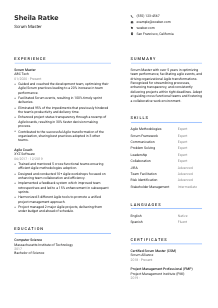
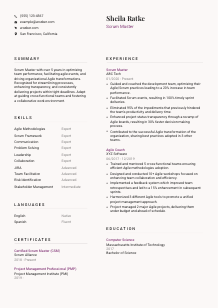
Focus each bullet on what changed because of your work. Good Scrum Master bullets often cover improved sprint predictability, faster blocker resolution, stronger retrospective follow-through, better board hygiene, or broader Agile adoption. In the example resume, "20% increase in team performance" and "100% timely sprint deliveries" work well because they connect facilitation to delivery outcomes instead of describing routine duties.
Quantify your impact with measures that make sense for Scrum environments. Depending on your work, that could include sprint completion rate, reduction in impediment cycle time, team velocity stability, adoption across multiple squads, release frequency, or faster stakeholder decision-making. The sample's "95% of impediments eliminated" and "30% faster decision-making" are strong because they show operational improvements a Scrum Master directly influences.
Keep the section centered on Agile facilitation, coaching, team dynamics, delivery support, and transparency. If you have broader project or operations achievements, include them only when they reinforce your Scrum work. The goal is to make your resume read like someone who has enabled teams to deliver consistently, not someone with a generic mix of coordination tasks.
By the end of this section, a reviewer should understand the teams you supported, the ceremonies and workflows you ran, and the delivery improvements you helped create. That is the clearest proof that you can step into an active Scrum Master seat and add value quickly.
Education usually plays a supporting role on a Scrum Master resume, but it still matters when a posting asks for a specific academic background. Present it clearly and let it confirm that you meet the baseline requirement without distracting from your Agile experience.
When the job asks for a bachelor's degree in Computer Science, Information Systems, or a related field, make sure your degree is easy to find. If your background matches directly, say so plainly. In the example, a Bachelor of Science in Computer Science aligns neatly with the requirement.
List the degree, field of study, school, and graduation year in a consistent order. This section does not need extra styling or long descriptions. A straightforward format keeps the focus on the qualification itself and supports clean ATS reading.
Name the discipline fully rather than relying on abbreviations or broad labels. "Computer Science" or "Information Systems" gives the employer a clearer connection to the technical environment many Scrum Masters support, especially when working with software delivery teams.
If you are earlier in your career, a short note on coursework in software engineering, systems analysis, product development, or project management can add useful context. For experienced Scrum Masters, this is usually unnecessary unless it strengthens a clear link to the role.
Honors, leadership roles, or academic projects can be worth adding if they reinforce facilitation, collaboration, or technical fluency. Keep these extras brief. Once you have several years of Scrum or Agile experience, your delivery record should remain the main focus.
This section only needs to confirm that you meet the academic baseline and understand the environment your teams work in. Clear degree information is enough when the rest of the resume already shows strong Scrum practice.
Certifications matter more for Scrum Master hiring than they do in many adjacent roles because they show formal grounding in Scrum principles and Agile practice. When a posting specifically names a credential, your resume should surface it quickly.
If the employer asks for Certified Scrum Master or an equivalent Agile credential, put that certification first. In this case, listing "Certified Scrum Master (CSM)" prominently creates an immediate match and supports your credibility before the reviewer even reaches your experience bullets.
Prioritize certifications that reinforce Scrum facilitation, Agile coaching, delivery leadership, or team effectiveness. Additional credentials such as PMP can still help when they support cross-functional coordination or broader delivery oversight, but they should not overshadow your Scrum-specific qualifications.
Include the year earned and any active date range when relevant. This is especially useful for credentials that require renewal or continuing education, because it shows that your knowledge is current and maintained rather than stale.
If you are building beyond a core Scrum credential, include certifications or training that deepen your practice in Agile coaching, scaled frameworks, facilitation, or servant leadership. That continued learning matters because Scrum Master work often expands from one team into broader transformation efforts.
A well-ordered certifications section tells the reader you meet the formal expectations of the role and continue investing in Agile practice. For Scrum Master applications, that can be a meaningful tie-breaker when candidates have similar experience.
A Scrum Master skills section should show more than generic leadership traits. It needs to reflect the mix of facilitation, Agile process knowledge, tooling, and interpersonal judgment that keeps a team moving through a sprint without losing focus or transparency.
Pull the core skills directly from the posting and match them to your real experience. For this role, that includes Agile methodologies, Scrum practices, facilitation, communication, collaboration, and tools such as JIRA and Confluence. Using the same language improves ATS alignment and helps the reviewer connect your background to the team's day-to-day workflow.
Show both sides of the role. Scrum Masters need process fluency in areas like sprint planning, backlog flow, board management, and retrospective facilitation, but they also need communication, conflict resolution, coaching, and stakeholder management. The sample skills list works because it mixes Scrum Framework and JIRA with collaboration, leadership, and team facilitation.
Place the most important capabilities first, especially the ones named in the posting. Keep the list easy to scan and avoid overloading it with vague fillers. A concise set of well-chosen skills helps hiring teams quickly see whether you can support ceremonies, remove blockers, maintain visibility, and coach teams effectively.
Your skills section should read like the toolkit of someone who runs healthy Agile ceremonies, keeps delivery visible, and helps teams improve sprint after sprint. That is far more useful than a long list of broad professional traits.
Scrum Masters spend much of their time facilitating conversations, surfacing risks, and helping people move through ambiguity together. If a job calls out language proficiency, treat that as a practical work requirement rather than a minor detail.
List English clearly if the role requires advanced or fluent proficiency. That is especially important for a Scrum Master position, where stand-ups, retrospectives, stakeholder updates, and conflict resolution all depend on precise communication.
Additional languages can strengthen your profile when teams, stakeholders, or vendors work across regions. If you speak another language fluently, include it. In the example, Spanish adds range without distracting from the primary English requirement.
Terms like "Native," "Fluent," and "Professional Working Proficiency" give a hiring team a practical sense of how you communicate. Keep the scale consistent across all languages so the section is easy to interpret.
Multilingual ability becomes more relevant in distributed teams, global product organizations, or companies with cross-border engineering collaboration. Mention it when it supports the way the team actually works, not just as extra profile decoration.
Only include languages you can actively use in meetings, written updates, or team discussions. For a Scrum Master, overstating language ability creates risk because communication is central to facilitation, alignment, and issue resolution.
When language ability supports smoother ceremonies, clearer stakeholder communication, or collaboration across regions, it belongs on the resume. Just make sure the ratings reflect how you would actually operate in the role.
The summary should quickly tell the reader what kind of Scrum Master you are. Focus on your years of experience, the Agile environments you have supported, and the delivery or team outcomes you consistently influence.
Start with a direct introduction that names you as a Scrum Master and states your level of experience, such as 3+ years or 5+ years. If your background also includes Agile coaching or transformation work, mention it early when it is relevant to the target role.
Follow with the capabilities that define your value. For this posting, that would mean coaching teams on Agile and Scrum, facilitating sprint ceremonies, removing impediments, maintaining transparency, and supporting organizational Agile adoption. Keep the phrasing specific enough to distinguish you from a general project coordinator.
A summary becomes more credible when it includes proof. Metrics such as improved team performance, stronger on-time sprint delivery, or successful Agile adoption across multiple teams work well because they reflect outcomes a Scrum Master can influence. The example summary succeeds by tying optimization, transparency, and delivery under deadlines into one compact profile.
Aim for a short paragraph of about 3 to 5 lines. Every phrase should earn its place. Mirror the language of the job description where it fits naturally, so your summary immediately connects your experience with the role's expectations and performs well in ATS screening.
A focused summary should make the hiring team expect strong Scrum facilitation, measurable delivery support, and credible Agile coaching in the sections that follow. If it does that, the rest of your resume has a clear direction from the first few lines.
A Scrum Master resume works when it makes your impact on team flow, delivery cadence, and Agile practice easy to follow. Every section should support that picture, from the CSM credential and local availability to the sprint outcomes, facilitation work, and tooling experience you highlight.
Use Wozber to turn that experience into an ATS-friendly resume format with sharper tailoring, cleaner structure, and stronger ATS optimization. With the right wording and examples in place, your resume should make it easy to judge how you coach teams, remove blockers, and keep delivery moving.